
AEO vs GEO vs LLMO vs AIO vs AISO: which acronyms deserve separate strategy?
All five of these acronyms name real work, but only four map cleanly to a surface and a metric you can report. AEO, GEO, LLMO, and AIO each point to a distinct search surface with its own success measure, while AISO functions more as a translation-layer label for non-SEO stakeholders. Treat SEO as the foundation underneath all of them.
Here is the strict version. AEO (Answer Engine Optimization) structures a passage so an engine can extract it as a direct answer. GEO (Generative Engine Optimization) makes a page citable inside multi-source generated responses. LLMO (Large Language Model Optimization) frames the work of getting your brand understood at the model level. AIO is the trap: it carries two active meanings, covered below. AISO (AI Search Optimization) is the outreach term teams use with stakeholders who don't speak SEO.
According to GEO Compass, AEO emerged around 2014–2016 in the featured-snippet and voice-assistant era, while GEO emerged around 2022–2024 as ChatGPT, Perplexity, Google Gemini, Claude, and Bing Copilot changed how people search. These entered practice at different times, for different surfaces.
The confusion carries a real cost. Fractl reports that 84% of practitioners recognize the term GEO, but only 14% describe their AI visibility work as "SEO." A decoder that separates surface, optimization unit, and KPI is what stops a team from measuring the wrong outcome.
Get your pages structured for AI citation with Mentionwell's GEO workflow.
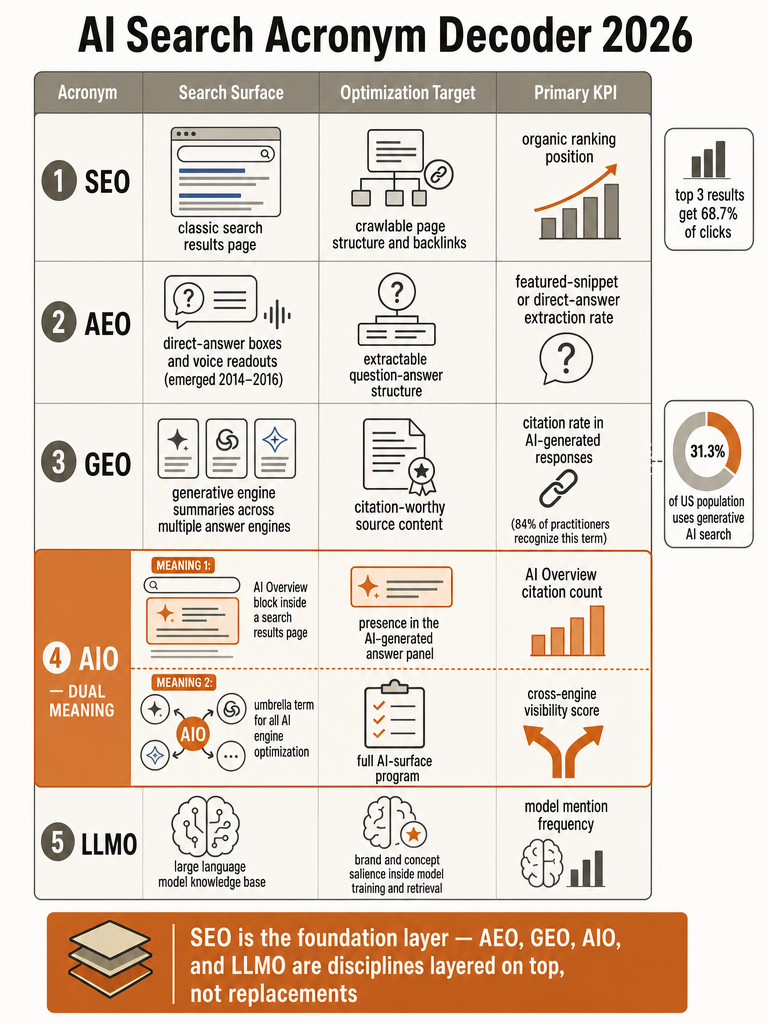
SEO vs GEO vs AEO vs AIO: how do they differ?
The clean way to separate these terms is by three variables: the surface where the result appears, the unit you optimize, and the outcome you can measure. Confusing them causes measurement drift — Pepper notes teams that don't know which surface they're optimizing for can't measure success on it.
SEO optimizes a page to rank in classic Google and Bing results, and the outcome is position and clicks. Hibu says the top 3 organic results still receive 68.7% of all clicks on the Google Search page, so ranking still carries the traffic. AEO optimizes a passage so an answer engine can extract it directly, and the outcome is extraction. GEO optimizes a page so generative engines retrieve, ground against, and cite it, and the outcome is citation presence. AIO, in its dominant usage, targets Google AI Overviews specifically.
| Term | Surface | Optimization unit | Measured outcome |
|---|---|---|---|
| SEO | Google, Bing SERPs | Page / domain | Ranking, clicks |
| AEO | Direct answers, featured snippets, voice | Passage | Answer extraction |
| GEO | ChatGPT, Perplexity, Gemini, Copilot summaries | Page + entity | Citation / reference presence |
| AIO | Google AI Overviews | Page | AI Overview citation presence |
The unit of optimization shifts from the domain in SEO, to the page in GEO, to the passage in AEO — and that shift decides how you write. Sources: GEO Compass, Hibu, Pepper.
What is the difference between AEO, GEO, AIO, and LLMO?
Each term owns a different job in the answer stack. AEO gets your words pulled into a direct answer, GEO gets your page referenced inside a generated summary, AIO (in its common use) targets Google's AI Overviews citation set, and LLMO frames how the underlying model understands your brand. EisnerAmper puts it plainly: AEO helps you get pulled into direct answers, GEO helps you get referenced in AI summaries, and the broader optimization work makes AI systems consistently understand who you are and why you're credible.
The operational boundary matters more than the definition.
- AEO — Make one passage extractable. Clear headings, a 1–2 sentence direct answer under the header, consistent language. Pepper dates this to the featured-snippet era; it predates AI chat by years.
- GEO — Make the whole page citable across engines. Pepper defines GEO as optimizing content so it's retrieved and cited by ChatGPT, Google Gemini, Perplexity, and Microsoft Copilot when they generate answers.
- AIO — In dominant practice, get cited inside Google AI Overviews. This is a narrower Google surface, not the whole AI field.
- LLMO — Structure content and brand signals so large language models understand and represent you correctly at the model layer.
Fractl frames the relationship usefully: GEO is the strategy lens, AEO is the execution layer. They describe layers of one system. For a deeper split by team, see which AI-search workflow fits your team.
What does AIO mean in SEO?
AIO has two distinct meanings in active 2026 usage, and reading it wrong changes your entire measurement plan. GEO Compass says AIO can mean AI Overviews — Google's SERP-integrated AI answer block — or AI Optimization, a broad umbrella for optimizing across AI engines. Top terminology guides use it inconsistently, which is why the term causes more confusion than any other in this category.
The dominant usage in practice is AI Overviews. When practitioners write "optimizing for AIO," they usually mean getting cited in Google AI Overviews, not running a general AI program.
That distinction decides the KPI:
| If AIO means... | Then the goal is... | And you measure... |
|---|---|---|
| AI Overviews | Appear in Google's AI answer block | Citation presence in the AIO source set |
| AI Optimization | Broad visibility across AI engines | A blended set of AEO/GEO/LLMO metrics |
Before anyone reports "AIO performance," confirm whether they mean a single Google surface or the whole field — the numbers are not comparable. For the full breakdown of every reading, see what AIO means in 2026. Source: GEO Compass.
What is AISO in AI search?
AISO stands for AI Search Optimization, and Fractl frames it as a translation-layer term — the label teams reach for when explaining AI-search work to stakeholders who don't speak SEO. It sits alongside AEO, GEO, and LLMO in Fractl's terminology research as one of the commonly discussed AI-search terms, aimed more at non-SEO audiences than at practitioners.
The term has measurable traction even if its scope is broad. Fractl reports that across more than 33,000 Indeed job postings, AISO outpaced SEO, GEO, AEO, and LLMO combined in AI-driven job listings — a signal that hiring managers and business stakeholders are adopting the term faster than practitioners are.
Treat AISO as your stakeholder-facing umbrella and keep the granular terms for briefs and dashboards. For the fuller treatment, see what AISO means in 2026. Source: Fractl.
Are AEO, GEO, and LLMO all SEO?
They are layers on top of SEO, not replacements for it. SEO still underpins the newer disciplines because classical search rankings influence whether a page even enters an AI retrieval set. GEO Compass is direct about this: abandoning SEO to go all-in on GEO is a mistake, and layering AEO and GEO on solid SEO is the working path.
The traffic math backs the caution. Hibu reports the top 3 organic results still receive 68.7% of all clicks on the Google Search page. Ranking still moves people, even as AI answers expand where discovery happens.
Fractl frames the overlap sharply: the biggest mistake is treating SEO, GEO, AEO, and AISO as competing ideologies when they describe different layers of the same system. The same research found 84% of practitioners recognize GEO, while only 14% call their AI visibility work "SEO" — the vocabulary diverged even where the work overlaps.
So the honest answer: the retrieval foundations are shared, but the newer terms add specific work SEO alone doesn't specify — passage-level extractability for AEO, cross-engine citation signals for GEO, and model-level brand understanding for LLMO. Position them as complementary. For how the underlying engine shift plays out, see the Search Generative Experience guide. Sources: GEO Compass, Hibu, Fractl.
AEO vs GEO vs AIO: how does AI search work in 2026?
Three different mechanics sit behind these acronyms, and matching your content structure to the right one is what earns extraction or citation. AEO relies on direct-answer extraction, GEO relies on multi-source generative synthesis, and AIO (as AI Overviews) relies on Google assembling a cited answer block inside its own SERP.
Here's how each mechanic pulls content:
- Direct-answer extraction (AEO). The engine identifies a specific question and lifts the single best passage. EisnerAmper's guidance: lead with a 1–2 sentence direct answer under the relevant header so the engine can extract it. If your page makes readers hunt for the answer, the engine pulls from someone else.
- Generative synthesis (GEO). The engine assembles a multi-source summary and cites the pages it trusts. EisnerAmper describes GEO-style results as what appears when a platform generates a summary instead of picking one best answer. The work is being one of the trusted sources.
- AI Overviews assembly (AIO). Google generates an answer block above organic results and cites its sources. This is a Google-specific surface with its own retrieval logic.
The structure that wins extraction — a tight answer under a clear header — is often not the structure that wins a multi-source citation, which needs credible sourcing and entity coverage across the whole page. For the citation surface specifically, see how to show up in Google AI Overviews. Source: EisnerAmper.
Which engines should you optimize for in 2026?
Prioritize the engines that actually assemble answers your buyers read: ChatGPT, Google AI Overviews, Google Gemini, Perplexity, and Bing Copilot / Microsoft Copilot, with Claude, Google, and Bing rounding out coverage. Unfair Advantage names Google Gemini, ChatGPT, Perplexity, and Bing Copilot as the engines dominating generative AI search, and notes Reddit content surfaces prominently in many AI Overviews.
The demand signal justifies the effort. Unfair Advantage reports 31.3% of the US population uses generative AI search, which is why the firm calls GEO no longer optional.
Practical priority for most B2B SaaS teams:
- ChatGPT — the largest conversational answer surface; see how to show up in ChatGPT.
- Google AI Overviews — sits directly in the SERP where classic SEO already lives.
- Google Gemini — how to show up in Gemini.
- Perplexity — citation-heavy and source-transparent; how to show up in Perplexity.
- Microsoft Copilot — Bing-indexed; how to show up in Microsoft Copilot.
- Claude — how to show up in Claude.
Cover the major engines with answer-first, well-sourced pages before chasing platform-specific tactics the sources don't support. Source: Unfair Advantage.
Which KPI belongs to each acronym?
Assign one primary metric per term or you'll measure the wrong outcome. AEO is measured by answer extraction, GEO by citation or reference presence, AIO by AI Overview citation presence, and LLMO by model or entity understanding. AISO, because it's a broad stakeholder-facing label, borrows the KPI of whichever specific surface a project targets rather than carrying its own.
| Acronym | Primary KPI | What you're actually counting |
|---|---|---|
| SEO | Ranking, organic clicks | Position and traffic on Google/Bing |
| AEO | Answer extraction | Whether a passage is lifted as the direct answer |
| GEO | Citation / reference presence | Whether AI summaries cite or reference your page |
| AIO | AI Overview citation presence | Whether you're in Google's AI Overview source set |
| LLMO | Model / entity understanding | Whether models represent your brand correctly |
| AISO | Inherits the target surface's KPI | Communication-layer term, not a standalone metric |
Pepper's warning applies here: if you don't know which surface you're optimizing for, you can't measure success on it. The clean move is to tag each content workstream with its surface and its KPI up front. A blended "AI visibility score" that averages extraction, citation, and Overview presence hides which layer is failing — report them separately. Sources: Pepper, Fractl.
When should teams use one umbrella term versus multiple terms?
Use one umbrella label for executive summaries and stakeholder communication; split into AEO, GEO, LLMO, SEO, and AIO the moment you assign work or report metrics. The reason is measurement: these terms map to different surfaces with different KPIs, so a single label collapses distinctions your operators need.
A practical rule:
- Use one umbrella term in board decks, budget lines, and cross-functional updates — where the audience needs "we're investing in AI search visibility," not five metrics. Pepper coined "Search Everywhere Optimization" for exactly this framing, and AISO serves the same communication purpose given its traction with non-SEO stakeholders.
- Use separate terms in content briefs, QA checklists, tooling decisions, and analytics dashboards — where surface and KPI drive the actual work.
The vocabulary is unsettled, which is why standardizing internally matters. Fractl found 84% of practitioners recognize GEO but only 14% call their work "SEO," so pick your canonical terms and document them once. Given that AIO carries two meanings, spell out in your glossary which reading you use.
Sources: Pepper, Fractl.
How should existing SEO content be refactored for AEO, GEO, LLMO, and AIO?
Refactor for answer-first structure, credible sourcing, entity coverage, and a refresh cadence — usually on the existing URL, so you keep ranking equity while making pages extractable and citable. EisnerAmper's checklist is the concrete starting point: lead with a 1–2 sentence direct answer under each header, add FAQ and Service schema, strengthen E-E-A-T with author signals and first-party data, earn third-party citations, and refresh quarterly.
Work the archive in order:
- Triage the archive. Keep winners, refactor high-citation-potential pages, prune dead weight. See the GEO content strategy for SaaS sites with old blogs.
- Add answer-first passages (AEO). Rewrite the opening under each header into a liftable direct answer. The AEO content strategy for teams with existing archives covers this.
- Fix the AI Overviews failure points (AIO). A page can rank and still get skipped — diagnose trigger, extraction, verification, and freshness. See why your blog still gets skipped.
- Strengthen citation signals (GEO). Credible sources, schema, entity clarity. Use how to refresh old SEO posts for AI citations.
- Update glossary and terminology pages. Rewrite each entry as a standalone answer passage — see how to update glossary pages for AI search citations.
For the brief that ties AEO structure and GEO citation signals into one draft, use the 7-part writer brief template.
Sources: EisnerAmper, Hibu.
What should an acronym decoder change in the publishing workflow?
The decoder turns into an operating rule: every brief names the target surface, the direct-answer passage, the cited evidence, the entity coverage, the refresh cycle, and the KPI before drafting starts. That spec is what stops a team from shipping generic acronym pages that rank for nothing and get cited by no engine.
A brief built this way forces the decisions the terminology implies:
| Brief field | What it locks in | Which acronym it serves |
|---|---|---|
| Target surface | Which engine/SERP block the page aims at | AEO / GEO / AIO |
| Direct-answer passage | The extractable 1–2 sentence answer | AEO |
| Cited evidence | Sources and stats that earn trust | GEO |
| Entity coverage | Named companies, products, people | LLMO |
| Refresh cycle | Quarterly or tiered update cadence | All |
| KPI | Extraction, citation, or Overview presence | Per surface |
This is where a citation-shaped content engine earns its place. Mentionwell builds AEO, GEO, LLMO, and SEO into every draft as an operational pipeline — site profile, brief, publish, refresh — across one site or many, rather than treating AI visibility as a one-off writing task. The GEO content brief spec shows what a citation-ready draft needs before writing begins.
A brief that names its surface and KPI before the first sentence produces a page that answers to something specific — decide both up front. Sources: EisnerAmper, Pepper.
If your archive ranks but never gets cited, that's the gap Mentionwell was built to close — get your site GEO optimized.
Sources
- AEO vs GEO vs AIO (How AI Search Works in 2026)www.youtube.com
- SEO vs GEO vs AEO vs AIO: How They Differeagrowthsolutions.com
- AEO vs GEO vs AIO vs LLMO: The Alphabet Soup Explainedguptadeepak.com