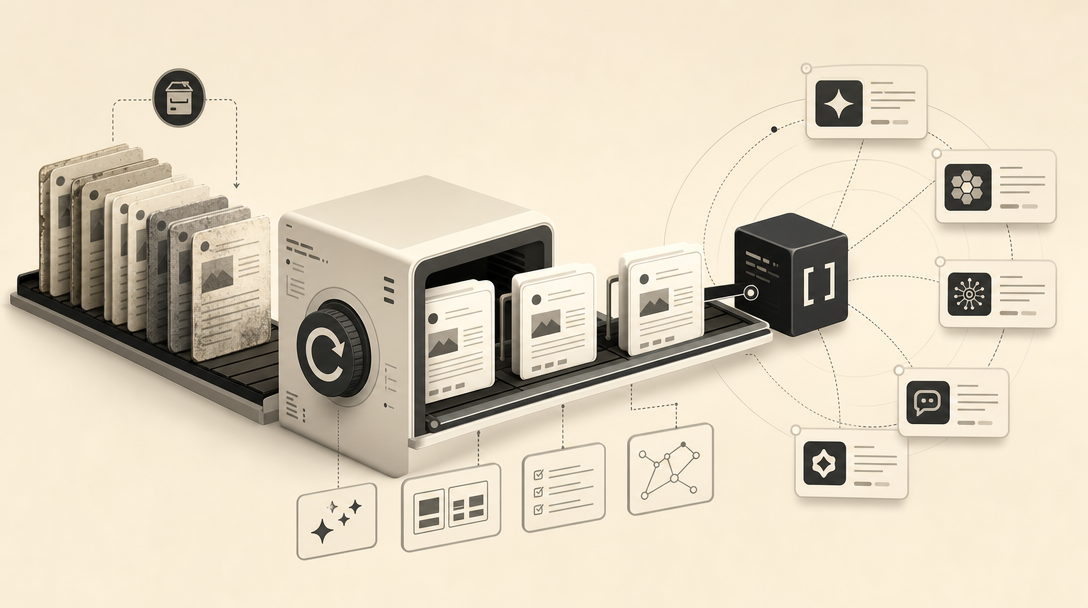
How to refresh old content for AI citations
Refreshing old SEO content for AI citations means updating an existing page so answer engines can retrieve and cite it, without discarding the URL equity it already holds. The sources treat this as substantive and structural work, not a date change. ZipTie.dev reports that AI-cited content is 25.7% fresher on average than traditionally ranked content, and that 76.4% of ChatGPT's top-cited pages were updated within the last 30 days.
The operating model is four moves on the same URL:
- Keep the URL equity. A live post with backlinks and historical trust outperforms a fresh one starting from zero. Onely's guidance leans hard on preserving that history.
- Set the objective first. SEOptimer's process starts by finding underperforming posts, then setting refresh objectives, then editing — not the reverse. Decide whether you're defending rankings, chasing citations, or both before you touch the draft.
- Make real changes. Animalz frames a refresh as a way to defend rankings, capture AI citations, and reverse content decay. That requires updated claims and reworked structure, not a cosmetic pass.
- Optimize for retrieval eligibility. Answer engines pull self-contained passages. Restructure the post so a paragraph reads correctly when lifted out of context.
Does changing the date help AI citations?
Changing the publication date alone does not earn AI citations, and it can hurt the page. Attrifast argues that "date and republish" is the wrong refresh instruction, because freshness mainly influences live retrieval — the real-time fetch behind answers — while the frozen training corpus barely moves with a date edit. A timestamp swap with no new substance is fake freshness, and engines treat the underlying content, not the metadata, as the signal.
Onely's recommendation resolves how to handle dates without lying to crawlers or readers: keep the original publication date and add a visible "Last updated: [date]" line once the page has materially changed. That preserves historical trust — the accumulated authority of a URL that's existed and earned links for years — while still sending a legitimate freshness signal. A last-updated date is only honest when the body actually changed; the timestamp is a consequence of the work, not a substitute for it.
The practical test: if you removed the new date, would the page still look meaningfully different from last quarter's version? If not, you haven't refreshed it. For deeper page-level guidance, see how to retrofit old SEO posts for AI Overviews.
Should you refresh the same URL or rewrite the old post from scratch?
Default to refreshing the same URL when the page still holds value; rewrite or replace only when the topic itself has shifted past repair. The reason is economic. MentionLayer quotes a claim that refreshing a stale pillar page takes about 30 minutes, while writing a replacement page takes roughly 30 hours — and that a refresh can deliver up to 60x the ROI of creating new content. A live URL carries links and trust a new page starts without.
Use these signals to choose:
| Situation | Action | Why |
|---|---|---|
| Page ranks or earns citations but data/structure is stale | Refresh on same URL | Onely: preserve historical trust; cheapest path to recovery |
| Topic still valid, but coverage is thin or disorganized | Rewrite on same URL | Animalz: reverse content decay while keeping URL equity |
| Topic obsolete or merged with a stronger page | Replace / consolidate | SEOptimer: start by finding underperformers and setting objectives |
The corpus is thin on a precise threshold for when value is too low to keep, so treat this as judgment, not a formula. The constant across all three sources: keeping the URL is the preferred move whenever the page has anything worth saving. SEOptimer's sequencing matters here — set the objective before deciding refresh versus rewrite, because the objective tells you how deep to go.
What should you update in old posts for AI search?
The updates that matter for AI citations go beyond normal SEO edits: they make passages extractable, current, and self-contained so engines can quote them. ZipTie.dev defines an AI-citation refresh as updating existing content with targeted structural and substantive changes aimed at extractability, freshness signals, and platform-specific citation patterns. Animalz adds the substantive half — updated claims that reverse content decay.
Work through these on every refreshed post:
- Open with an answer-first passage. Lead each section with a 40–80 word block that answers the implicit question directly, so ChatGPT, Perplexity, Gemini, Claude, and Google AI Overviews can lift it intact.
- Make passages self-contained. Strip "as above" and "this" references that break when a paragraph is pulled out of context. Each block should stand alone.
- Update every claim, stat, and date. Replace outdated figures with current sourced numbers. Stale claims are the fastest way to lose retrieval relevance.
- Tighten topic coverage. Add the sub-questions a reader actually asks that the original post skipped, then give each its own labeled section.
- Add citation-shaped structure. Use tables for comparisons, numbered lists for processes, and clear named entities so engines can map the page to a topic.
The substantive and structural work travels together. A perfectly structured page with outdated facts won't get cited, and accurate facts buried in unextractable prose won't either. For glossary-style pages specifically, how to update glossary pages for AI search citations covers the answer-passage pattern in detail.
Once your archive is current, get my site GEO optimized to keep those passages citation-shaped on a cadence.
How often should you refresh high-value pages for AI citations?
Page type, not a single annual schedule, should set refresh cadence for AI citations. ZipTie.dev recommends product pages monthly, blog posts quarterly, high-value pages every 3–6 months, and all content at minimum annually. MentionLayer narrows the focus further: run a monthly review cycle on your top 10 pages, since it quotes a claim that a pillar page can lose rankings and AI citations if it goes 90 days without an update.
| Page type | Cadence | Effort per refresh | Source |
|---|---|---|---|
| Top 10 / pillar pages | Monthly review | 20–30 min | MentionLayer |
| Product pages | Monthly | — | ZipTie.dev |
| High-value pages | Every 3–6 months | — | ZipTie.dev |
| Supporting articles, comparisons | Quarterly | 15–20 min | MentionLayer |
| Blog posts | Quarterly | — | ZipTie.dev |
| Underperforming content | Annual (often a rewrite) | 1–2 hours | MentionLayer |
The effort numbers are the point operators miss. A monthly pillar refresh is 20–30 minutes, not a project — which is why MentionLayer's quoted 30-minute-vs-30-hour comparison favors refreshing over replacing. The short ChatGPT freshness window ZipTie.dev observed (most cited pages updated within 30 days) is what makes the monthly top-10 cadence worth the time.
Which older posts should be refreshed first?
Prioritize refresh candidates by value and staleness, not by treating the archive as one undifferentiated pile. MentionLayer's core argument is that teams should rank pages by what they're worth and how decayed they are, then spend time accordingly. SEOptimer's process opens the same way: find underperforming posts before you set objectives.
A workable priority order:
- Top-traffic pages that already pull visitors — highest downside if they decay, so refresh first.
- Pillar pages anchoring a topic cluster — MentionLayer's 90-day decay warning hits these hardest.
- Pages already earning citations — protect the wins you have before chasing new ones.
- Supporting articles and comparisons — quarterly, lighter touch at 15–20 minutes each.
- Underperformers — last, and often a rewrite at 1–2 hours rather than a quick edit.
The principle behind that order is simple: refresh the pages with the most to lose before the ones with the most to gain, because decay on a top page costs more than upside on a weak one.
The corpus doesn't give a precise Search Console or analytics threshold for sorting candidates at scale, so build your own cutoff from your own traffic and citation data. Teams with large archives can map this against an AEO content strategy for existing SEO archives to sequence the work.
SEO refresh tasks vs AEO, GEO, and LLMO refresh tasks
Classic SEO refresh work and AI-citation refresh work pursue different outcomes on the same page, and they reinforce each other on a single pass. Animalz makes the dual goal explicit: a refresh defends rankings and captures AI citations and reverses content decay — three results from one edit cycle. The tasks overlap enough that doing the SEO work badly undermines the citation work, and vice versa.
| Goal | Classic SEO refresh task | AEO / GEO / LLMO refresh task |
|---|---|---|
| Defend rankings | Update title, meta, internal links, fix decayed keywords | Keep the URL and historical trust intact (Onely) |
| Reverse decay | Refresh stats, dates, broken claims | Rewrite stale facts engines would otherwise distrust |
| Improve extraction | Tighten headings and on-page structure | Build self-contained answer passages and tables (ZipTie.dev) |
| Signal freshness | Light edits, internal recirculation | Add visible "Last updated" without changing original date (Onely) |
The sources are thin on a clean dividing line between the two disciplines, which is the point: they're complementary, not competing. The SEO layer earns the crawl and the ranking that gets a page retrieved; the AEO, GEO, and LLMO layer determines whether a retrieved page actually gets quoted. If you want the distinction between those last three before sequencing the work, AEO vs GEO vs LLMO: which workflow fits your team breaks it down.
How can you tell whether a refresh changed live-retrieval citations?
Measuring a refresh means separating two different signals: live-retrieval citation visibility in AI answers, and traditional SEO performance like rankings and organic clicks. They move on different timelines and respond to different inputs. Attrifast's distinction is the key — freshness mainly influences live retrieval, while the frozen training corpus barely shifts — so a refresh can change which pages get fetched into an answer without moving classic rankings, or the reverse.
In practice, that means watching citation appearance in ChatGPT, Perplexity, Gemini, Claude, and Google AI Overviews as a separate metric from Search Console clicks and positions. A page can start getting quoted in answers while its ranking sits still, because retrieval and ranking are not the same mechanism.
Be honest about the limit here: the corpus does not provide a sourced, engine-by-engine measurement framework proving a refresh raised AI citations, and there's no public before-and-after case study with verifiable citation gains to lean on as of this writing. Treat citation tracking as observation, not attribution, until better measurement evidence exists.
Where archive and glossary refresh workflows connect
Refresh workflows scale only when they become repeatable across an archive, not one-off edits on individual posts. The cadence schedules from ZipTie.dev and MentionLayer are operating rules precisely because they're meant to run on a calendar across many pages — monthly top-10 reviews, quarterly blog passes, annual full sweeps. The harder problem is applying the same citation-shaped structure consistently every time, at archive scale, across one site or hundreds.
That consistency is where the related resources connect:
- For turning an existing archive into citation candidates, see AEO content strategy for teams with existing SEO archives.
- For glossary entries that need standalone answer passages, how to update glossary pages for AI search citations.
- For the spec a citation-ready draft should hit before editing starts, GEO content briefs: what AI citation-ready drafts need.
- For the page-level retrofit decision, how to retrofit old SEO posts for AI Overviews.
This is the layer Mentionwell runs as a system: a citation-shaped editorial pipeline that handles archive refreshes on a cadence and applies the same AEO, GEO, LLMO, and SEO structure across every page, so refreshes stay consistent whether you manage one domain or many. To put that pipeline on your own archive, get my site GEO optimized.
Sources
- How to Refresh Old Content for SEO and the Age of AI - SEOptimerwww.seoptimer.com
- Content Refresh Playbook for AI Citations | MentionLayerwww.mentionlayer.com
- Content Refresh for AI Citations (2026) | Attrifastattrifast.com