
What Is AI Search Optimization (AISO)?
AISO stands for AI Search Optimization — the practice of making content discoverable, extractable, summarized, and cited by AI-powered search and answer systems. It is also expanded as Artificial Intelligence Search Optimization or AI Search Engine Optimization, and in current usage overlaps heavily with AISEO.
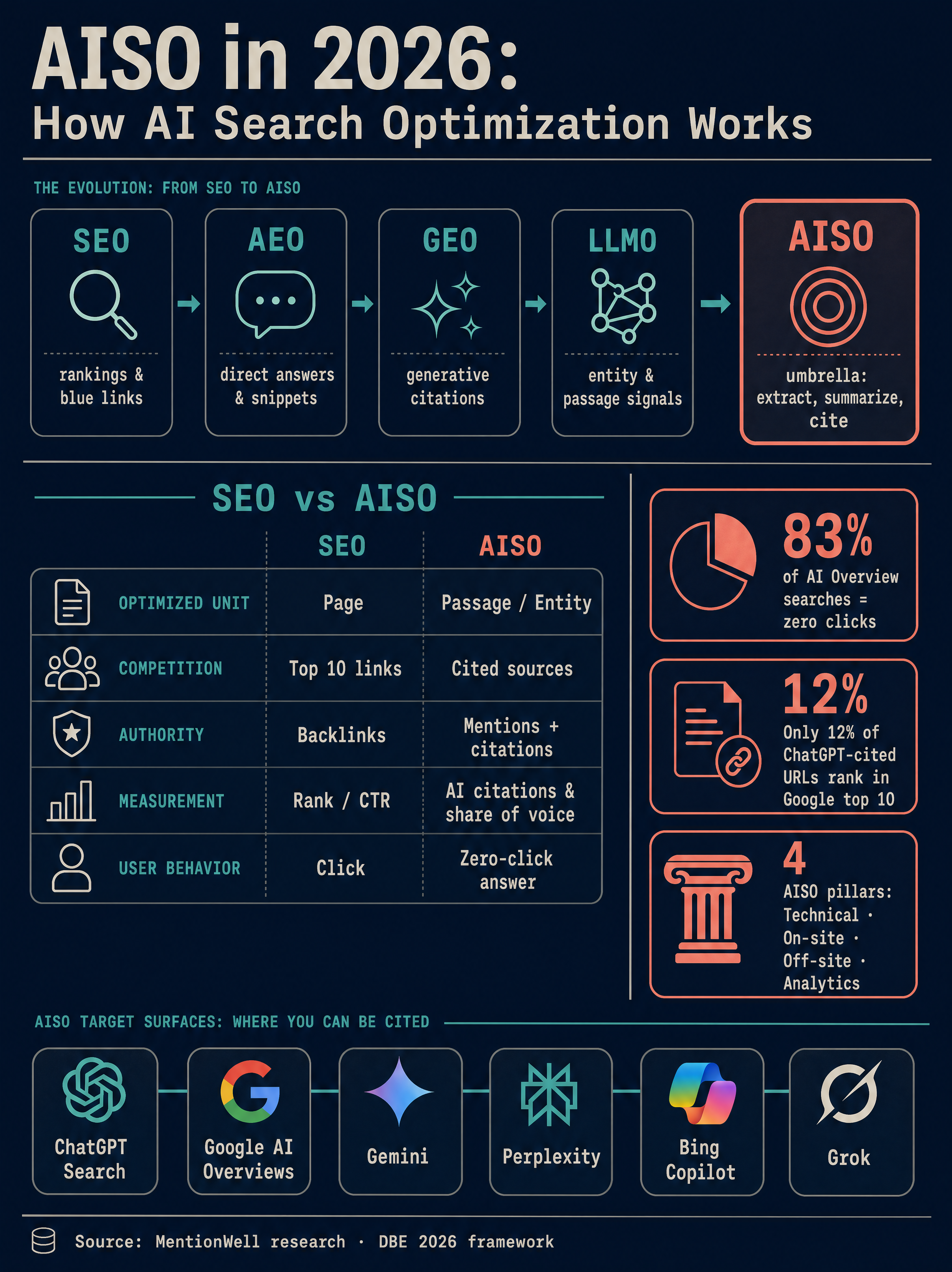
In 2026, visibility is no longer just a blue-link ranking problem. Buyers research products, compare competitors, and make purchase decisions inside ChatGPT, ChatGPT Search, Google AI Overviews, Google AI Mode, Gemini, Perplexity, Bing Copilot, Grok, and voice assistants — often without ever loading your site. According to Exposure Ninja, 83% of searches with an AI Overview result in zero clicks, and only 12% of URLs cited by ChatGPT appear in Google's top ten. That gap is what AISO exists to close.
AISO is the discipline of earning citations and recommendations inside AI answers — not just rankings inside search result pages.
Operationally, it means four things running in parallel: technical accessibility for AI crawlers, on-page structure optimized for extraction, off-site authority signals that AI systems treat as credible, and analytics that track inclusion instead of only clicks. AISO does not replace SEO. It layers on top — adding comprehension, extraction, and citation readiness to the classic ranking stack.
If you operate a B2B SaaS site, an agency portfolio, or a programmatic content footprint, AISO is the work of converting existing pages into answer-level competitors across every surface where AI assistants compose responses.
What Is an AISO? Search-Marketing Meaning vs. Security Acronym
In search marketing, AISO means AI Search Optimization. In cybersecurity, the same acronym refers to the Accredited Information Security Officer certification issued by IISOO and built on the ISO Body of Knowledge (ISOBOK). These are unrelated disciplines that happen to share three letters.
If you arrived from a SERP that mixed results — a certification page from IISOO, acronym directories like AIDIRECTORY, AiSOAP tooling, or compliance references to HIPAA and SOC 2 — ignore them for this discussion. This article covers only the marketing sense: optimizing content so AI search and answer engines retrieve and cite it.
AISEO, ASO, SEO, GEO, AEO, AISO — What's the Difference?
SEO targets rankings, AEO targets direct answers, GEO targets generative citations, LLMO targets how language models represent your brand, and AISO (often interchangeable with AISEO) is the umbrella that unifies them. These acronyms describe overlapping but distinct layers of visibility work.
| Term | Stands For | What It Optimizes | Primary Surface |
|---|---|---|---|
| SEO | Search Engine Optimization | Page rankings, organic clicks | Google, Bing blue links |
| AEO | Answer Engine Optimization | Snippets, voice answers, answer boxes | Featured snippets, Alexa, Siri |
| GEO | Generative Engine Optimization | Summaries and citations inside AI answers | ChatGPT, Perplexity, Gemini |
| LLMO | Large Language Model Optimization | Entity, passage, and brand signals inside models | ChatGPT, Claude, Gemini retrieval |
| AISO / AISEO | AI Search Optimization | Discovery, extraction, citation across AI search | AI Overviews, AI Mode, Copilot, chat tools |
| ASO | App Store Optimization | App store listings and discovery | Apple App Store, Google Play |
| SAIO | Search AI Optimization (non-standard variant) | Used interchangeably with AISO in some sources | AI search surfaces |
AISO Hub frames AISO as the unification layer: technical accessibility for AI crawlers, chunk-first content patterns, citation-earning tactics, and analytics. The Rank Masters describes the optimized unit as entities, passages, citations, and reputation — not pages. BizBoxStory treats AISO as the broader strategy that combines AISEO, GEO, and AEO across AI chat platforms, voice assistants, and recommendation systems.
If you want to go deeper on any single layer, see the companion breakdowns on [AEO](/what-is-aeo-in-2026-answer-engine-optimization-explained), [GEO](/what-is-geo-in-2026-generative-engine-optimization-explained), [LLMO](/what-is-llmo-in-2026-large-language-model-optimization-explained), and [AIO](/what-is-aio-in-2026-ai-optimization-explained), plus the operational view in [AEO vs GEO vs LLMO](/aeo-vs-geo-vs-llmo-which-workflow-fits-your-team).
What Is the Difference Between AISO and SEO?
SEO optimizes your page to rank against other pages. AISO optimizes your passages, facts, and entities to be retrieved and cited when an AI assistant composes an answer. The competition unit is different, and so is everything downstream.
| Dimension | SEO | AISO |
|---|---|---|
| Optimized unit | Pages | Passages, entities, citations |
| Competition | Page-level against ranked URLs | Answer-level against every source the model might use |
| Authority signals | Backlinks, domain authority | Linked and unlinked mentions, expert attribution, cross-platform citations |
| Content format | Keyword-targeted pages, internal linking | Definitions, answer blocks, evidence sections, schema, first-100-word answers |
| Measurement | Rankings, clicks, organic traffic | AI citations, inclusion rate, AI-origin traffic, branded-search lift |
| User behavior | Click through to site | Often zero-click; assisted conversions via AI recommendation |
SEO remains foundational because AI engines still retrieve from indexed content — but AISO is what determines whether your passage is the one they quote. According to AISO Hub, AISO competition is answer-level rather than page-level, because a brand competes against every source an AI model might use to construct its response.
Two practical consequences follow. First, you can rank number one on Google and still be absent from ChatGPT's answer if your page is not structured for extraction. Second, you can earn citations in Perplexity or AI Overviews from pages that don't rank in the top ten — Exposure Ninja's 12% figure makes this explicit.
Ready to make your existing pages citation-ready across ChatGPT, AI Overviews, Perplexity, and Copilot? Get My Site GEO Optimized with Mentionwell.
Why Is Traditional SEO Alone Not Enough?
Traditional SEO alone is insufficient because AI answer surfaces now intercept a large share of commercial research before users reach a results page, and the attribution layer for that behavior sits outside traditional analytics. SEO is not dead — it is incomplete.
The data tells the story. According to DBS Interactive, nearly 60% of Google searches in 2024 ended with zero clicks. Exposure Ninja reports 83% of searches with an AI Overview result in zero clicks. DBS Interactive also notes that ChatGPT reached 100 million users in just two months, the fastest consumer adoption curve on record.
The sources disagree on one important question: how tightly do AI citations track classic rankings? DBS Interactive says AI answers are frequently generated from the top ten traditional search results — roughly 70% of the time. Exposure Ninja reports only 12% of URLs cited by ChatGPT appear in Google's top ten. Both can be true depending on surface and query type:
- AI Overviews and AI Mode, which sit inside Google, lean heavily on Google's top results.
- ChatGPT Search, Perplexity, and Copilot pull from broader retrieval pools that include forums, PR coverage, PDFs, and lower-ranked but well-structured pages.
The operating takeaway: keep your SEO foundation, then add citable passages, crawlable pages for GPTBot, PerplexityBot, and ClaudeBot, entity clarity, and third-party validation. Classic SEO and AISO are complementary — SEO captures search intent on Google, and AISO captures search intent in AI assistants.
What Are the 4 Elements of AI Search Optimization?
Digital Brand Expressions (DBE), in its April 2026 framework, organizes AISO around four strategic elements: Technical, On-Website Content, Off-Website Content, and Analytics. This is the cleanest operating model in the public literature, and it maps directly to how a publishing pipeline should be structured.
Technical
Technical work makes your site legible to AI crawlers. According to DBE, this includes strong Core Web Vitals, bot crawling permissions, entity clarity, sitemaps, navigational search bars, internal sitelinks, schema markup, structured data formats such as FAQs, and optimized titles, tags, and alt text.
- Allow AI crawlers in robots.txt: Googlebot, GPTBot (OpenAI), PerplexityBot, and ClaudeBot (Anthropic). Blocking these bots removes you from retrieval pools entirely.
- Ship Schema.org markup for Article, FAQPage, Product, Organization, and Person where relevant.
- Fix Core Web Vitals — slow pages get deprioritized in both Googlebot and AI crawler retrieval.
The llms.txt file is contested. DBE says marketers should stay updated on llms.txt adoption but does not currently recommend it. AISO Hub treats llms.txt as an AI-friendliness signal. Treat it as low-cost optional instrumentation, not a must-have.
On-Website Content
On-site structure is where AISO diverges most sharply from SEO. AI systems extract passages, so your pages need to be built for extraction.
- Lead every page with a concise answer in the first 100 words (AISO Hub).
- Use clear H2 and H3 headings that mirror real questions.
- Add definitions, evidence blocks, FAQ sections, and machine-readable markup.
- Structure pillar pages around the Answer → Evidence → Expand pattern, with roughly five H2 sections.
Off-Website Content
Off-site authority is how AI models decide whether to trust you. Kelsey Libert of Fractl, speaking with Liz Glagowski on TTEC's Customer Strategist Journal podcast, describes the earned-media model: publish data-driven research that journalists at Business Insider, Huffington Post, and CNBC will cover, building linked and unlinked brand mentions around the entities you want to be known for.
That external footprint — digital PR, expert attribution, community discussion, and credible third-party citations — feeds directly into the authority signals AI systems use when selecting which sources to cite.
Analytics
DBE's analytics stack includes GA4 (AI Source/Medium sessions), Google Search Console and Bing Webmaster Tools (branded query growth, Position 1 rankings), Bing Webmaster Tools AI Performance, AWR Cloud, and HubSpot AEO Grader. Exposure Ninja's sponsor, Profound, is another option for tracking brand sentiment and citations across AI search tools.
Watch: A Complete Guide to AI Search Optimisation for 2026 (AI SEO, AEO, GEO)
How Can Businesses Optimize for AISO and GEO? A Step-by-Step Publishing Workflow
Turn AISO into an operating model, not a tactics checklist. The repeatable workflow below combines DBE's four-element framework with AISO Hub's five-step method (Audit, Foundation, Monitor, Optimize, Prove) and a research-driven publishing pipeline.
- Audit pages, facts, and speed. Inventory your top 50 pages. Check crawlability for GPTBot, PerplexityBot, and ClaudeBot. Measure Core Web Vitals. Flag pages with no direct-answer opening, no schema, or outdated facts.
- Define a site profile. Document your entities: brand, product, people, categories, differentiators, pricing facts, customer proof. This is the source-of-truth file every new page draws from.
- Collect real customer questions. AISO Hub recommends documenting 20 real questions per query family. Pull from sales call transcripts, support tickets, Reddit, and existing search console data.
- Create Answer/Evidence/Expand page structures. Draft pillar pages with roughly 5 H2 sections, each opening with a concise answer, followed by evidence (data, quotes, examples), then deeper explanation.
- Add schema and citation-ready attribution. Mark up FAQs, Articles, Products. Attribute every statistic to a named source. Unattributed numbers get ignored by LLMs.
- Tune revenue pages. Pricing, comparison, and feature pages need the same direct-answer structure as blog content — these are the pages AI assistants cite in purchase-intent queries.
- Publish through your CMS or headless stack. Keep the delivery layer consistent so templates, schema, and refresh metadata stay intact across hundreds of pages.
- Test priority prompts monthly. Track 10 head queries and 10 tail queries across ChatGPT, AI Overviews, Perplexity, Copilot, and Gemini. Log inclusions, citations, and drift.
- Refresh pages when citations drift. When a page stops getting cited or a competitor takes its position, update facts, tighten the answer block, and re-publish.
Mentionwell operationalizes this pipeline as a blog engine — research-grounded drafts with AEO, GEO, LLMO, and SEO built in, publishing into existing CMS or headless stacks, and supporting archive refreshes and programmatic SEO across one site or hundreds. It is not a generic AI writing tool; it is the editorial pipeline layer.
How Should Marketers Measure, Refresh, and Scale AISO Without Thin Pages?
Measure AISO on inclusion and citation behavior, not sessions, and govern your archive with a refresh cadence tight enough to keep pages eligible as models and retrieval pools evolve. This is where most AISO programs break.
The AISO dashboard
Build the dashboard around metrics that reflect how AI surfaces actually work:
- AI citations — count of times your URLs appear as sources in AI answers across ChatGPT, Perplexity, AI Overviews, Copilot, Gemini.
- Inclusion rate — percentage of tracked prompts where your brand is mentioned or cited.
- AI share of voice — your citations divided by total citations for a topic cluster.
- AI-origin traffic — GA4 sessions tagged to AI source/medium.
- Branded-search lift — Google Search Console and Bing Webmaster Tools growth in branded queries.
- Assisted conversions and referral quality — pipeline touches from AI-origin visits.
Measurement tools named in the research corpus include GA4, Google Search Console, Bing Webmaster Tools, Bing AI Performance, AWR Cloud, HubSpot AEO Grader, and Profound.
Archive refreshes and entity architecture
Most teams over-invest in new pages and under-invest in refreshing existing ones. Retrofit old posts with direct-answer openings, updated dates, schema, entity clarity, and attributed evidence. Pages that were fine for 2022 SEO are often invisible to 2026 AI retrieval.
Entity architecture matters more at scale: a clean product facts file, consistent author bios, structured comparison pages, and topical hubs let AI assistants lift facts without hallucinating.
Scaling without thin pages
Programmatic SEO fails when templates outrun editorial controls. Tie scale to repeatable templates with strict evidence thresholds — every programmatic page needs real data, real differentiation, and real citations, not just field-swapped boilerplate. Scale is a governance problem, not a volume problem.
Multi-site operators and agencies face this most acutely. A consistent site profile, publishing pipeline, and refresh cadence across every domain is what keeps quality stable as footprint grows.
If you're ready to run a citation-shaped editorial pipeline across one site or hundreds — with AEO, GEO, LLMO, and SEO built into every draft — Get My Site GEO Optimized with Mentionwell.
Sources
- The 4 Elements of AI Search Optimization: A 2026 Framework for AI ...www.digitalbrandexpressions.com
- SEO vs. AISO vs. GEO: Search and AI Visibility Strategieswww.dbswebsite.com
- AI Search Optimization (AISO): The Future of Digital Marketing ...www.ninetwothree.co
- Learn AI Search Optimization (AISO) | Learn AISObaileszindler.com