What Is a GEO Content Brief?
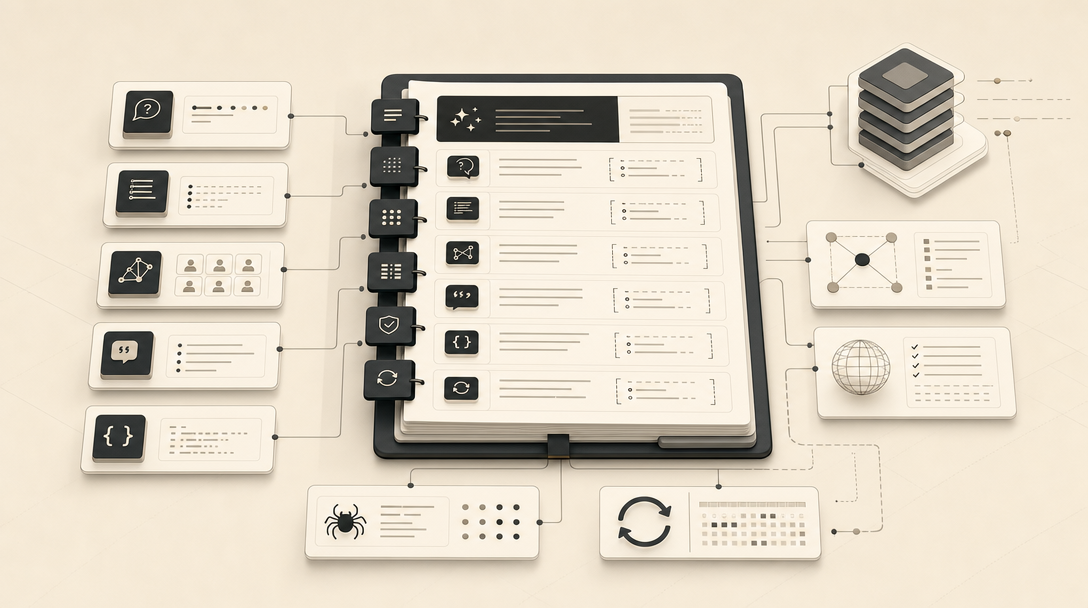
A GEO content brief is a writer-ready operating spec that turns a target AI question into instructions for answer-first structure, extractable sections, proof points, citations, schema, and QA before drafting starts. Generative Engine Optimization (GEO) is the practice of structuring content so large language models can extract, understand, and quote it when answering user queries (Source: Vemetric). The brief is the blueprint that operationalizes those principles for the person writing the page.
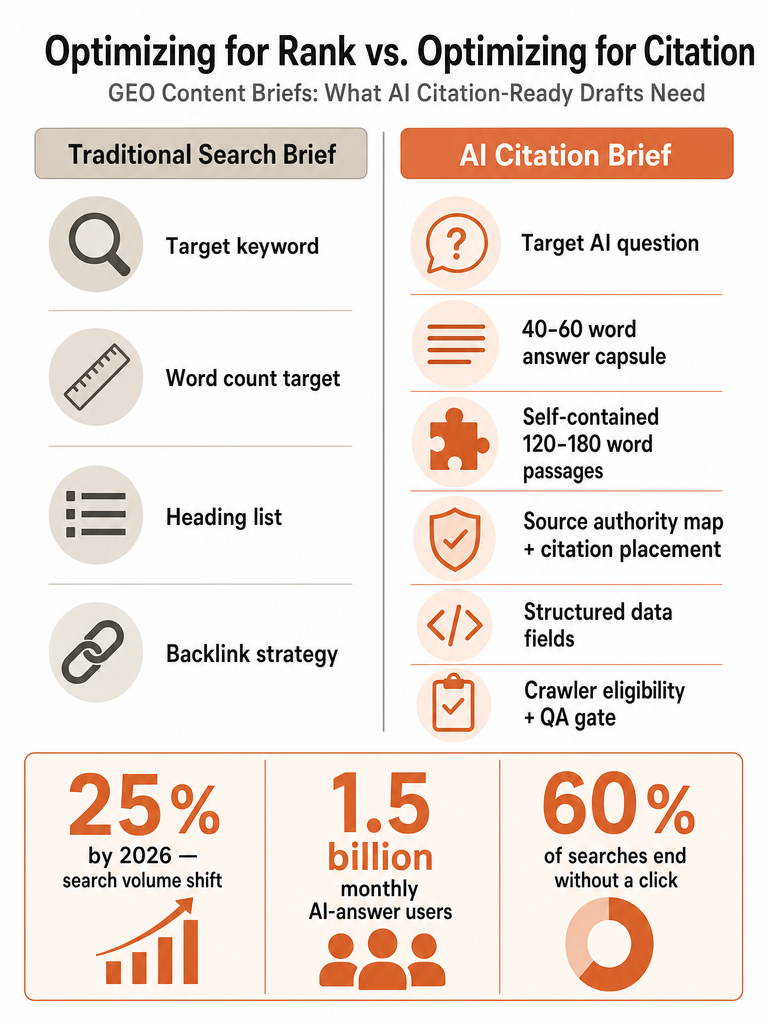
A standard SEO brief tells a writer which keyword to target, how many words to hit, and which backlinks to chase. A GEO content brief reorders the inputs. It starts with the specific question someone types into ChatGPT, Perplexity, or Google AI Overviews, then specifies the short direct answer the engine can lift, the structured elements that make the page parseable, and the proof points that make it trustworthy (Source: Vemetric).
The reason this matters now is operational, not theoretical. Vemetric reports that Gartner predicts traditional search volume will drop 25% by 2026 as users move to AI answer engines. The brief is how a team makes every published page eligible for that traffic instead of invisible to it.
Why Does Ranking #1 No Longer Guarantee AI Citation?
Ranking first earns clicks; citation requires extraction. AI systems cite content they can extract a clean answer from, verify against other sources, and attribute to a credible author — not simply content that ranks well (Source: Turing College). Two pages can sit in Google's top three and still never appear in an AI answer if neither offers a definition block, a comparison table, or a hyperlinked citation the model can pull.
Turing College's author tested this directly in Perplexity, querying for the best email platform for small e-commerce. The Sources panel cited a G2 comparison page, a pricing table, a Reddit thread, and a blog post with a named data source. Two of Google's top-three results for the same query didn't appear anywhere. Both were well-written. Neither had a structure the model could lift a chunk from.
The shift is measurable. Vemetric reports that Google AI Overviews now reach 1.5 billion monthly users, and that 60% of searches end without a click through to an external site. As Moz co-founder Rand Fishkin put it, traffic was always a vanity metric — what changed is where you optimize for the sale.
A page that ranks but can't be extracted earns the click that no longer happens. GEO brief discipline exists to fix that gap across ChatGPT, Perplexity, Gemini, Claude, and Copilot at once.
SEO brief vs GEO content brief: What Makes a GEO Content Brief Different?
A GEO content brief swaps ranking inputs for citation inputs. Where an SEO brief specifies a target keyword, word count, and backlink plan, a GEO brief specifies a target AI query, an answer-first structure, self-contained sections, a source authority map, and a citation placement plan (Source: Vemetric; Typescape). Both still matter — classic SEO and GEO are complementary — but the GEO layer controls whether the page is extractable, not just rankable.
The clearest way to see the difference is field by field:
| Brief input | SEO brief | GEO content brief |
|---|---|---|
| Starting unit | Target keyword | Target AI query / question |
| Heading logic | H2 structure for skimming | Answer-first structure for extraction |
| Length rule | Target word count | Section length for chunking |
| Competitor work | Competitor content analysis | Source authority mapping |
| Sources | Generic source inclusion | Citation placement plan |
Source: Typescape.
The mechanical reason for the answer-first rule is how engines read pages. AI systems break a page into passages and evaluate each passage for relevance, clarity, and factual density, so every section has to work independently outside the full article (Source: Vemetric). A writer briefed only on word count will produce sprawling sections that read well top to bottom but offer no liftable chunk.
Typescape reports that content with proper citations, quotations, and statistics achieves 30–40% higher visibility in AI responses — which is why evidence planning belongs in the brief, not the edit.
How to Write a Content Brief for AI Search
Writing a GEO brief follows a fixed sequence that moves from the AI question down to the refresh owner. Each step produces an instruction the writer cannot skip. Typescape reports the full process takes 30–60 minutes per brief, with the first brief running about an hour and the fifth dropping to roughly 30 minutes once the team has a template.
Build the brief in this order:
- Define the target AI query. Start with a single, clearly defined core question rather than a keyword (Source: Vemetric). This is the question the page must answer cleanly.
- Name the audience job. State who is asking and what decision they're trying to make, so the answer matches intent.
- Assemble the source set. Gather authoritative sources before drafting — the brief needs access to citable data, not a writer guessing (Source: Typescape).
- Specify the answer capsule. Require a 40–60 word direct answer near the top; Turing College reports this is the strongest predictor of ChatGPT citation.
- Set entity rules. Identify the core entities and require full proper names on first mention, since AI systems use entity clarity to decide what to surface (Source: Finch).
- Draft the outline. Map H2s to the sub-questions a reader fans out into, with self-contained sections.
- Mark evidence slots. Pin specific statistics, quotes, and source links to the sections that need them.
- List schema needs. Note which structured-data types the content type requires (Source: Finch).
- Run technical checks. Confirm the published page will be crawlable and parseable.
- Set the QA gate and refresh owner. Name who scores the draft and who owns the next refresh.
The sequence is what separates a brief from a wish list. TSMGeo's framing is blunt: a writing brief should tell the writer exactly what each piece must contain and why, including the outline, evidence slots, entity rules, and schema requirements. For teams running this across many domains, an AI search content engine turns the sequence into a repeatable pipeline instead of a per-article scramble.
If you'd rather run this brief workflow as a pipeline than build it by hand, Get My Site GEO Optimized.
How do you create content that AI can easily cite?
Citable content is content an engine can lift without reading the whole page. AI engines look for Answer Nuggets — concise 1–3 sentence definitions or solutions designed to be lifted into a summary (Source: Finch). The brief's acceptance criteria should require these nuggets, not hope a writer produces them.
Set the bar with specific, testable rules:
- Answer capsule: a 40–60 word direct answer near the top of the page, which Turing College reports is the strongest predictor of ChatGPT citation.
- Self-contained sections: every section must read correctly pulled out of context, since AI systems evaluate passages independently (Source: Vemetric).
- Section length tied to complexity: Turing College reports pages with 120–180 words between headings received 70% more ChatGPT citations than pages with sections under 50 words. TSMGeo cautions that length should follow topic complexity rather than an arbitrary count — so brief the 120–180 range as a target, not a cage.
- Factual density over keyword density: include specific statistics, dates, and cited research; "delivers strong ROI" is mush, a named figure with a source is a quote (Source: Finch; Turing College).
- Clear entities: define the core entity and list its attributes so the model has a ready-made definition (Source: Finch).
- High readability: plain phrasing that a model can parse cleanly.
These map to measured lift. Turing College reports the four citable traits — statistics (+30–40%), source citations (+31%), expert quotations (+25–30%), and readability (+15–30%) — boost generative engine visibility by 15–40% overall, per Princeton research. Brief for the traits, not for a vibe.
Where should proof points and citations sit in the brief?
Evidence belongs in named slots, placed so the page is verifiable without weakening the answer block. The brief should require specific statistics, hyperlinked source citations, named expert quotations, and author credentials — the four traits Turing College ties to a 15–40% visibility lift — and assign each to a section rather than leaving sourcing to the writer's discretion.
Placement is where most briefs go thin. Turing College adds a specific caution: outbound links inside an answer capsule can reduce citation likelihood, because they point the engine away from the page it's trying to attribute. The practical rule is to keep the 40–60 word capsule clean and concentrate hyperlinked citations in the supporting paragraphs beneath it.
For each evidence slot, the brief should specify:
- The exact statistic or claim, with its source and a working link.
- The named expert or study behind a quotation — Turing College's example, "$36 for every $1 spent across 2,000 e-commerce brands in 2024 (Litmus)," shows the level of specificity that reads as a citable fact.
- Author credentials, so the engine can attribute the page to a credible source.
Freshness counts as evidence too: Turing College cites SE Ranking finding content updated within three months averaged 6 ChatGPT citations versus 3.6 for outdated pages.
What role does structured data play in GEO?
Schema markup tells AI systems what each content element actually represents — product prices, author credentials, and answers to common questions (Source: Finch). The brief should name the structured-data types a given page needs so the writer and publisher implement them by design rather than retrofit them later. Content type determines structure, required schemas, and which GEO techniques apply most (Source: TSMGeo).
Public detail on exact field-by-field schema requirements per content type is limited in the sources here, so brief the type, not invented properties. A workable mapping based on the available material:
| Content type | Likely schema to specify |
|---|---|
| Standard article or guide | Article, Organization, Person |
| Definition or glossary page | DefinedTerm, Article |
| How-to or process | HowTo |
| Comparison or product page | Product, Review, AggregateRating |
| Question-shaped coverage | FAQPage |
| Hub or index page | CollectionPage |
The Person and Organization types carry the author-credential and brand signals engines use for attribution, which ties schema directly to the citation traits above. Note that a dedicated FAQ block is often rendered separately by the CMS, so brief FAQPage markup at the page level rather than duplicating Q-and-A inside the body. Treat the table as a starting map and confirm required fields against current schema documentation before publishing.
Which technical checks make a drafted page eligible for AI crawlers?
A page is only citable if an AI crawler can reach and parse it. Technical blockers — robots.txt restrictions, JavaScript rendering issues, and paywalls — can make excellent content invisible to AI crawlers (Source: Turing College). The brief should carry a pre-publish eligibility checklist so a strong draft never dies on access.
Run these checks before publishing:
- robots.txt access: confirm AI crawlers aren't disallowed from the path.
- JavaScript rendering: verify the answer content exists in server-rendered HTML, not only after client-side JS executes.
- Paywalls and gating: ensure the citable passages sit outside any gate.
- Server log review: Turing College recommends checking server logs to confirm AI crawlers are actually fetching the page before optimizing anything else.
- Schema interpretation: confirm structured data validates and parses.
- Crawl and parse: check that the finished page can be both retrieved and read as clean text.
The most polished answer capsule earns zero citations if robots.txt blocks the crawler that would lift it. These checks belong in the brief, not a separate engineering ticket, because the writer's answer-first work and the publisher's access work have to ship as one eligible page.
How should a QA scorecard test citation readiness before publishing?
A QA scorecard converts the finished brief into a pass/fail gate before the page goes live. The completed brief should act as the quality gate: every requirement it set becomes a line item the reviewer scores, so a draft that meets the spec on paper proves it in the published artifact (Source: TSMGeo). This is the step most GEO brief guides describe as strategy but never operationalize.
Score each draft against the same dimensions the brief specified:
| Check | Pass condition |
|---|---|
| Answer-first opening | 40–60 word capsule near the top, no outbound link inside it |
| Self-contained sections | Each section reads correctly out of context |
| Section length | Roughly 120–180 words between headings where complexity supports it |
| Entity clarity | Core entities named in full on first mention |
| Citation placement | Statistics, quotes, and source links present in support paragraphs |
| Schema coverage | Required structured-data types implemented and valid |
| Author attribution | Credentials present for the named author |
| Technical access | robots.txt, rendering, and paywall checks cleared |
| Refresh readiness | Owner and next-review date assigned |
The scorecard is also where the refresh loop starts. Turing College reports content updated within three months averaged 6 ChatGPT citations versus 3.6 for outdated pages, so the gate should fail any page that ships without a refresh owner attached.
How do AEO, GEO, LLMO, and SEO fit into one brief workflow?
One brief can carry all four disciplines because they target the same page from different angles. GEO structures content so generative engines can extract and quote it; Answer Engine Optimization (AEO) shapes direct answers for answer engines; Large Language Model Optimization (LLMO) builds the brand and entity signals models recommend on; and classic SEO keeps the page indexable and rankable. They're complementary layers, not competing playbooks.
In practice, the same brief fields serve each layer: the answer capsule and FAQ structure feed AEO, the entity rules and author credentials feed LLMO, the schema and crawl checks feed both GEO and SEO, and the keyword and internal links keep classic search intact.
For the definitions and per-engine mechanics behind each layer, these explainers go deeper:
- What Is GEO in 2026? Generative Engine Optimization Explained
- What Is AEO in 2026? Answer Engine Optimization Explained
- What Is LLMO in 2026? Large Language Model Optimization Explained
- AEO vs GEO vs LLMO: Which Workflow Fits Your Team?
- How to Show Up in ChatGPT in 2026 and Google AI Overviews
Mentionwell runs this brief workflow as a pipeline — site profile in, citation-shaped drafts out — so AEO, GEO, LLMO, and SEO ship together across one site or hundreds. To put a citation-ready pipeline behind your own domains, Get My Site GEO Optimized.
Sources
- GEO content strategy: How to write for AI search and citationsdiscoveredlabs.com
- AI SEO (GEO): How to Make Content Rank in 2026 - Turing Collegewww.turingcollege.com
- Content Brief Buildertsmgeo.com