
What is the difference between SGE and AI Overviews?
SGE was the experiment; AI Overviews is the product. Search Generative Experience (SGE) was Google's opt-in test inside Search Labs, while AI Overviews is the production feature that shipped to regular search results. Impression Digital states that SGE was first announced in 2023 and officially rolled out as AI Overviews on 05/14/2024. If you use the terms interchangeably in 2026, you are conflating a lab test with a live feature.
The confusion is understandable. Both put an AI-generated summary above the standard results, both pull from multiple web sources, and both keep the classic blue links below. The difference is status and name. SGE was gated behind Search Labs sign-up and framed as an early experiment. AI Overviews (AIO) is the default experience many users now see without opting into anything, and it feeds into AI Mode for follow-up questions.
For content teams, the practical takeaway is that optimization advice written for "SGE" and advice written for "AI Overviews" usually target the same underlying behavior: an AI summary layer that references sources. The mechanics carried over. Only the packaging and reach changed. If AI search citations are your goal, Mentionwell can help you get your site GEO optimized.
When did Google launch Search Generative Experience?
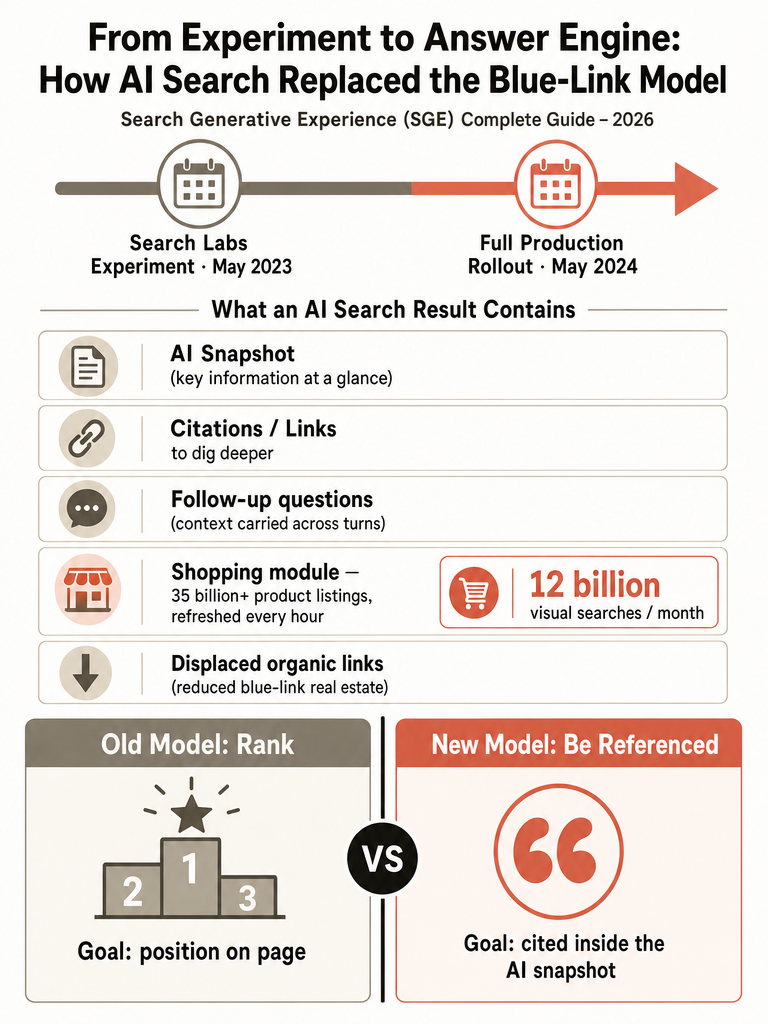
Google announced Search Generative Experience on 05/10/2023, introduced by Elizabeth Reid, Vice President and GM of Search. The announcement framed SGE as Google's "first steps in this new era of Search" and made it available inside Search Labs, described as "a new way to access early experiments in Search." It was an opt-in test, not a default rollout.
The 2023 launch post anchored SGE in Google's broader AI momentum. At the time, Google said people were already using Lens for 12 billion visual searches a month — a "four-fold increase in just two years" — evidence it used to argue that AI-driven search behavior was already mainstream before generative summaries arrived.
The chronology then moves to production. Impression Digital, in a guide updated 04/13/2026, states that SGE "was first announced in 2023, and then officially rolled out as AI Overviews (AIO) on 14th May 2024." So the clean timeline reads: announced May 2023 as a Search Labs experiment, promoted to AI Overviews in May 2024. The Search Labs experiment and the public feature are one year and one name apart — May 2023 to May 2024.
What does an SGE result actually include besides the summary?
An SGE result bundles four elements around the summary, not just the AI text. According to Google's 2023 announcement, a query surfaces "an AI-powered snapshot of key information to consider, with links to dig deeper." Below that snapshot sit suggested next steps and follow-up questions, plus jumping-off points to web content — and the traditional organic listings still appear, pushed further down the page.
Google's own example was the query "what's better for a family with kids under 3 and a dog, bryce canyon or arches." Instead of forcing the searcher to break that into smaller questions, the snapshot does "some of that heavy lifting."
Here is what a generative result assembles, per Google's description:
| Element | What it does |
|---|---|
| AI-powered snapshot | Summarizes key information at the top of the page |
| Links to dig deeper | Cited sources the summary draws from |
| Suggested next steps | Prompts to continue the task |
| Follow-up questions | Tappable prompts that open conversational mode |
| Web content jumping-off points | A range of perspectives to explore |
| Blue links | Traditional organic results, displaced lower |
For content teams, the links-to-dig-deeper slot is the one that matters. That is where a page gets referenced. If you want the mechanics of why a strong page still misses that slot, see why your blog still gets skipped in AI Overviews.
How do follow-up questions and conversational context change search?
Follow-up questions collapse a multi-query session into a single continuous thread. Google said SGE lets you tap a suggested prompt — its example was "How long to spend at Bryce Canyon with kids?" — which opens "a new conversational mode where you can ask Google more about the topic you're exploring." The key mechanic: "context will be carried over from question to question."
That kills the old refinement loop. Impression Digital illustrates it with skincare: users historically asked separate questions like "What is the best cleanser for 30s?" and "What is the best serum for early fine lines and wrinkles?" With generative search, they ask one question — "What is the best skincare routine for a 30-year-old with combination skin?" — and expect a formed answer, then go deeper in AI Mode.
For content strategy, this shifts the target. A page no longer competes for one keyword; it competes to be the source a session keeps referencing as the user drills from a broad question into narrower ones. Pages structured as self-contained answers to related sub-questions fit that thread better than pages built around a single exact-match phrase.
How does Google SGE work behind the scenes?
SGE runs on generative AI layered over Google's existing search understanding. Impression Digital says it uses natural language processing (NLP), deep learning, and neural networks to understand context, semantics, and search intent, and applies "advanced machine learning techniques to generate organic search results and recommendations." It weighs factors like user behavior, browsing history, location, and demographics to tailor results.
The generative summary sits on top of language-understanding systems Google built earlier. Google's own SGE explainer references its Multitask Unified Model (MUM), which the document says is 1,000 times more powerful than BERT and was trained across 75 different languages. Machine learning in Search is not new for Google either — the same explainer notes its early spelling-correction system dates to 2001.
What the corpus supports is that generative summaries synthesize across multiple sources rather than retrieving a single ranked page. What it does not support is a hard claim about the exact live model powering AI Overviews in 2026. NLP, MUM, and BERT are documented understanding layers, but no primary source here ties current production behavior to a specific named model. Treat any "it runs on model X" statement as unverified unless Google states it directly.
Why can a page rank well but still lose visibility in AI Overviews?
A page can hold a top organic position and still lose visibility because the AI Overview sits above it and answers the query first. SEO Perth Experts puts it plainly: in the past your site "could potentially show up in the top 3-4 positions," but with an AI summary at the top, a searcher "may never even allow someone to visit your site." Impression Digital adds that AI Overviews and AI Mode reduce the search real estate available to traditional organic results.
The model shifts from rankings to references. SEO Perth Experts frames it as moving "from being ranked to being a trusted reference that Google's AI can draw from" — and offers a sharp analogy: "In the old days, Google rewarded websites that met all of the correct criteria. Now, Google rewards websites that teach the AI enough so that it will quote them." Ranking #1 no longer guarantees the click; being cited inside the AI summary does.
That reframes the whole scoreboard. Position tracking still matters, but it now measures only part of the visibility a page can win — or lose. For teams sitting on older archives, the fix is usually surgical, not a rebuild; retrofitting old SEO posts for AI Overviews targets exactly this gap.
How is SGE changing SEO in 2026?
SGE reframes SEO around being cited, not just ranked — which is why AEO, GEO, and LLMO now sit alongside classic SEO rather than replacing it. SEO Perth Experts says the content that works best "teaches the user something rather than being stuffed with keywords" and that authority and context "matter more than ever." Impression Digital advises teams to stop being "dictated by the monthly search volume" and focus on value and intent.
Translated into operator decisions, four moves matter:
- Structure answer-first. Lead each section with a self-contained answer a summary can lift, then expand.
- Build citation readiness. Make claims specific, sourced, and extractable so the AI has something quotable to reference.
- Reinforce relevance and authority. Context between topics — not keyword density — decides whether a page gets drawn from.
- Refresh the archive. Old posts that ranked under the blue-link model often need updating to earn citations under the summary model.
These four practices span AEO (answer engine optimization), GEO (generative engine optimization), and LLMO (large language model optimization) at once. For how they differ and which fits your team, see AEO vs GEO vs LLMO. Classic SEO does not disappear here — it becomes the retrieval layer the AI summary reads from.
How do you use Google Search Generative Experience (SGE) effectively?
Use SGE as a starting map, then verify before you act on anything consequential. The snapshot compresses multiple sources into one answer, which is fast but not infallible — Google itself warns that generative search "will not always get it right." Treat the summary as a first read, not a final one, especially for decisions involving money, health, or safety.
A practical workflow for searchers:
- Read the snapshot for the key factors and the shape of the answer.
- Inspect the linked sources — the "links to dig deeper" show where the summary drew from.
- Use follow-up prompts to open conversational mode and narrow the topic, since context carries between questions.
- Compare viewpoints across the range of perspectives Google surfaces rather than trusting one framing.
- Verify important claims against a primary source before relying on them.
For content teams, running your own target queries through this loop is diagnostic: it shows which sources the summary actually cites for questions you want to win, and whether your pages appear in the "dig deeper" slot at all.
How does shopping work in generative search?
Generative shopping search runs on Google's Shopping Graph, the dataset behind product summaries in AI results. Google's 2023 announcement says a product search returns "a snapshot of noteworthy factors to consider and products that fit the bill," with descriptions that include "relevant, up-to-date reviews, ratings, prices and product images." The Shopping Graph holds more than 35 billion product listings, and Google says it refreshes more than 1.8 billion listings every hour.
That refresh cadence is the point. Prices, inventory, sellers, brands, and reviews change constantly, and hourly updates keep the generative shopping snapshot current rather than stale.
| Shopping Graph element | Detail (per Google) |
|---|---|
| Total listings | More than 35 billion |
| Refresh rate | More than 1.8 billion listings hourly |
| Data included | Product listings, sellers, brands, reviews, prices, inventory, images |
| Output in search | Snapshot of factors to consider plus matching products |
For brands, that means structured, accurate, current product data — reviews, prices, availability — feeds directly into what generative shopping answers show.
What limitations and unsourced SGE claims should marketers watch?
Google's own caveat should anchor any SGE strategy: generative search has known limitations and "will not always get it right." That admission comes from the same 2023 announcement that introduced the feature, and it is the balancing detail most third-party explainers skip. Build workflows that assume the summary can be wrong, incomplete, or missing your best source.
Beyond Google's caveat, several widely repeated claims lack strong primary sourcing in this corpus. Treat these as unverified until a first-party source confirms them:
- Trigger rates. There is no reliable, independently sourced figure here for how often AI Overviews appear on SGE-related queries. Broad percentages circulate; strong primary sources do not.
- CTR and traffic loss. No verified click-through or publisher-traffic-loss data attributable specifically to SGE or AI Overviews appears in these sources.
- Geography and device availability. The corpus has no authoritative 2026 availability matrix by region or device.
- Live model stack. Mentions of PaLM 2 or Gemini as the production engine are not backed by an authoritative source tying current AI Overviews behavior to a specific model.
The honest position: the mechanics are well documented, but much of the impact data is not. Write to what Google confirms, and label the rest. If you want a repeatable way to structure content for citation in these engines, Mentionwell can get your site GEO optimized.
Sources
- Search Generative Experience (SGE) Complete Guide- 2026mdazizurrahman.com.bd
- Guide to Search Generative Experience (AI Overviews) in 2026www.impressiondigital.com
- SEO in 2026: How Google's SGE (Search Generative Experience) Is ...www.seoperthexperts.com.au
- How to Rank in Google AI Overviews (SGE) - YouTubewww.youtube.com
- Google SGE Guide: AI Search Visibility in 2026seoctopus.io
- What Is Google SGE? Complete 2026 Guide (AI Search)techeasify.com