What should an AEO and GEO content brief include?
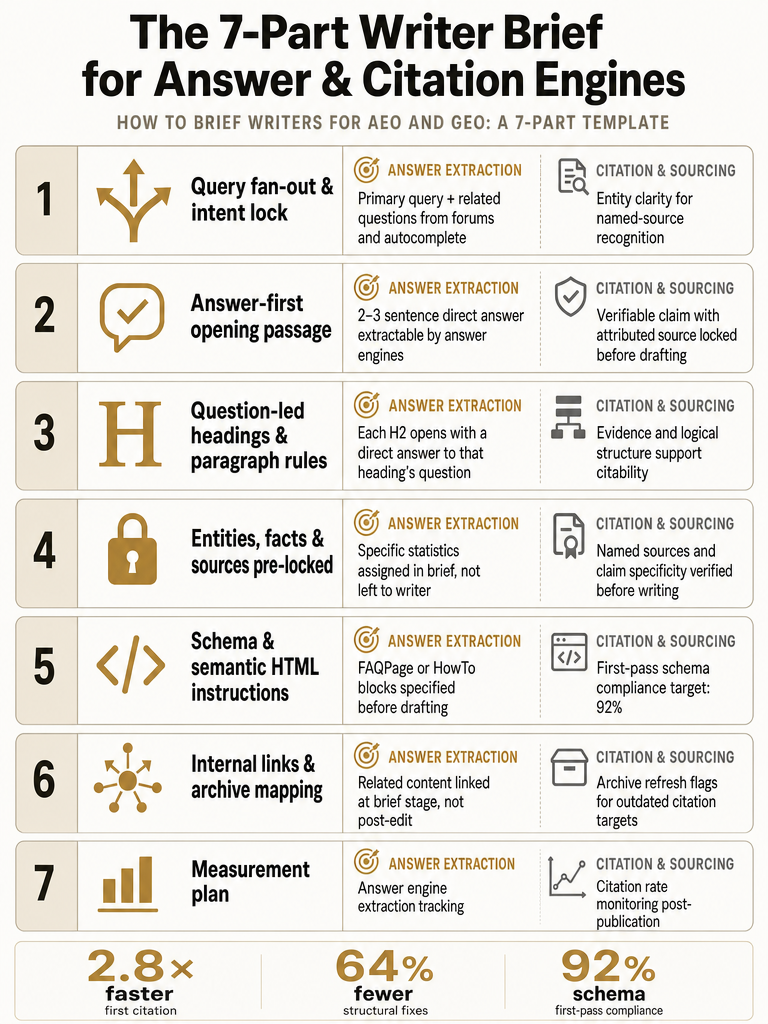
A working AEO and GEO content brief is a production spec with seven parts: query fan-out, a standalone answer, section extraction rules, locked entities and sources, schema and HTML instructions, internal links and archive mapping, and post-publish measurement. Each part carries two columns — an AEO requirement for direct-answer extraction and a GEO requirement for named-source citation. SearchForged says a well-designed AEO brief reduces post-write revisions from an average of 2.8 rounds to under 1.
The split matters because the two jobs pull in different directions. AEO shapes how a page answers so an engine can lift the passage. GEO shapes why an engine trusts the page enough to name it as a source.
Here is the template at a glance:
| Part | AEO requirement | GEO requirement |
|---|---|---|
| 1. Query fan-out | Primary question + PAA/autocomplete list | Prompts where you want to be cited |
| 2. Standalone answer | 2–3 sentence liftable summary | Named source + verifiable claim inside it |
| 3. Section rules | H2 opens with a direct answer | Each claim traceable to a source |
| 4. Entities & sources | Entity coverage for the topic | Required stats, named references |
| 5. Schema & HTML | FAQPage/HowTo, semantic HTML | Author, sourcing, freshness signals |
| 6. Links & archive | Internal link map | Retrofit of old posts for citation |
| 7. Measurement | Extraction/QA checks | AI-answer citation tracking |
A brief that assigns sources and structure before drafting turns citation from luck into a repeatable step.
Get My Site GEO Optimized — Get My Site GEO Optimized
What is the difference between GEO and AEO in a writer brief?
AEO and GEO briefing are not the same job. AEO instructions help a page become the direct answer through question-led headings and answer-first paragraphs. GEO instructions help the page become a cited source through clear entities, verifiable claims, and named references. According to Garrett Mickley's analysis, AEO focuses on becoming the direct answer, while GEO focuses on being cited inside AI-generated responses.
In practice, one field often serves both. A standalone answer passage satisfies AEO extraction and, when it carries a named source and a specific number, also satisfies GEO's proof bar. But some fields serve only one job. Entity clarity and outbound citations are GEO work — they rarely change whether a passage is extractable, only whether it's trusted enough to name.
The corpus disagrees on hierarchy. Some sources treat AEO and GEO as distinct siblings; others frame AEO as a subset of GEO. The practical stance for a writer: treat them as two checklists on the same page. One asks "can a model lift this cleanly?" The other asks "will a model attribute it to us?"
Part 1: Which query fan-out should the writer answer?
Query fan-out is the ranked list of questions a page must answer, built from real user language before a writer drafts a single line. Agenxus says its query and intent section uses a 30–50 item query fan-out list sourced from People Also Ask, autocomplete, and forums like Reddit. Ansly adds that a brief should name 2 to 4 secondary target queries alongside the primary one.
Lock these before drafting:
- Primary question — the exact query, phrased as the reader would type or speak it, set as the H1.
- Search intent — informational, commercial, comparison, or transactional, so the writer picks the right depth.
- PAA and autocomplete pulls — the specific "people also ask" strings and autocomplete completions for the topic.
- Forum prompts — real Reddit and community phrasings that expose the underlying job to be done.
- The 30–50 item fan-out — the full list, from which 5–8 secondary questions become H2 sections.
The AEO job here is coverage: enough real questions that the page can answer several extraction targets, not one. The GEO job is priority — flag which prompts you actually want to be cited in, so the writer weights proof toward those. SearchForged says content produced without competitor-gap guidance duplicates 60% of the top result, which is what happens when fan-out is skipped and the writer defaults to whatever ranks.
Part 2: What standalone answer should the article open with?
The standalone answer is a 2–3 sentence passage near the top of the page that answers the primary question completely, with no dependence on surrounding text. Agenxus and Ansly both specify this 2–3 sentence length as the portion a model could cite verbatim. It is the single most extractable element you can brief.
Write it so it survives being pulled out of context. No "as mentioned above," no pronoun referring to the heading, no setup clause. The first sentence states the answer with the key term inside the first ten words. The second adds the qualifying context. When a real number exists, a third sentence carries it with attribution.
For AEO, this passage is the extraction target across ChatGPT, Google AI Overviews, Perplexity, Gemini, Claude, and Bing Copilot — all lift short, self-contained answers. For GEO, the same passage does double duty when it names a source or a specific figure inside those two or three sentences, because that's the version an engine is comfortable attributing.
Brief the standalone answer as a deliverable, not a summary the writer backs into after drafting. The difference shows up in whether the passage reads cleanly when quoted alone.
Part 3: Which heading and paragraph rules make each section extractable?
Every required H2 should be phrased as a question, and the first sentence beneath it should answer that question directly. Ansly states the rule plainly: the first sentence under each required H2 should directly answer the heading. SearchForged says answer-first structure is applied inconsistently across 40% of H2s when writers work without a brief — which is exactly the failure a section-level instruction prevents.
Give the writer these rules per section:
- Question-form heading. Turn a fan-out query into the H2 verbatim where it reads naturally. Balu Kosuri notes that question-based headings are the strongest signal for AI answer extraction, and question-answer pairs are the most extractable content.
- Answer-first opener. State the answer in the first sentence, then support it. No throat-clearing.
- One idea per section. Keep sections self-contained and roughly 120–300 words so a model can lift the whole block.
- Evidence follows the claim. After the direct answer, one or two sentences of concrete support — a number, an example, a named entity.
- Logical order. Sequence sections so each stands alone but the page still reads as an argument.
The AEO payoff is clean extraction. The GEO payoff comes from the evidence rule: sections that pair a claim with a verifiable, sourced detail read as authoritative, which is what pushes an engine to name the page. For teams retrofitting older content, how to refresh old SEO posts for AI citations applies these same rules to pages that already exist.
Part 4: Which entities, facts, and sources must be locked before writing?
Assign the exact sources, statistics, and entities in the brief rather than leaving research to the writer. SearchForged says that when writers source their own statistics, 30% use unverifiable or incorrect data — a citation risk you eliminate by locking references upfront. This is the field where GEO briefing lives.
Lock four things:
- Named sources. List the specific references the writer must cite, with URLs, so every claim traces back to something verifiable. This is what makes a page nameable by an answer engine.
- Required statistics. Name the exact stats and their sources so numbers aren't invented or misattributed. A figure without a source is a liability, not a proof point.
- Claim specificity. Instruct the writer to be concrete — a precise number and date beats "studies show." Specificity is what GEO rewards.
- Entity coverage. List the companies, products, tools, and people that must appear by full proper name. Answer engines use entity co-occurrence to decide what to surface, so naming the right entities is a retrieval signal.
The AEO side of this field is thin — extraction doesn't care much about attribution. The GEO side carries the weight: named sources, verifiable claims, and clear entities are the proof requirements that separate a page an engine quotes from one it merely reads.
Part 5: What schema and HTML instructions belong in the brief?
Specify schema type and semantic HTML before drafting, not during editing. SearchForged says schema specified before writing reaches 92% first-pass compliance, while schema added after writing requires revisions 45% of the time. Deciding the markup upfront is cheaper than retrofitting it.
Put these in the brief:
- Schema.org type. Name the primary type — FAQPage for question-cluster pages, HowTo for step-based processes, Article as the baseline. Match the type to the content shape, not the other way around.
- FAQPage or HowTo blocks. If the page carries genuine Q&A or numbered steps, mark them up so engines can parse them as structured data.
- Semantic HTML. Require proper heading hierarchy, real lists, and clean structure. Logical heading structures, a mini table of contents, an FAQ section, and semantic HTML all rank among the effective content strategies for AEO and GEO.
- Validation check. Assign a validation pass against Schema.org before publish so markup errors don't ship.
For AEO, structured markup helps engines locate and lift the right block. For GEO, schema and clean HTML reinforce that the page is machine-readable and trustworthy enough to attribute. Do not invent schema the content doesn't support — FAQPage markup on a page with no real questions is a validation failure waiting to happen.
Part 6: How should internal links and old SEO posts be mapped before drafting?
Assign internal links in the brief instead of leaving them to the writer's discretion. SearchForged says assigning 3–5 internal links in the brief produces a 100% inclusion rate, versus the inconsistency you get when links are an afterthought. The brief should name the target pages and the descriptive anchors before drafting starts.
Map two directions:
- Up to the pillar. Link the new page to its topical hub so the cluster reads as coherent authority.
- Sideways to siblings. Link to related pages the reader would want next — comparison pages, definition pages, workflow guides.
The same field connects new briefs to archive work. Old SEO posts often already rank but get skipped by AI Overviews because they were never structured for extraction. Rather than rewrite from scratch, map which archive URLs the new page should link to and which should be refreshed in parallel. See how to retrofit old SEO posts for AI Overviews for the diagnosis-first version of this, and GEO content strategy for B2B SaaS sites with old blogs for triaging which URLs are worth the work.
The AEO benefit of assigned links is navigational clarity. The GEO benefit is topical density — a tightly linked cluster signals that the page sits inside a body of related, authoritative content, which supports citation.
Part 7: How should teams measure AI citation readiness after publishing?
Measure both classic SEO output and AI citation signals, because a page can rank well and still get skipped by answer engines. SearchForged frames citation readiness through structural pre-planning, saying pages built from AEO briefs earn their first AI Overview citation 2.8× faster than pages created without it. The post-publish checklist should confirm the brief was executed, then track whether the page surfaces in AI answers.
Run these checks after publishing:
- Extraction QA. Confirm every H2 opens with a direct answer and the standalone summary reads correctly when quoted alone.
- Schema compliance. Validate the markup against Schema.org and confirm FAQPage or HowTo blocks parse.
- Internal link inclusion. Verify the assigned 3–5 links shipped.
- Revision rounds. Track how many editing passes the draft needed — SearchForged targets under 1 round for a well-briefed page.
- AI-answer visibility. Test the primary and secondary prompts in ChatGPT, Perplexity, Gemini, Claude, Google AI Overviews, and Copilot, and log where you appear or get cited.
- Qualified referrals. Watch for the referral traffic and mentions that follow citation, not just impressions.
If a page is ranking but not getting cited, AI Overviews citations: why your blog still gets skipped breaks the failure into trigger, extraction, verification, and freshness so you fix the right one.
How to brief writers for AEO without killing originality?
Enforce format, sources, and section jobs — leave the thinking to the writer. A good brief locks the answer structure, the required sources, and what each section must accomplish, but it does not script the sentences or dictate the examples. That boundary is what keeps a citation-ready page from reading like a template. SearchForged says content produced without competitor-gap guidance duplicates 60% of the top result, which is the failure originality actually prevents.
The rule of thumb: constrain the shape and free the substance. Tell the writer that each H2 must open with a direct answer and cite an assigned source. Don't tell them which analogy to use, which example illustrates the point, or how to sequence the argument within a section.
Where a subject-matter expert adds a non-duplicative angle — a contrarian read, an operational detail competitors miss, a concrete case — that judgment is the information gain an answer engine has no other source for. The brief should invite it, not crowd it out.
Programmatic scale raises the same risk at volume; programmatic SEO without thin pages covers the go/no-go test that keeps templated pages useful.
How does this brief connect AEO, GEO, LLMO, and SEO together?
This seven-part brief is one production spec that serves four disciplines at once, because the same page has to answer directly, earn citation, stay machine-readable, and still perform in classic search. Gartner predicts that traditional search engine volume will drop 25% by 2026, per its 2024 report cited by VP Analyst Alan Antin — the reason no team can afford to brief for rankings alone anymore.
The mapping is clean: the standalone answer and question-led sections do the AEO work; named sources and entity clarity do the GEO work; schema and semantic HTML do the LLMO work of staying model-readable; internal links and query fan-out carry the SEO foundation. One brief, four outcomes, no separate workflows to reconcile.
This is the operating model Mentionwell runs as a blog engine — onboard a domain, define a site profile, and ship citation-shaped drafts with AEO, GEO, LLMO, and SEO built into every one, across a single site or hundreds. For the discipline-by-discipline breakdown, AEO vs GEO vs LLMO: which workflow fits your team shows how the pieces fit before you scale them.
Ready to run this brief across your whole site? Get My Site GEO Optimized.
Sources
- Building an AEO Content Brief (Free Template)www.agenxus.com
- 7 best practices for SEO, GEO, & AEO copywritingwww.jasper.ai
- 7 Examples of Content for AEO and GEO [With Templates]www.tripledart.com
- The AEO Content Brief Template — AEO Encyclopedia | SCC | SearchForgedwww.searchforged.com