
How to update glossary pages for AI search citations
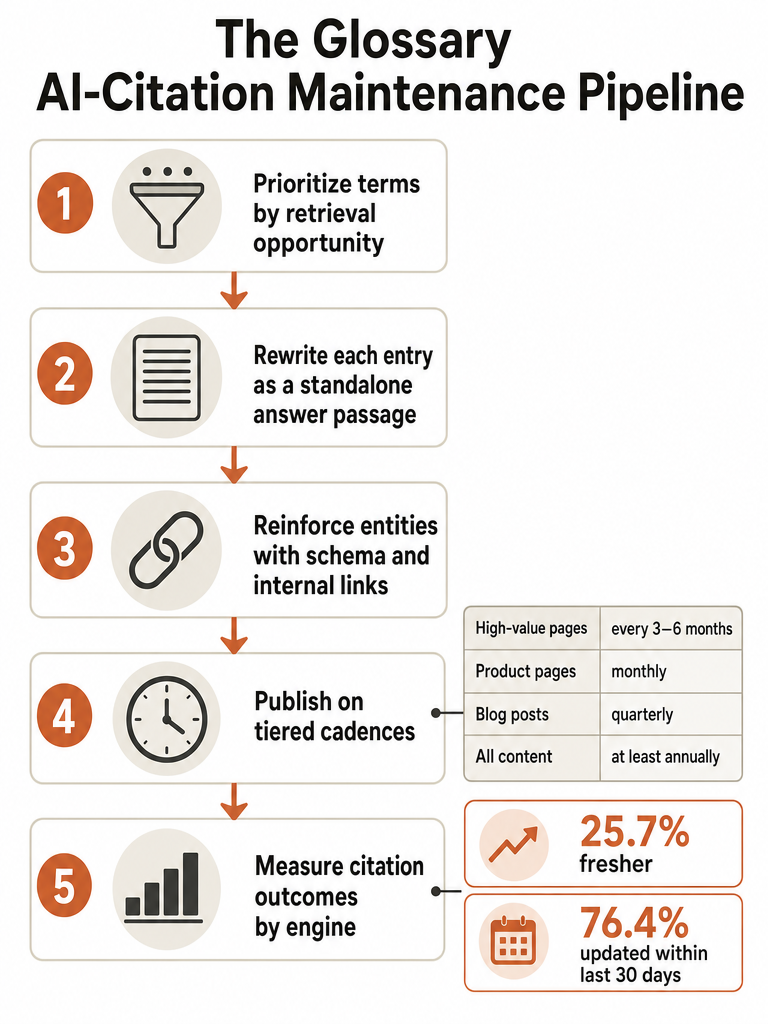
Updating glossary pages for AI search citations means refreshing definition entries so answer engines can retrieve, quote, and attribute them at the passage level. The pipeline has five stages: prioritize terms by retrieval opportunity, rewrite each entry into a standalone answer passage, reinforce entities with schema and internal links, publish on tiered cadences, and measure citation outcomes by engine. ZipTie.dev reports that 76.4% of ChatGPT's top-cited pages were updated within the last 30 days, and that AI-cited content is 25.7% fresher on average than traditionally ranked content.
Freshness alone won't earn a citation, but staleness reliably loses one. Frase describes Retrieval-Augmented Generation (RAG) as a process where an AI model pulls relevant external documents in real time, synthesizes an answer, and cites the sources it drew from — which means citation decisions happen at the passage level, not the page level. A glossary entry that reads cleanly when lifted out of context is the unit that gets cited.
The stakes are concrete. Frase states that more than 50% of brands still have no GEO strategy, while LLMs cite only 2–7 domains per response on average. That concentration rewards teams who run glossary maintenance as a system instead of a one-time build.
This guide treats the glossary as an AI-citation maintenance pipeline across AEO, GEO, LLMO, and SEO — not four separate workflows.
Which existing glossary pages should be refreshed first for AI citation potential?
Refresh the glossary entries with the highest retrieval opportunity first: terms that already get long-tail question demand, sit inside a topic where you hold authority, and show movement in Google Search Console. Citation concentration is severe — Frase states the top 20% of cited domains capture 80% of all AI references — so triage matters more than volume.
Build the priority list from signals you already have:
- Long-tail question demand. Entries tied to "what is" and "how does X work" queries are the ones answer engines reach for. ROI Growth Agency recommends optimizing each term for specific long-tail keywords like "what is customer lifetime value" rather than the bare acronym.
- Google Search Console signals. Pages holding stable impressions but falling clicks are prime candidates — ZipTie.dev attributes that exact pattern to AI Overviews intercepting the click.
- Google Analytics signals. Entries with existing AI-referral sessions confirm the engine already trusts the page; reinforce those before chasing new terms.
- Topical authority and Knowledge Graph gaps. Terms where your entity is weakly resolved, or where no clear definitional owner exists, offer the most upside.
This triage feeds directly into an AEO content strategy for teams with existing SEO archives.
How to optimize glossary pages for AI answers?
Optimizing a glossary page for AI answers means making each entry a clear, self-contained, machine-readable passage with a definition, context, and examples. Tely states that organized material can enhance citation probability by 40%, and ROI Growth Agency lists definition-focused schema markup, reciprocal internal linking, natural-language definitions, and long-tail keyword integration as the core levers.
Work through this checklist on every entry you refresh:
- Lead with a plain-language definition. Write
[Term] is [definition]in the first sentence so the answer is liftable without the heading. - Add context and at least one example. Tely says definitions should be supported by examples or context, which gives RAG systems the factual density they prioritize.
- Use headers and subheaders to group related terms for both readers and AI systems.
- Cover the long-tail variants — synonyms, the full term, the acronym, and the question phrasing a reader would type.
- Add definition schema markup so engines understand the term and its relationships.
- Link reciprocally to pillar pages and related entries.
Frase says RAG systems prioritize semantic clarity, factual density, structural organization, and authority signals when selecting sources. An entry that opens with a clean definition and one concrete example carries all four signals in a single passage. Write for extraction, not for word count.
How to structure glossaries and definition pages for AI retrieval?
Structure a glossary as a retrieval-ready knowledge base, not a list of dictionary entries. Single Grain frames well-structured glossaries as resources that give language models clear, atomic explanations of concepts, products, and frameworks so they can quote and reference the source accurately in AI Overviews and chat-style answers, reducing ambiguity around brand terminology.
Single Grain's CORE Framework maps the work into four stages:
| Stage | What you do | Output |
|---|---|---|
| C — Collect | Gather high-impact terms and the questions readers ask about them | A prioritized term and query list |
| O — Organize | Build glossary architecture and navigation | Clear hierarchy and entry routing |
| R — Reinforce | Add internal links, context blocks, and examples | Connected, extractable entries |
| E — Evaluate | Track LLM retrieval over time | Citation feedback loop |
Structure also has a hard limit: model context windows. Witscode notes that longer content does not automatically improve AI visibility — what matters is whether the most important information fits inside the model's context window and lands in positions the model weights heavily. GPT-4o supports roughly 128,000 tokens and Claude up to 200,000 tokens, but the definition still needs to sit at the top of the passage. Front-load the answer; don't bury it under context.
Publish-date updates vs substantive AI-citation refreshes
A substantive AI-citation refresh changes what an engine can extract; a publish-date update changes only the timestamp. ZipTie.dev defines a content refresh strategy for AI citations as updating existing content on specific cadences with targeted structural and substantive changes aimed at extractability, freshness signals, and platform-specific citation patterns — not keyword rankings alone.
The distinction is operational:
| Superficial publish-date update | Substantive AI-citation refresh |
|---|---|
| Bumps the "updated" date | Rewrites the definition into a standalone passage |
| No change to extractability | Improves factual density and semantic clarity |
| Stale supporting sources | Replaces outdated stats and citations |
| Same internal links | Adds related-term and pillar links |
| No schema change | Adds or corrects definition schema |
| One generic version for all engines | Adds platform-specific citation checks |
ZipTie.dev's framing is that AI refreshes optimize for extractability, freshness signals, and platform-specific citation patterns — three things a date change touches none of. The freshness data backs this: AI-cited content runs 25.7% fresher than traditionally ranked content, but that statistic describes pages where the content actually changed, not the metadata.
What refresh cadence should glossary pages use: monthly, quarterly, every 3–6 months, or annually?
Glossary cadence follows the page's value tier. ZipTie.dev recommends refreshing high-value pages every 3–6 months, product pages monthly, blog posts quarterly, and all content at minimum annually. Most glossary entries behave like high-value evergreen pages, so the 3–6 month cycle is the default; entries tied directly to a product feature warrant monthly review.
| Page type | Refresh cadence (ZipTie.dev) |
|---|---|
| High-value glossary / evergreen entries | Every 3–6 months |
| Product-tied glossary entries | Monthly |
| Blog posts | Quarterly |
| All content (floor) | At minimum annually |
The freshness pressure is real because ChatGPT skews hard toward recency: ZipTie.dev reports 76.4% of ChatGPT's top-cited pages were updated within the last 30 days. That doesn't mean every entry needs a monthly rewrite — it means entries competing for ChatGPT citations in fast-moving categories decay faster than ones in stable domains.
Set a next-review date per entry and tie it to the tier. A term defining an emerging AI-search concept needs the 3–6 month cycle; a settled financial term can run on the annual floor.
How do glossary updates differ for ChatGPT, Perplexity, and Google AI Overviews?
Glossary updates differ by engine because the engines barely share sources. ZipTie.dev reports that only 11% of websites are cited by both ChatGPT and Perplexity, while 89% of sources cited by one platform are not cited by the other. Treating all answer engines as one channel wastes refresh effort; each needs its own check.
The source-preference data explains the divergence. ZipTie.dev lists Wikipedia as ChatGPT's top source preference at 47.9% and Reddit as Perplexity's top source preference at 46.7%. Underneath all of them sits the same mechanism: Frase describes Retrieval-Augmented Generation as real-time document retrieval with passage-level citation, so the entry still has to be extractable everywhere — the difference is which surrounding signals each engine trusts.
Run separate refresh checks:
- ChatGPT — recency and encyclopedic clarity; favors the kind of authoritative, Wikipedia-style definition. See how to show up in ChatGPT.
- Perplexity — community and discussion signals carry weight. See how to show up in Perplexity.
- Google AI Overviews and Google AI Mode — tied to ranking and structured data. See how to show up in Google AI Overviews.
- Gemini and Claude — retrieval plus structured, clearly-attributed passages. See how to show up in Claude.
The structural difference between AI Overviews and ChatGPT drives most of these per-engine choices.
How can a team measure whether a refreshed glossary page gained, retained, or lost AI citations?
Measuring a refresh means running a post-update loop that tracks engine-specific citation appearances against your existing search and referral metrics. The public corpus is thin on controlled tests proving a single glossary edit caused a citation, so treat measurement as observation over time, not attribution of one change.
Build the loop from data you can actually capture:
- Record baseline citations by engine before the refresh — note where the term already appears in ChatGPT, Perplexity, Google AI Overviews, Gemini, and Claude.
- Re-check the same prompts after the refresh and log gained, retained, or lost appearances per engine, since ZipTie.dev's 11% overlap means each platform needs its own check.
- Compare AI-referral and search metrics. Watch Google Analytics for AI-referral sessions and Google Search Console for the impressions-stable, clicks-falling pattern ZipTie.dev attributes to AI Overviews.
- Set the next review date based on what moved.
For context on scale, Frase states AI platforms generated 1.13 billion referral visits in June 2025, a 357% year-over-year increase, and that AI search traffic converts at 14.2% versus 2.8% for Google organic. Even small citation gains compound when the converting traffic behind them runs that much higher.
Tools like Semrush track AI visibility as a line item, but measurement alone doesn't ship the next refresh.
How do you automate glossary page generation with AI without creating thin templates?
Automate glossary generation as governed programmatic SEO: standardize the entry structure, but enforce a unique, source-backed definition for every term. The corpus is thin on detailed governance for programmatic definitions, so the discipline is editorial — automation handles consistency, while controls prevent duplicate definitions, low-value term pages, and inconsistent entity coverage.
The governance layer that keeps programmatic glossaries citable:
- De-duplicate near-synonyms. When two entries define overlapping concepts, canonicalize to one and cross-link the rest rather than publishing competing thin pages.
- Enforce minimum substance per entry. Single Grain's atomic-definition principle and Tely's example-plus-context requirement become hard template fields, not optional ones.
- Hold entity coverage consistent. Rampiq's glossary groups concepts into categories — technical infrastructure, query and content optimization, visibility metrics, AI-first strategy — and Witscode pairs each term with "you will encounter this when," related terms, and "why this matters." Those repeatable slots give automation structure without flattening the content.
- Gate on extractability. No entry ships unless its lead sentence reads as a standalone answer.
This is the line between volume and citation yield. A blog engine like Mentionwell runs this as a citation-shaped pipeline — site profile, governed templates, and tiered refreshes — across one glossary or many, so programmatic scale doesn't collapse into thin pages. Compare the approaches in SEObot writes 9 articles, MentionWell writes the right 9.
Sources
- AI Search Glossary of Terms - Parsnippwitscode.com
- Mastering AI Citations: The Ultimate GEO Playbook | Frase.iowww.singlegrain.com