Best AEO platforms 2026: which tool fits which job?
The right AEO platform depends on which of three jobs you're buying: monitoring where AI engines cite you, optimizing content to earn more citations, or attributing that citation traffic to revenue. Most vendors claim all three. According to Attrifast's 2026 buyer's guide, almost none deliver all three to the same depth. That gap is the whole selection problem.
Answer Engine Optimization (AEO) is the practice of getting your brand cited inside AI-generated answers from systems like ChatGPT, Perplexity, Gemini, and Google AI Overviews (Source: cloro.dev). The tooling around it splits by job, not by brand name.
A fast shortlist by buyer job, drawn from the sources compared below:
| Job you're buying | What it answers | Sourced options |
|---|---|---|
| Monitoring | Did AI engines cite or mention me? | Profound, Otterly.ai, Peec AI, Ahrefs Brand Radar |
| Optimization | How do I get cited more? | Conductor, AirOps, Writesonic, Surfer SEO |
| Attribution | Did the cited traffic pay me? | HubSpot AEO (with CRM), thin across the category |
HubSpot's research says 42% of buyers now use AI search as part of their evaluation process, and it calls AI search the top predictor of purchase intent. That's why this became a paid software category rather than a talking point. The sections that follow break each job apart, then map pricing and engine coverage to the tier where they actually break.
Monitoring vs optimization vs attribution: which AEO job are you buying?
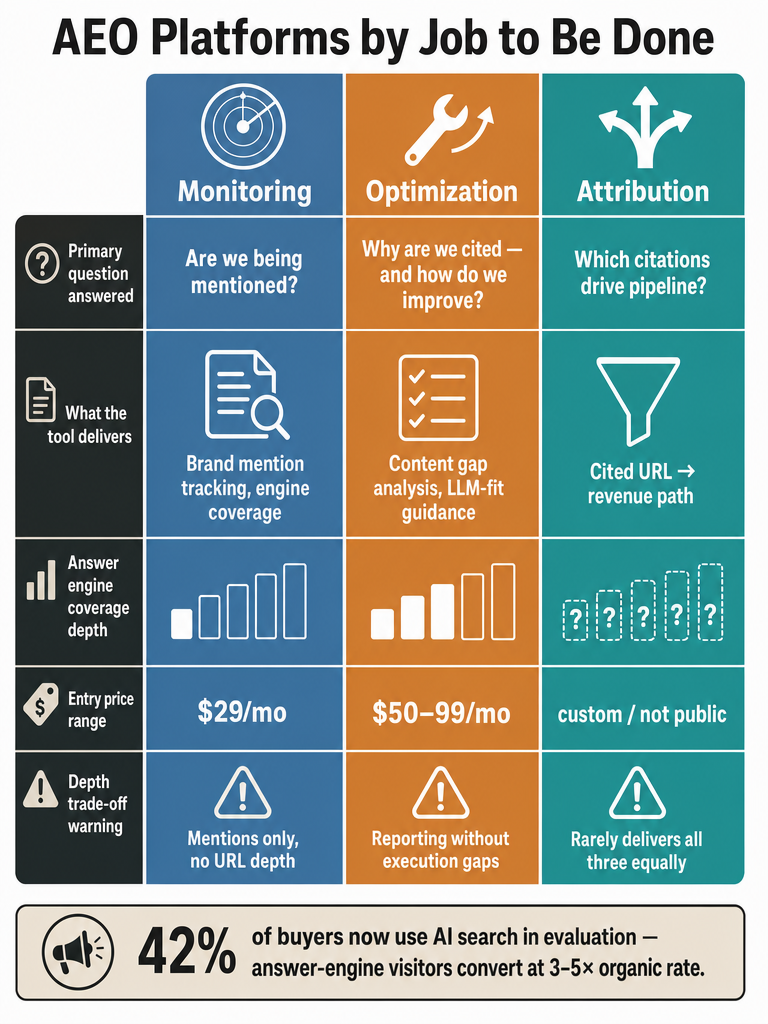
AEO tools fall into three distinct jobs, and treating them as one category is the most common buying mistake. Attrifast's 2026 guide lays them out as a table: monitoring answers "Did AI engines cite or mention me?", optimization answers "How do I get cited more?", and attribution answers "Did the cited traffic pay me?" Each job maps to a different vendor strength.
Monitoring is the crowded end. These tools query live AI engines, extract answers, parse citations, and track the results over time. According to Conductor, AEO tools track whether AI engines mention your content, analyze why certain sources get cited, benchmark visibility against competitors, and provide optimization guidance for how LLMs evaluate content.
Optimization is where fewer tools go deep. Conductor's core point in its 2026 ranking: the best AEO tools connect visibility data to content execution and technical site health, so insights don't just sit in a dashboard.
Attribution is the thin layer. Attrifast calls revenue attribution the category's biggest weak spot, arguing that doing it properly requires a payment-processor join that a GA4-style integration cannot fake.
Novelty SEO puts the operational risk plainly: AEO tools split into citation trackers and content optimizers, and most teams buy a tracker and never close the loop.
Which AEO platforms do professionals use in 2026?
The recurring 2026 platform set spans monitoring, SEO-suite add-ons, and content workflow tools, with Conductor, Semrush, Profound, Otterly.AI, Writesonic, Athena, Evertune, Surfer SEO, Peec AI, and xSeek appearing across published rankings. Conductor ranked those ten in its 2026 guide and evaluated each on AI engine coverage, citation tracking accuracy, content optimization capabilities, enterprise readiness, and integrations.
Other rankings widen the list. HubSpot says it reviewed more than 20 AEO platforms and shortlisted 10, naming HubSpot AEO, AirOps, Otterly.ai, Semrush, Peec AI, Scrunch, SE Ranking, Ahrefs Brand Radar, Profound, and Rank Prompt. Profound's own guide adds Scout, MarketMuse, Ahrefs, Otterly.ai, Goodie AI, and Evertune.
The lists disagree because the vendors do different jobs. Here's how the recurring names cluster, drawn from the sources above:
| Cluster | Platforms named | Primary job |
|---|---|---|
| Enterprise monitoring | Profound, Evertune, Conductor | Multi-engine visibility, citation tracking |
| SEO-suite add-ons | Semrush, Ahrefs Brand Radar, SE Ranking, Surfer SEO | AI visibility layered on classic SEO |
| Mid-market / lean monitoring | Peec AI, Otterly.ai, Scrunch, Rank Prompt | Prompt-level tracking at lower cost |
| Content execution | HubSpot AEO, AirOps, Writesonic, MarketMuse | Turn visibility gaps into content |
Profound describes itself as multi-engine, saying it tracks 10+ AI engines and runs over 6 million prompts every day. That scale is a monitoring metric, not an optimization one. One 2026 Reddit thread on r/DigitalMarketing reads Profound as strong on data and reporting, "very enterprise software," with a polished UI and clean reports. Use the cluster, not the brand halo, to decide what you're actually buying.
Best AEO tools for B2B SaaS companies
B2B SaaS teams should judge AEO tools on three things: buyer-prompt tracking, URL-level citation attribution, and competitor share-of-answer across the engines your buyers use. LoudFace's B2B SaaS ranking scores every tool on engine coverage, URL-level citation attribution, competitor share-of-voice, and enterprise/multi-brand features, then names Profound and Evertune as strongest overall.
The distinction that matters for SaaS: LoudFace says AEO tools measure how often AI engines name your brand on a defined set of buyer prompts and surface which pages the engines cite as sources. That's different from a rank tracker. Ahrefs and Semrush track keyword rank on Google; AEO tools track brand mention rate inside generated answers across ChatGPT, Claude, Perplexity, Gemini, and Google AI Overviews (Source: LoudFace).
A real AEO tool for SaaS, according to LoudFace, needs three components: multi-engine prompt running, citation attribution to URLs, and prompt taxonomy with tags. If a tool only reports a share-of-voice number without telling you which URL earned or lost the citation, you can't act on it.
LoudFace names Peec AI the best practical choice for most mid-market B2B SaaS teams, with Profound and Evertune reserved for enterprise URL-level depth. HubSpot's comparison table lists Peec AI starting at €89/month (~$95); note that Attrifast lists $89/mo and LLM Pulse describes it as "from $95/month," so confirm the current tier on the vendor page.
For teams tracking buyer prompts across many engines, see how an AIO tracker measures where AI engines mention your brand before you commit to a plan tier.
What are the top tools to get cited in ChatGPT answers?
Getting cited in ChatGPT requires more than brand-mention monitoring: you need prompt sets that match buyer questions, attribution to the exact URLs ChatGPT pulls, and source analysis of why competitors get chosen. Friction AI's capability list for a good AEO platform includes citation and source analysis that identifies which URLs AI pulls from, plus search query extraction showing what keywords AI models actually searched.
ChatGPT's scale is why this matters. Friction AI cites OpenAI's disclosure that ChatGPT hit 900 million weekly active users in February 2026. When one answer replaces ten blue links, being absent from the source set means you don't compete in that buying moment.
The tools that go beyond monitoring here are the ones that parse citation sources. Profound says its Prompt Volumes feature draws on insights from 200M+ real user prompts, and it flags citation volatility of 40–60% monthly drift across platforms. That drift is the argument against a one-time audit: a URL cited today can drop next month.
Monitoring tells you whether ChatGPT cites you. Only content execution changes the answer. Novelty SEO's warning applies directly: most teams buy a tracker and never close the loop between the gap and the page that fills it. For engine-specific structure, see what AEO means in 2026 and how citations get earned.
Best AEO tool for ChatGPT, Google AI Overviews, and Perplexity: what coverage matters?
Engine coverage varies by plan tier far more than most comparison tables admit, and the logo count on a landing page rarely matches what your affordable tier actually tracks. Friction AI's checklist calls for multi-engine tracking across ChatGPT, Gemini, Perplexity, Google AI Overviews, and Google AI Mode. Attrifast warns that engine sampling frequency matters as much as which engines are listed.
Match coverage to where your buyers actually ask, and to how often the tool samples each surface:
| Surface | Why it matters (per sources) |
|---|---|
| ChatGPT | 900M weekly active users, Feb 2026 (Friction AI) |
| Google AI Overviews | LLM Pulse says these trigger on a majority of informational queries in English markets |
| Google AI Mode | Named as a distinct surface in Friction AI's coverage checklist |
| Perplexity | Routes an increasing share of high-intent commercial research before traditional search (LLM Pulse) |
| Gemini | Generates summary answers cited in Friction AI's checklist |
| Claude | Included in LoudFace's multi-engine tracking definition |
| Copilot | Named by Friction AI as a Bing-driven answer surface |
The buying rule here is different from the earlier ChatGPT-citation question: this is about breadth and sampling, not about which tools parse ChatGPT's source set. Buy on the engines your buyers use, the sampling frequency, and whether the tier you can afford includes them. For platform-by-platform detail, how to show up in Perplexity in 2026 and how to show up in Google AI Overviews in 2026 break the surfaces down individually.
How much do AEO, GEO, LLMO, and SEO platforms cost in 2026?
Public starting prices for AEO platforms in 2026 range from about $29/month to $1,500/month, a spread that reflects the monitoring-to-enterprise gap rather than feature parity. HubSpot's comparison table and Conductor's guide supply most of the sourced numbers below; full pricing is not public for every platform.
| Platform | Starting price (per source) | Source |
|---|---|---|
| Otterly.ai | $29/mo | HubSpot |
| Rank Prompt | $49/mo | HubSpot |
| HubSpot AEO | $50/mo ($45 paid annually) | HubSpot |
| Peec AI | €89/mo (~$95) | HubSpot |
| Profound | $99/mo (Starter) | HubSpot / Friction AI |
| Semrush AI Visibility | $99/mo + base plan | HubSpot |
| SE Ranking | $129/mo (SEO + GEO bundle) | HubSpot |
| Ahrefs Brand Radar | $199/mo + base | HubSpot |
| Scrunch | $250/mo | HubSpot |
| Conductor | $1,500/mo | Conductor |
Friction AI lists tiered structures that show how fast prices climb inside a single vendor: Otterly AI at $29/mo, $189/mo, and $489/mo (Lite, Standard, Premium), and Profound at a $99/mo Starter and $499/mo Lite before enterprise plans. One caveat on the Profound entry price: Friction AI describes the $99 Starter as ChatGPT-only, so it does not buy multi-engine coverage. Treat $499 Lite as the realistic floor for tracking multiple engines, and check the vendor page since Attrifast and Conductor list Profound's higher tiers as custom.
The category spans roughly 50x from cheapest monitor to enterprise platform, so pricing alone tells you almost nothing about fit. Several vendors gate AI visibility behind a base SEO plan (Semrush and Ahrefs Brand Radar both show "+ base"), which means the advertised add-on price is not the real bill.
For a deeper split across starter, mid-market, and enterprise tiers, see AI visibility pricing compared across platforms.
What is the real starting cost to get useful prompt coverage?
Advertised entry pricing rarely buys usable coverage, because prompt caps, engine access, and add-ons sit above the headline number. A $29/month monitor and a $199/month add-on can track very different engine sets at very different depth. Attrifast's guide warns directly that long-tail engines are often gated behind add-ons and that prices move frequently, so vendor pages should be checked before purchase.
The three levers that inflate the real cost:
- Prompt caps. Entry plans limit how many buyer prompts you can track. A small cap won't cover a full purchase-intent portfolio, so useful coverage often means the next tier up.
- Engine access. Cheaper tiers may track ChatGPT and Perplexity but gate Google AI Mode, Copilot, or others behind higher plans or add-ons (Attrifast). Profound's $99 Starter, for example, is ChatGPT-only (Friction AI).
- Base-plan gating. Semrush AI Visibility starts at $99/mo + base plan and Ahrefs Brand Radar at $199/mo + base (Source: HubSpot). The add-on price assumes you already pay for the suite.
Sampling frequency compounds this. Attrifast notes that how often a tool queries each engine affects whether your data reflects reality, and higher frequency typically sits on higher tiers.
For the entry-tool trajectory specifically, when prompt caps and engine coverage justify moving past a $29 tool walks the upgrade math.
How should you compare AEO, GEO, LLMO, and SEO claims in one vendor?
Compare bundled claims by mapping each acronym to a surface and a metric, because AEO, GEO, LLMO, and SEO are related disciplines, not synonyms. Collapsing them into "AI SEO" is how buyers overpay for overlap or miss a gap. AEO is the practice of being extracted as a direct answer; GEO focuses on generative answers built from multiple sources; classic SEO still optimizes for ranked links and clicks (Source: LLM Pulse and cloro.dev).
The clean boundary, drawn from the sources:
| Discipline | What it optimizes | Primary metric |
|---|---|---|
| SEO | Ranked links on Google | Rank position, clicks |
| AEO | Extraction as the direct answer | Citation share, share of answer |
| GEO | Inclusion in multi-source generative answers | Citation frequency across engines |
| LLMO | How LLMs describe and recommend a brand | Mention accuracy, recommendation rate |
When one vendor claims all four, ask which surface each claim actually touches and which metric it reports. A tool strong on citation share may be thin on how Gemini describes your brand. A vendor's acronym stack is a marketing choice; its data schema is the truth, so verify the surface and metric behind every claim.
SEO still underpins the rest. For the full breakdown, decode AEO, GEO, LLMO, and AIO by surface and workflow.
AEO platforms vs SEO suites: where do Semrush, Ahrefs, and SE Ranking fit?
SEO-suite add-ons make sense when your team already lives in that suite and wants AI visibility bolted on, but they trade depth for convenience. Cloro.dev groups Semrush, Otterly.ai, SE Ranking, and Ahrefs Brand Radar as add-ons for existing SEO users, and Novelty SEO notes that legacy SEO platforms can't natively query AI engines or parse cited sources, which is why the add-on exists.
The decision comes down to who already pays for the base. Semrush AI Visibility starts at $99/mo + base plan, SE Ranking bundles SEO + GEO at $129/mo, and Ahrefs Brand Radar starts at $199/mo + base (Source: HubSpot). If you're already on the suite, the marginal cost is the add-on; if you're not, you're buying a whole platform to get the AI layer.
Profound's guide positions Ahrefs specifically as the pick for teams bridging traditional SEO and early AI visibility, especially Google AI, citing large-scale crawl data and Google AI Overview snippet tracking. That's a real strength for AIO-heavy strategies and a limitation if your buyers cluster in ChatGPT and Perplexity.
If you already run a monitoring or benchmarking tool but content still isn't earning citations, why AI visibility benchmarking alone doesn't ship citation-ready content covers the gap between the line item and the workflow.
Revenue attribution vs visibility reporting: what can the platform prove?
Evaluate attribution as a separate purchase from monitoring, because it's the category's weakest layer. Attrifast calls revenue attribution the biggest weak spot in AEO tooling and argues that doing it properly requires a payment-processor join that a GA4-style integration cannot fake. Most monitoring tools rely on GA4-style integrations that Attrifast says are systematically wrong because they can't join payment data.
There's a real commercial reason to care. HubSpot cites its research that visitors arriving from answer engines convert at 3–5x the rate of traditional organic search visitors, because they arrive post-research, ready to act. If that traffic converts that well, proving it becomes the CFO conversation.
The gap between reporting and proving:
- Visibility reporting answers whether you appear and how often. Nearly every platform does this.
- Attribution answers whether the cited traffic paid you. Attrifast names CRM- or payment-joined attribution as the exception, and HubSpot positions its Marketing Hub Pro and Enterprise tiers for CRM attribution specifically.
No sourced platform in this comparison clearly proves AI-cited traffic to revenue without a CRM or payment join, so treat any GA4-only attribution claim with suspicion. Ask the vendor exactly which data source powers the revenue number before you trust the dashboard.
What happens after a prompt drops out of the citation set?
When a prompt drops out of the citation set, the tool's job ends and the content work begins: diagnose why the URL lost the citation, update the page, and republish. Novelty SEO frames this bluntly, saying most teams buy a tracker and never close the loop between the missed prompt and the content that would win it back. Citation volatility makes this a recurring task, not a one-time fix. Profound reports 40–60% monthly drift in citations across platforms.
The operational sequence most comparison pages skip:
- Confirm the drop. Check whether the prompt lost you specifically or the whole answer changed. Profound's drift figure means some churn is normal noise.
- Diagnose the cause. Was it a competitor entering the source set, a freshness problem, or a structural extraction issue? Friction AI's citation-source analysis and Conductor's link between visibility data and technical health both point here.
- Fix the page. Update facts, tighten the answer-first passage, and refresh the freshness signals on the same URL where possible.
- Republish and re-track. Ship the change into your CMS, then let the monitor confirm whether the citation returns.
Novelty SEO adds that MCP-style access makes it technically possible to monitor top prompts hourly and regenerate content when competitors enter the citation set. For the mechanics, how to refresh old SEO posts for AI citations and why your blog still gets skipped in AI Overviews cover the diagnosis-first fix.
If your monitoring tool keeps surfacing gaps you can't staff against, Mentionwell is the citation-shaped blog engine that turns those missed prompts into researched articles: Get My Site GEO Optimized.
How to choose the right AEO platform for your team
Choose an AEO platform by team context and the job you most need solved, not by the longest feature list. The three-job split, monitoring, optimization, and attribution, from Attrifast, plus LoudFace's fit-by-team logic, give a cleaner buyer path than any flat top-10 ranking.
| Team type | Primary job | Sourced fit |
|---|---|---|
| B2B SaaS, mid-market | Monitoring + URL attribution | Peec AI (~$95/mo, LoudFace's practical pick) |
| B2B SaaS, enterprise | URL-level attribution, share-of-answer | Profound, Evertune (LoudFace) |
| Agencies / multi-brand | Prompt tracking across sites | Otterly.ai (HubSpot names it for agencies) |
| Existing SEO-suite users | AI visibility add-on | Semrush, Ahrefs Brand Radar, SE Ranking |
| Enterprise reporting | Coverage depth, clean reports | Profound ("enterprise software," per Reddit) |
| Content-heavy teams | Turn gaps into pages | AirOps, HubSpot AEO (HubSpot) |
| Lean startups | Cheap entry monitoring | Otterly.ai ($29/mo), Rank Prompt ($49/mo) |
Work the checklist in order:
- Name the job. Do you most need to know you're cited, get cited more, or prove the traffic paid? Buy for that first.
- Match the engines. Confirm the plan you can afford covers the engines your buyers use, not just the ones on the logo wall.
- Check the real price. Add base-plan gating and add-ons. Semrush and Ahrefs Brand Radar both list "+ base."
- Verify attribution honestly. If revenue proof matters, ask what data source powers it (Attrifast's payment-join warning).
The best AEO platform is the one whose deepest job matches your most urgent question, since no single tool does monitoring, optimization, and attribution equally well. For layered buying, break AISO services into audit, optimization, and attribution before signing a retainer.
Where Mentionwell fits after an AEO monitoring tool finds the gap
Mentionwell is a citation-shaped blog engine, not a monitoring dashboard. It fits after an AEO tool identifies the gap, when the next step is turning a missed prompt into a researched, published article. The sources agree on the recurring failure: most teams buy a tracker and never close the loop (Novelty SEO), because monitoring reports visibility but doesn't ship the page that changes it.
That's the boundary Mentionwell works inside. A monitoring platform tells you a buyer prompt dropped out of the citation set across ChatGPT, Perplexity, Gemini, or Google AI Overviews. Mentionwell takes that gap and produces research-grounded articles with AEO, GEO, LLMO, and SEO structure built into the draft, then delivers into an existing CMS or headless stack.
The operational fit matters for teams with the pain points this category leaves open:
- Volatile citations. With 40–60% monthly drift reported by Profound, archive refreshes on existing URLs keep pages retrievable instead of letting them decay.
- Multi-site operations. Agencies and multi-brand operators onboard a domain, define a site profile, and run a consistent editorial pipeline across one site or many.
- Programmatic scale without thin pages. Glossary-style topical coverage runs through editorial controls rather than templated bulk output.
Mentionwell doesn't monitor, score, or attribute revenue; those are the monitoring tool's jobs. It's the publishing layer that acts on what the monitor finds.
Sources
- The 10 Best AEO Tools in 2026: Ranked and Reviewedwww.conductor.com
- 10 Best AEO Software Tools for 2026 (Tested & Ranked)www.hubspot.com
- AEO Tools Guide 2026: 9 Best Answer Engine ...www.tryprofound.com
- 10 Best AEO Tools in 2026 — A Practical, No-BS ...www.frictionai.co
- Best AEO Tools 2026: 12 Platforms Compared | Attrifastwww.airanklab.com
- 10 AEO Tools Tested: What Works in 2026www.reddit.com