What Is AI Visibility?
AI visibility is how often your brand is mentioned, cited, or recommended in AI-generated responses across ChatGPT, Perplexity, Gemini, Google AI Overviews, and Microsoft Copilot. That is the working definition Semrush uses, and it is the right one to start from because it separates three things buyers used to treat as one signal: whether you appear at all, whether your page is the source, and whether you are the recommendation.
The shift matters because buyers are now influenced without ever clicking. A prospect can read a synthesized answer, form a vendor shortlist, and arrive on your site already decided — or never arrive at all. Classic rank tracking does not see that journey.
This is where the framing of this article begins. Semrush has built a serious diagnostic layer for measuring AI visibility, and the AI Visibility Toolkit inside Semrush One is one of the more complete dashboards on the market. But measurement is not operation. Knowing your AI Visibility Score moved from 41 to 47 does not, on its own, ship a single citation-ready page. The job of growing AI visibility is an editorial and engineering job — one that lives downstream of whatever Semrush surfaces.
What Does Semrush One Add Beyond the SEO Toolkit?
Semrush One unifies the SEO Toolkit and the AI Visibility Toolkit into a single diagnostic layer where traditional rankings sit beside AI-generated mentions. The practical effect: Domain Overview now shows Authority Score, organic traffic, and backlinks alongside AI Visibility Score, Cited Pages, Mentions, and Mentions by LLM in the same view.
That co-location is the real upgrade. Before Semrush One, a content lead had to triangulate organic performance in one tool and AI citations in another, then guess at the relationship. Now the questions stack: is the page that ranks #3 in Google also the page LLMs cite? Are competitors with weaker backlink profiles still winning ChatGPT mentions? Where does Authority Score correlate with Mentions by LLM, and where does it not?
| View | Classic SEO signals | AI visibility signals |
|---|---|---|
| Domain Overview | Authority Score, organic traffic, backlinks | AI Visibility Score, Cited Pages, Mentions, Mentions by LLM |
| Position Tracking | Keyword positions, SERP features | Average AI Mode position, owned sources, cited-page position |
| Site Audit | Crawl errors, Core Web Vitals | AI Search Health, blocked AI crawlers |
Semrush One is best understood as a benchmarking and diagnostic surface, not a publishing system. It tells you what is happening across both channels in one report. What it does not do is decide what to write next, refresh the archive, or push to your CMS.
How Do You Measure AI Visibility in Semrush?
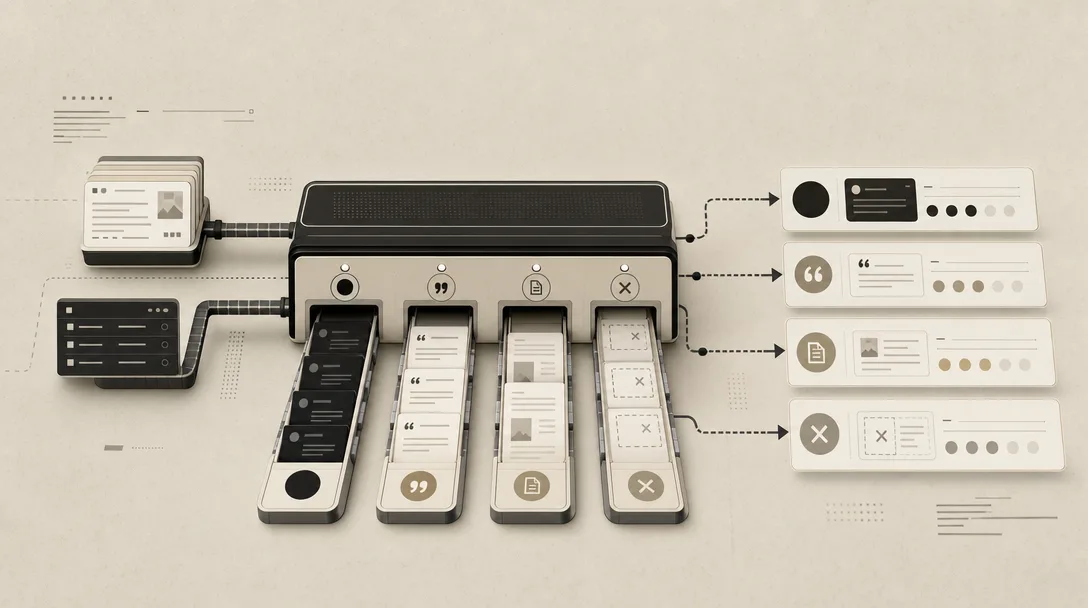
Semrush organizes AI visibility into about a dozen metrics, and they fall cleanly into four decision categories: presence, positioning, source attribution, and segmentation.
Presence metrics answer "are we in the answer at all?" These are AI Visibility Score (a 0–100 benchmark), Mentions, and prompt position. Semrush positions visibility as the threshold question: for a target prompt, does the brand get named.
Positioning metrics answer "when we appear, how do we look?" Share of voice, sentiment, and recommendation context live here. According to Semrush's own LLM visibility case study, citations alone did not prove positioning because LLMs could cite Semrush content while still recommending competitors — which is why share of voice exists as a separate metric.
Source attribution metrics answer "is our content the citation, or is someone else's?" Cited Pages, Owned Sources, and Topics & Sources show whether your URLs are the ones LLMs pull from, or whether a competitor's blog, a Reddit thread, or a third-party listicle is doing the work for you.
Segmentation metrics answer "where and on what model?" Distribution by LLM and Mentions by Country break the data down by ChatGPT vs. Gemini vs. Google AI Mode, and by region.
| Metric | Question it answers | Limit |
|---|---|---|
| AI Visibility Score | Overall benchmark vs. category | Aggregate; obscures per-prompt variance |
| Mentions | How often you're named | Doesn't measure recommendation strength |
| Cited Pages | Which URLs LLMs pull from | Citation ≠ endorsement |
| Share of Voice | Positioning when mentioned | Sensitive to prompt set |
| Distribution by LLM | Per-model performance | Coverage varies by platform |
| Sentiment | Tone of mentions | Model-interpreted; volatile |
Is Being Cited by an LLM the Same as Being Recommended by an LLM?
No. A citation means an LLM pulled text or a link from your page to support an answer. A recommendation means the LLM is telling the user to choose you. These two things often diverge, and Semrush's own team documented the gap.
In its internal case study, Semrush reported that LLMs were citing its blog content hundreds of times even while blog traffic declined — and yet, in the same period, those LLMs were still recommending competitors when users asked which tool to buy. The citation was happening at the research layer. The recommendation was happening at the decision layer. Different mechanics, different signals.
This is why Semrush settled on two core metrics rather than one: visibility (does the brand get mentioned at all for target prompts) and share of voice (how is the brand positioned when it is mentioned). Cited Pages tells you the LLM trusts your content as a source. Share of voice and recommendation context tell you the LLM trusts your brand as an answer.
If your AEO, GEO, and LLMO program optimizes only for citations, you can win the source race and still lose every shortlist. The remediation is different too: citations come from page structure, schema, and answer-shaped content. Recommendations come from entity consistency, third-party reinforcement, and topical authority across the whole web.
Which AI Platforms Does Semrush Cover, and Where Is Coverage Limited?
Semrush's AI Visibility Toolkit reports coverage across ChatGPT, Gemini, Google AI Mode, Google AI Overviews, and Google Search through Position Tracking. That is a strong Google-and-OpenAI footprint. The honest gap is in standalone answer engines: an independent comparison from ai-search-tools.com characterizes Semrush as primarily Google-centric and less complete than dedicated GEO platforms when it comes to Perplexity and Claude as standalone surfaces.
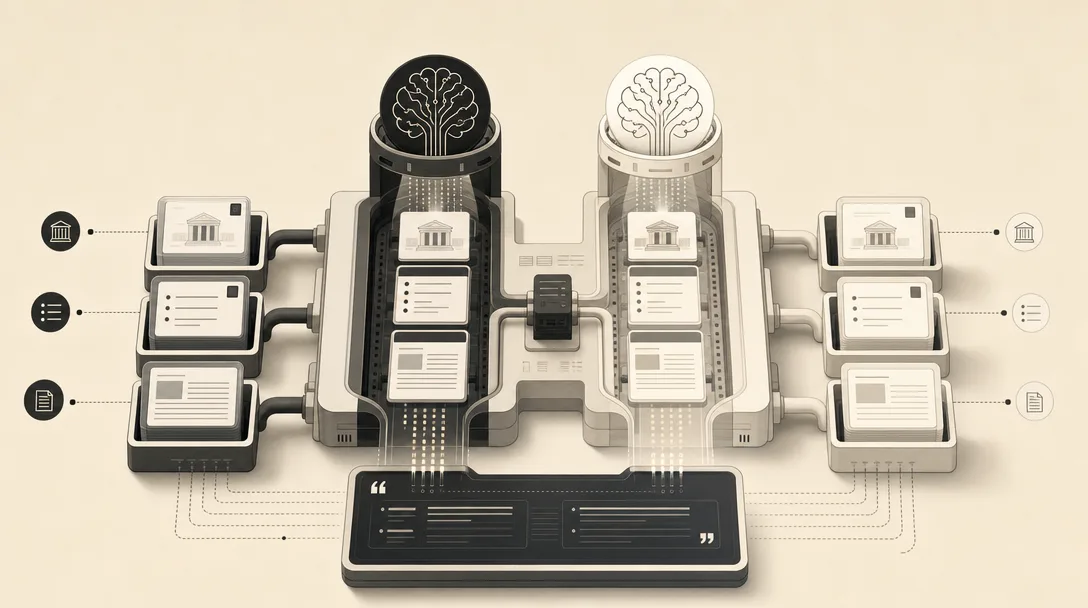
The deeper finding from Semrush's own AI Visibility Index is more important than the coverage list. According to Semrush, ChatGPT and Google AI Mode agreed 67% of the time on which brands to mention, but only 30% of the time on which sources to use. The brand consensus is moderately stable across models. The source consensus is not.
The operating implication: a single content asset will not earn citations across every model. You need model-specific source strategies — what gets cited in ChatGPT often will not be the same URL Gemini pulls. That is true even when the answer names the same brand.
| Platform | Semrush coverage | Notes |
|---|---|---|
| ChatGPT | Tracked | Strongest in Visibility Overview, Brand Performance |
| Google AI Overviews | Tracked | Position Tracking integration |
| Google AI Mode | Tracked | Average AI Mode position, owned sources |
| Gemini | Tracked | Distribution by LLM segmentation |
| Perplexity | Limited / partial | Independent reviewers note thinner coverage |
| Claude | Limited / partial | Standalone answer-engine coverage less mature |
| Microsoft Copilot | Limited | Bing-driven; check current toolkit notes |
How Do You Find AI Visibility Gaps With Semrush?
Semrush surfaces five gap types, and each one points to a different editorial decision.
- Prompt gaps — prompts where competitors get mentioned and you do not. Found in Prompt Research and Visibility Overview. Decision: net-new content or entity reinforcement.
- Topic gaps — categories where your topical authority is thin. Found in Topic Opportunities and Topics & Sources. Decision: cluster build or programmatic SEO expansion.
- Source gaps — third-party domains cited about your category that don't mention you. Found in Owned Sources vs. competitor cited pages. Decision: digital PR, guest contribution, or directory inclusion.
- Competitor gaps — head-to-head deficits across mentions, citations, and topic coverage. The Competitor Research report compares against up to four competitors. Decision: targeted content offensives.
- Narrative gaps — themes where competitors own the framing. Decision: original research, opinionated POV content.
The Free AI Brand Visibility Tool sits one layer up from this and, per Semrush, can show whether competitors appear 3–5x more often in AI recommendations than you do. That is a triage signal, not a workflow.
The trap most teams fall into: they export a 200-row gap list, assign articles round-robin, and ship templated content that doesn't move share of voice. The gap type has to map to the remediation type, or the work compounds slowly.
How Accurate Is Semrush's AI Visibility Toolkit?
Accurate enough for directional decisions, not accurate enough to treat as ground truth. That is the honest answer, and it is also the question Reddit users keep asking in r/seogrowth threads about the toolkit.
Semrush says Semrush One tracks AI visibility across 239M+ prompts, which is a meaningful sample and explains why the data is useful for benchmarking and trend reporting. According to Semrush's 2025 AI Visibility Index update covering August, September, and October 2025, 25 new brands entered the top 100, mostly in lower positions — the kind of movement detection that requires large prompt volume to be credible.
The limits are structural, not Semrush-specific:
- Model volatility. LLM responses change between sessions and across model updates. Two runs of the same prompt can return different brands.
- Sampling choices. A prompt set defines what gets measured. Different prompt sets produce different visibility scores for the same brand.
- Region and persona. Answers vary by location, account history, and inferred user type.
- Freshness lag. Models update on their own cadence; the data Semrush shows reflects when prompts were run, not real-time state.
Use Semrush AI visibility data as a planning signal, not a source of absolute truth. Compare yourself to your own trend line and to a stable competitor set, and don't over-index on month-to-month moves of a few points.
How Do You Grow AI Visibility After Semrush Finds a Gap?
This is where most teams stall, because the diagnostic layer ends and the operating layer begins. A prompt gap doesn't fix itself. Here is the playbook for converting Semrush signals into shipped work.
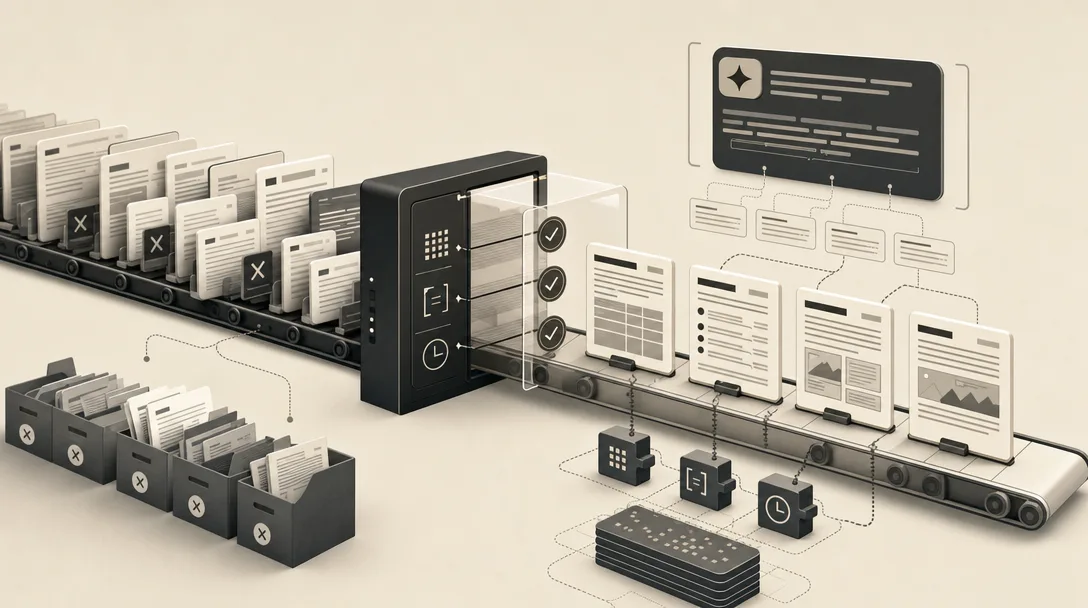
Step 1: Classify the gap. Use the table below to route each gap to the right remediation. Don't treat them all as "write a new article."
| Gap type | Right remediation | Wrong remediation |
|---|---|---|
| Prompt gap, no relevant page | Net-new article, answer-shaped | Refresh an unrelated page |
| Prompt gap, page exists but thin | Archive refresh, add direct answer | Write a duplicate |
| Source gap (third-party citations) | Digital PR, listings, contributed posts | More owned content |
| Topic gap | Cluster build or programmatic SEO | One-off article |
| Competitor cited, you're not | Entity reinforcement, schema, refresh | Net-new from scratch |
| Technical (AI Search Health flag) | Crawler access, schema, structure | Content work |
Step 2: Audit technical access. Run Site Audit's AI Search Health check before writing anything. Per Semrush, AI Search Health can reveal blocked crawlers or poor content structure that prevents AI platforms from finding and using your content. Writing more content into a broken pipe is wasted work. Pair this with a current llms.txt file — see What Is LLMs.txt in 2026? The AI Crawler File Explained.
Step 3: Format for citation. Citation-ready pages share traits: a direct answer in the first 1–2 sentences under each heading, named entities on first mention, attributed statistics, numbered steps for processes, and a sharp summary sentence per section that an LLM can lift verbatim. This is the AEO and GEO formatting layer covered in What Is AEO in 2026? and What Is GEO in 2026?.
Step 4: Refresh the archive on a cadence. Semrush reported lifting its own share of voice from 13% to 32% in one month for target prompts after applying a systematic LLM visibility approach — and that work is overwhelmingly refresh-driven, not new-publication-driven.
Step 5: Ship through your CMS, not around it. A gap closed in a Google Doc is not closed. The work has to land in production with the right schema, internal links, and entity markup intact.
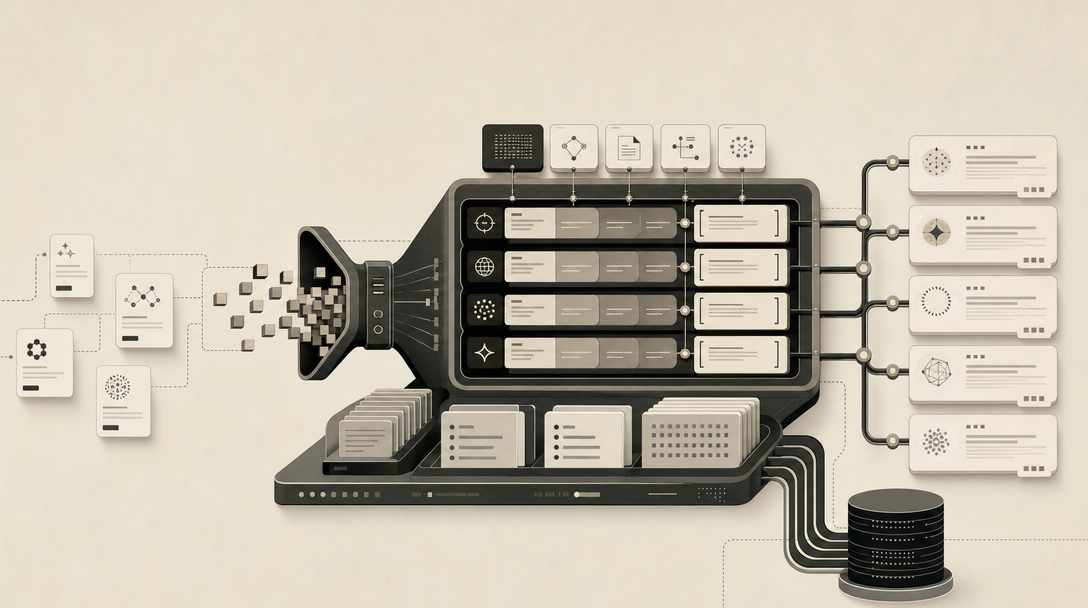
This is the layer Mentionwell is built for as a content engine: ingest prompt and topic gaps, generate citation-shaped drafts grounded in research, enforce site-profile templates across AEO, GEO, LLMO, and SEO, and publish into existing CMS or headless stacks. The Semrush dashboard tells you the gap exists. A governed publishing pipeline closes it on a repeatable schedule.
When Is Semrush Enough, and When Do You Need a Dedicated GEO, AEO, LLMO, or Content Operations Layer?
Semrush is enough when the work is measurement, executive reporting, competitor discovery, and prompt-level monitoring. You need a separate operating layer the moment the work shifts to producing, governing, and refreshing content at scale.
| Situation | Semrush alone | Add an operating layer |
|---|---|---|
| Monthly board report on AI visibility | ✓ | — |
| Competitor benchmarking | ✓ | — |
| Identifying prompt and topic gaps | ✓ | — |
| Writing citation-shaped articles | — | ✓ |
| Refreshing 200+ archive URLs on cadence | — | ✓ |
| Programmatic SEO with editorial QA | — | ✓ |
| Multi-domain agency publishing | — | ✓ |
| Enforcing brand templates across sites | — | ✓ |
| CMS / headless publishing pipelines | — | ✓ |
The framing question is simple: are you measuring a channel or operating one? Semrush measures it well. Operating it requires editorial rules, content templates, refresh schedules, CMS delivery, and a clear taxonomy of AEO, GEO, LLMO, and SEO work. For the taxonomy choice, AEO vs GEO vs LLMO: Which Workflow Fits Your Team? walks through how to pick a workflow before you tool up. For the broader playbook, What Is AI SEO in 2026? covers how the four disciplines fit together.
The cleanest configuration most operator teams land on: Semrush for diagnostics and reporting, a dedicated content engine for production, and a defined handoff between the two so gap signals turn into briefs, briefs turn into drafts, and drafts ship into the CMS without human bottlenecks.
How Should Agencies Turn AI Visibility Data Into CMS Publishing and Refresh Workflows?
Agencies and multi-site operators face a different problem than single-brand teams. The Semrush data scales linearly with the number of clients, but the editorial pipeline behind it usually does not. The fix is to industrialize the handoff.
A repeatable agency workflow looks like this:
- Site profile per client. Brand voice, audience, painpoints, competitors blocked, CTA rules, internal link inventory. This is the contract every brief is built against.
- Prompt-gap queue from Semrush. Pull Visibility Overview, Brand Performance, and Cited Pages exports weekly per client. Tag each row with gap type (prompt, topic, source, competitor, narrative).
- Editorial routing rules. Map gap type to action: net-new, refresh, entity reinforcement, technical fix, or PR push.
- Templates with QA. Article templates that enforce direct-answer openings, citable phrases, named entities, attributed stats, and schema. Programmatic SEO at scale fails without this.
- CMS or headless delivery. Push directly to WordPress, Webflow, Sanity, Contentful, or whatever the client runs. No copy-paste handoffs.
- Refresh cadence. Quarterly archive sweeps tied to AI Visibility Score movement. Pages that lose citations get re-shaped first.
- Reporting that triangulates impact. Combine visibility, share of voice, AI referral traffic, conversions, citations, and assisted-pipeline evidence.
That last point is the hardest reporting question and the one Semrush flagged honestly: traditional attribution misses AI influence because LLMs can shape buyer perception without producing clicks. The agency case-study headline of 429% more AI referral traffic and 137% more conversions is meaningful, but the full picture also includes citations earned, share of voice gained, and pipeline that arrived already-decided. Build a dashboard that shows all five.
| Reporting layer | Source | What it proves |
|---|---|---|
| AI Visibility Score, mentions | Semrush AI Visibility Toolkit | Presence in answers |
| Share of voice, sentiment | Semrush Brand Performance | Positioning quality |
| Cited Pages, Owned Sources | Semrush + GA4 referral filter | Source attribution |
| AI referral traffic | GA4, server logs | Click-through impact |
| Assisted pipeline | CRM + self-reported source | Influence without clicks |
If you are scaling AI visibility work across multiple clients and the bottleneck has moved from "what should we write?" to "how do we ship it consistently?", that is the right time to add a dedicated content engine between Semrush diagnostics and CMS delivery. Mentionwell is built for that handoff — site profiles, prompt-gap queues, governed templates, and refresh pipelines designed for operators publishing across one site or hundreds. Get My Site GEO Optimized to see the pipeline in action.
Sources
- How Agencies Use Semrush for AI Visibilitywww.semrush.com
- How to Find AI Visibility Gaps with Semrushwww.semrush.com
- How We‘re Driving LLM Visibility at Semrushwww.semrush.com
- How to Win AI Visibility with Semrush Onewww.semrush.com