What is an AI search monitoring tool?
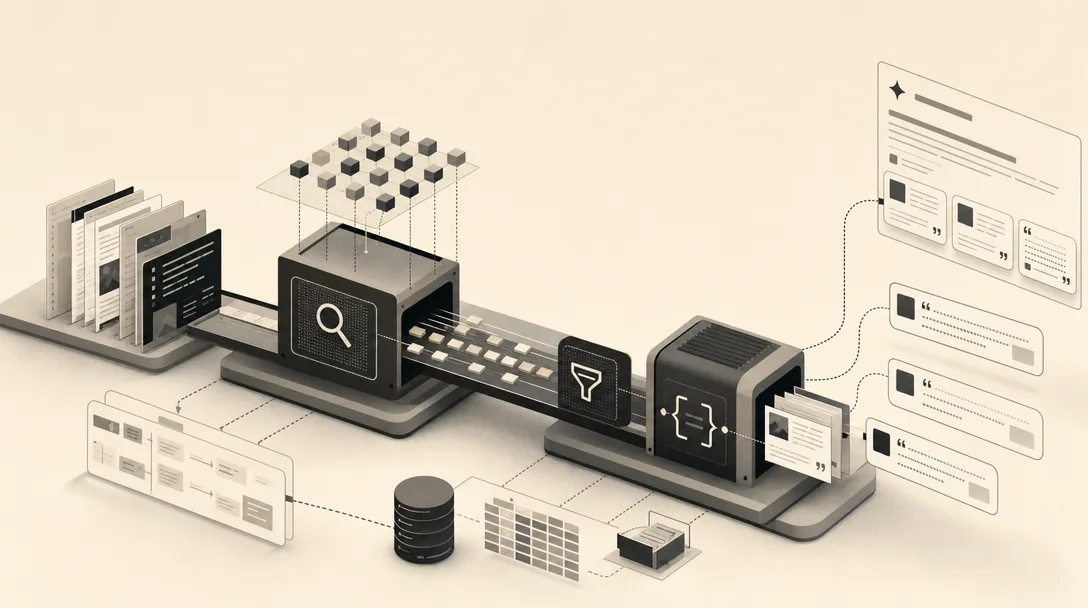
An AI search monitoring tool tracks how your brand appears in AI-generated answers across platforms like ChatGPT, Perplexity, and Google AI Overviews. It runs a predefined set of prompts and topics on a repeating schedule to measure brand mentions, citation frequency, sentiment, and competitive positioning over time (Source: UseOmnia). An AIO tracker is the specific version focused on AI-answer visibility rather than blue-link rank.
The reason teams need one is that classic analytics stops at the click, and AI answers increasingly remove the click. Gartner projects traditional search traffic will decline 25% by 2026 as engines answer questions directly on the results page (Source: UseOmnia). SEO pros who rely only on blue-link tracking miss roughly 60% of no-click searches now handled by AI Overviews.
That creates a measurement gap. When a prospect asks "best [solution] for [use case]," these engines return a narrative answer citing 3-5 brands (Source: UseOmnia). If you are not on that shortlist, you are invisible to a growing segment of buyers, and your rank tracker will show nothing wrong. An AIO tracker exists to see the answer itself, not the page it replaced.
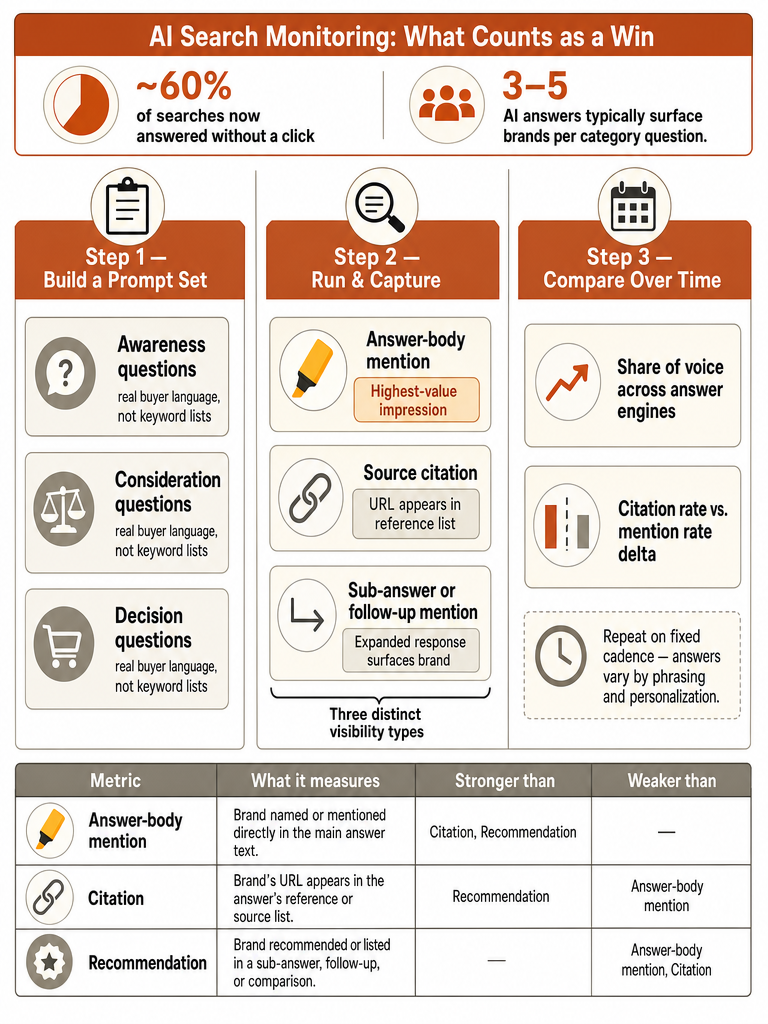
What should count as a win in an AIO tracker: answer-body mention, citation, or both?
Both count, but they measure different visibility, and the answer-body mention is the higher-value signal. AuditAE describes a named mention inside the answer body as the highest-value impression, because the user reads your brand as part of the recommendation whether they click or not. A citation matters because it can drive a click and shows which URL earned inclusion.
AI engines surface brands in three distinct ways (Source: AuditAE):
- Answer-body mention — your brand name appears inside the generated text, often as a recommendation.
- Source-list citation — your URL is listed as a reference the engine drew from.
- Sub-answer or follow-up mention — your brand appears when the user expands a topic or asks a follow-up.
A useful frame from the SaaS side separates outcomes by function: mentions create awareness, recommendations influence decisions, and citations create authority (Source: Medium / Write A Catalyst). A brand can be cited as a source without being named in the answer, and it can be named without being cited. Tracking only one of these overstates or understates real visibility.
AIO tracker vs AI Overviews tracker vs AEO, GEO, LLMO, and SEO measurement
An AIO tracker measures brand mentions and citations across multiple AI answer surfaces, while an AI Overviews tracker is narrower — it watches only Google's AI Overviews feature. The two get blurred in most tool roundups, but they answer different questions: one is engine-agnostic, one is Google-specific.
The acronyms around this space describe optimization disciplines, not the tracking layer itself. Each maps to a different surface and metric, which is why collapsing them into "AI SEO" loses precision.
| Term | What it optimizes for | What a tracker measures |
|---|---|---|
| AEO | Being quoted in answer engines | Answer-body mentions, direct-answer inclusion |
| GEO | Citations in generative engines | Source-list citations, share of voice |
| LLMO | Being surfaced by large language models | Mentions and recommendations across models |
| SEO | Ranked links and clicks | Keyword position, organic traffic |
The distinction matters for reporting. Traditional SEO optimizes for ranked links; AEO operates one layer up, where the engine produces a single synthesized answer. If you want the full breakdown of how these terms differ by surface and metric, see the AEO, GEO, LLMO, AIO, and AISO acronym decoder. An AIO tracker is the measurement instrument that spans several of these disciplines at once.
Which AI engines should you monitor first (ChatGPT, Google AI Overviews, Perplexity, Claude, Gemini, Google AI Mode, Copilot)?
Start with the engines your buyers actually query, which for most B2B SaaS teams means ChatGPT, Google AI Overviews, and Perplexity first, then Claude, Gemini, Google AI Mode, and Microsoft Copilot. Tracking only one platform gives an incomplete picture (Source: Medium / Write A Catalyst).
Each surface behaves differently and belongs to a different provider:
- ChatGPT (OpenAI) — heavily used for product research, comparisons, and pricing questions (Source: Medium / Write A Catalyst).
- Google AI Overviews (Google) — appears directly in search results and often replaces traditional SEO clicks.
- Perplexity — strong citation behavior, with heavy influence on technical buyers (Source: Medium / Write A Catalyst).
- Gemini (Google) and Copilot (Microsoft) — growing adoption inside the Google and Microsoft product families.
- Claude (Anthropic) and Google AI Mode — rounding out coverage where your audience skews technical or Google-native.
Prioritize by where your category's questions get asked, not by engine popularity in the abstract. A compliance-heavy buyer may live in Copilot; a developer audience may lean Perplexity and Claude. Your first baseline only needs the three or four engines your buyers use most — you can widen coverage once the workflow is stable. For engine-specific tactics, the guide to showing up in Perplexity and the Google AI Overviews citation guide go deeper than a tracker will.
How to track your brand in ChatGPT & AI search in 2026?
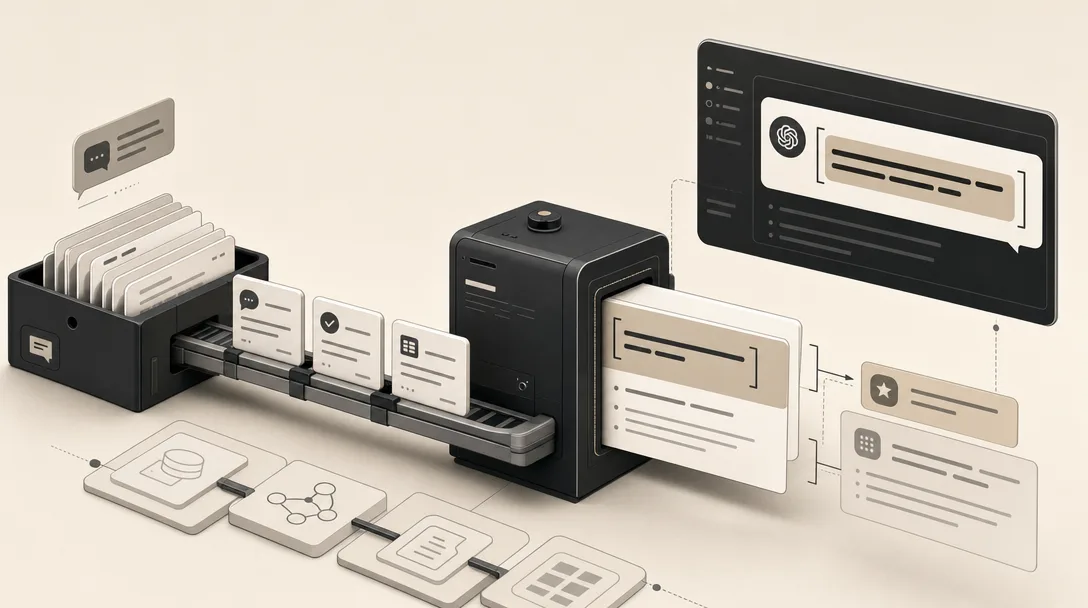
Track your brand by running a fixed prompt set against each engine, capturing both the answer text and the citations, recording competitor mentions, and comparing results across repeated runs. The method is reproducible whether you do it in a spreadsheet or a tool. Backlinko's Matt Kenyon demonstrates running this exact audit manually and for free across ChatGPT, Google AI Overviews, Claude, and Perplexity (Source: Backlinko).
The workflow breaks into six steps:
- Build a fixed prompt set. Use buyer-intent questions, not keywords. Keep the wording stable so runs are comparable.
- Run each prompt on each engine. Query ChatGPT, AI Overviews, Perplexity, and any others in scope.
- Capture the answer body. Copy the full generated text and note whether your brand is named.
- Capture the citations. Record which URLs the engine listed as sources, including whether one is yours.
- Record competitors. Log every rival brand named in the answer — AI responses are comparative, so this is the share-of-voice data.
- Diff across runs. Repeat on a schedule and compare. Trends, not single snapshots, are what matter.
Manual tracking is fine for a baseline. Automation becomes necessary once you track competitors weekly or need repeatable reporting (Source: Medium / Write A Catalyst). The audit is the diagnosis; publishing citable content is the fix — which is where a content engine built for AI search does the work a tracker can only measure.
How should you build a buyer-prompt set instead of an SEO keyword list?
Build your prompt set from real buyer questions phrased the way a person talks to an assistant, not from keyword briefs. Prompt sets for AI brand monitoring should read like buyer questions and cover awareness, consideration, and decision stages separately (Source: AuditAE). A keyword like "project management software" becomes a prompt like "what's the best project management tool for a remote engineering team?"
Structure the library by funnel stage:
- Awareness — "how do teams track brand mentions in AI search?" Broad, category-level questions.
- Consideration — "best [category] tools for [use case]" and "alternatives to [competitor]." Comparative shortlisting.
- Decision — "is [your brand] good for [specific need]?" and pricing or feature questions.
Include your competitors deliberately. Monitor 3-5 competitors in the same prompt set because AI answers are comparative — the engine ranks brands against each other, so you need their positions to read your own (Source: Medium / Write A Catalyst). Building a prompt library is the first step of manual tracking, focused on buyer-intent queries (Source: Medium / Write A Catalyst).
The prompt set is the entire measurement instrument, so a weak library produces a report that looks precise and means nothing. If you want the drafting side to match the prompts you monitor, the 7-part writer brief for AEO and GEO turns buyer questions into citation-ready structure.
How many prompts are enough for an AIO tracking baseline?
Sources put the practical baseline between 20 and 30 prompts, with manual tracking staying workable under 20 and meaningful programs running 25 to 100. The guidance conflicts slightly, and the conflict is worth reading rather than averaging.
| Source | Prompt guidance | What it's for |
|---|---|---|
| AuditAE | Under 20 prompts | Manual tracking stays practical |
| Medium / Write A Catalyst | 20-30 prompts | Starting a manual prompt library |
| AuditAE | 25 minimum; 50-100 | A meaningful monitoring program |
The reconciliation is about mode, not disagreement. AuditAE says manual, spreadsheet-based tracking works under 20 prompts because you are running each by hand across engines (Source: AuditAE). Above that, the labor stops scaling — which is why AuditAE also says a meaningful program starts at 25 prompts and often runs 50-100, and prices its automation at $0.05 per prompt × engine check (Source: AuditAE). The Medium guide's 20-30 range is the sensible starting library before you decide whether to automate (Source: Medium / Write A Catalyst).
A practical path is to start with 20-30 prompts by hand to learn your category, then automate at the 25-100 range once you need weekly competitor diffs. The number is a function of how many engines and competitors you track, not a fixed target.
How do you separate brand mentions from source links?
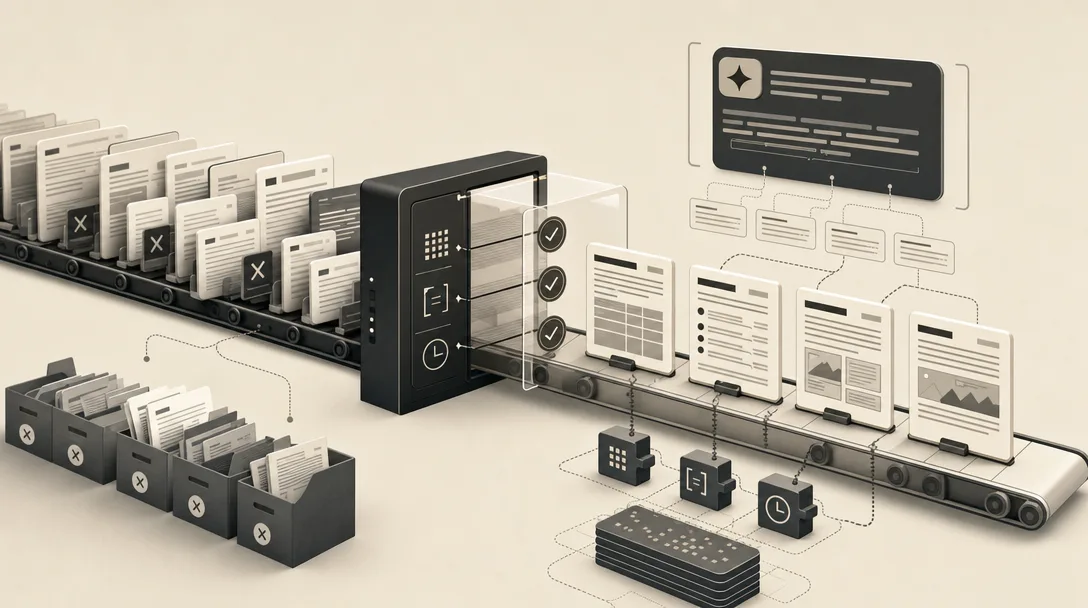
Separate them by classifying every result into distinct types before you count anything, because a source link and an answer-body mention are not the same visibility. AI engines surface brands as answer-body mentions, source-list citations, and sub-answer or follow-up mentions — three different impressions that should never be summed into one "visibility" number (Source: AuditAE).
Log each result against these categories:
- Answer-body mention — brand named in the generated text. Highest-value impression (Source: AuditAE).
- Cited URL — your page appears in the source list, whether or not the brand is named.
- Sub-answer mention — brand appears only on expansion or follow-up.
- Recommendation language — the engine actively suggests your product, not just lists it.
- False positive — a same-named company, a generic word match, or a misattributed citation.
The false-positive column is what most vendor dashboards skip. AI models can hallucinate citations, so you have to verify that a "citation" is real and points to your content before you count it. Recording these types separately prevents the inflated visibility reporting that comes from treating a footnote link and a named recommendation as equal.
How often should I monitor AI Overviews?
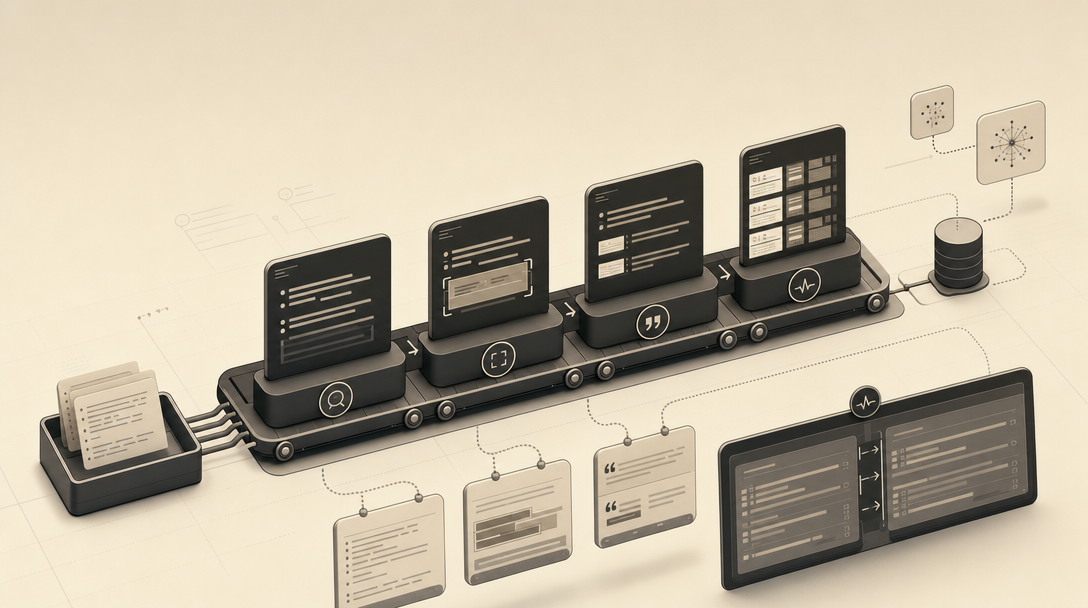
Monitor AI Overviews weekly for citation and share-of-voice tracking, which catches AI-answer volatility without generating daily noise. AIO Mapper re-checks pages about weekly so teams can watch share of voice trend over time and test whether content changes affect AI citations (Source: AIO Mapper). AI search monitoring tools typically run predefined prompts daily or weekly to measure mentions and citations over time (Source: UseOmnia).
Weekly is the sweet spot for a specific reason: AI answers vary with phrasing, personalization, and source selection, so a daily cadence mostly captures that variance rather than real movement (Source: UseOmnia). A weekly diff on a stable prompt set separates signal from noise. When you ship a content change, weekly re-checks let you attribute — or rule out — its effect on citations.
One week's answer is a sample; share of voice across weeks is the metric that matters. For lower-priority prompts, a monthly cadence is defensible; reserve tighter checks for the category-defining questions where 3-5 brands compete for the answer (Source: UseOmnia).
Do all keywords trigger AI Overviews?
No — not every keyword produces an AI Overview, which is why an AIO tracker cannot assume one exists for every query. Google AI Overviews appear for some searches and not others, so trigger detection is a separate measurement from mention or citation tracking. SE Ranking, for example, lists AI Overview trigger detection as a distinct feature alongside brand-mention and website-link tracking (Source: Social Cat).
This splits your data into layers that need separate treatment:
- Trigger detection — does this query surface an AI Overview at all? If not, there is nothing to measure there.
- Cached AIO text — capturing how your brand and competitors are presented inside overviews that do fire. Trackers analyze cached AIO texts for exactly this (Source: Social Cat).
- Prompt coverage — for conversational engines like ChatGPT and Perplexity, you monitor prompts, not keywords, because there is no fixed SERP feature to trigger.
- Classic SERP data — the blue-link ranking that still exists underneath and needs its own tracker.
The takeaway for reporting: an AIO tracker measures a probabilistic, conditional surface. A keyword with no AI Overview is not a failure to be visible — there is simply no answer block for that query. Conflating "no AIO fired" with "we lost visibility" corrupts the report.
Will tracking AI Overviews replace traditional rank tracking?
No — AI-answer monitoring and classic rank tracking measure different things and work as complements, not substitutes. Traditional rank trackers tell you where you sit on a results page; they say nothing about whether ChatGPT recommends you or whether Perplexity cites your guide (Source: Frase). An AIO tracker fills that gap without making rank data obsolete.
The two answer different questions:
| Capability | Rank tracker | AIO tracker |
|---|---|---|
| Measures | Fixed keyword position | Probabilistic answer mentions and citations |
| Surface | Blue-link SERP | ChatGPT, AI Overviews, Perplexity, and more |
| Output | Rank number over time | Mention type, citation rate, share of voice |
| Blind spot | No-click AI answers | Traditional organic clicks |
AEO, GEO, LLMO, and SEO metrics belong side by side. AIO Mapper returns separate SEO and AI Visibility scores in every audit precisely so teams can tell classic search performance apart from AI-answer readiness (Source: AIO Mapper). The disciplines reinforce each other — SEO signals like crawlability and authority still feed which pages AI engines can retrieve and cite. Rank tracking protects the clicks you still get; AIO tracking protects the answers you increasingly don't.
What are the best tools for tracking brand mentions in ChatGPT?
Judge AIO trackers by methodology — engine coverage, prompt handling, and how they classify mentions versus citations — rather than by vendor ranking, because the category's real weak spot is measurement quality, not feature count. Match the tool to the job you actually need: monitoring citations, optimizing content, or attributing revenue are three different problems, and few tools do all three well.
Named options in the corpus, with sourced starting prices:
| Tool | Starting price | Notes from source |
|---|---|---|
| Keyword.com (AI plan) | $24.5/month | AI Overviews tracking (Social Cat) |
| Otterly AI | $29/month | AI Overviews tracking (Social Cat) |
| Rankscale AI | €20/month | AI Overviews tracking (Social Cat) |
| HubSpot | $45/month | AI visibility, sentiment, share of voice, AEO recommendations (Social Cat) |
| Profound AI | $99/month | Answer-engine insights, agent analytics, prompt volume (Social Cat) |
| SE Ranking | $119/month | AI Overview trigger detection, brand mentions, link tracking (Social Cat) |
Other tools named across the corpus include AIO Mapper, AuditAE, Frase, Semrush AI Toolkit, seoClarity, Peec AI, Writesonic, and Bright Data. There is also an open-source route: the GEO/AEO Tracker GitHub project describes itself as self-hosted at $0/month, tracking a brand across 6 AI models using Bright Data's AI Scraper API (Source: GEO/AEO Tracker GitHub).
Most of these stop at the alert — they tell you which answers you're losing without writing the pages that win them back. That publishing gap is what a citation-shaped content engine closes: Mentionwell runs a research-grounded pipeline across AEO, GEO, LLMO, and SEO so the visibility a tracker measures actually has content behind it. For the tradeoff between a monitoring dashboard and a publishing engine, compare how Peec tracks the score while Mentionwell changes it.
Ready to close the publishing gap a tracker only measures? Get My Site GEO Optimized.
Sources
- AI Search Monitoring Tools 2026: The Best Platforms to Track ...www.useomnia.com
- Best Google AI Overviews Tracking Tools to Try in 2026thesocialcat.com