How do you turn support FAQs into pages ChatGPT will quote?
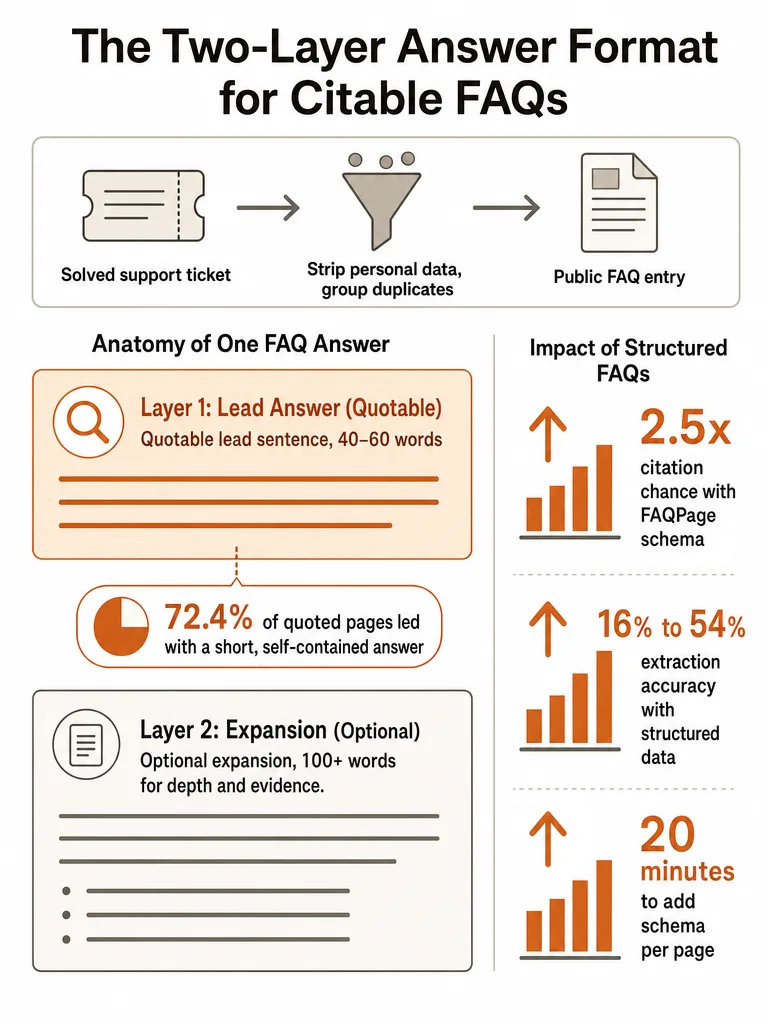
Turning support FAQs into pages ChatGPT will quote means rewriting solved tickets as self-contained question-and-answer pairs, each led by a short, quotable answer. Mike Khorev's 2026 citation analysis found that 72.4% of ChatGPT-quoted pages carried a self-contained answer near the top of the relevant section, the exact shape a well-built support FAQ already has.
That's not a coincidence. Khorev's explanation of the retrieval mechanism behind it is simple: a large language model doesn't read a page top to bottom the way a person does. It retrieves passages, and a question followed by a tight two-sentence answer is already the chunk the model wants, a self-contained unit with the query in the heading and the answer sitting right underneath. Wikipedia, Stack Overflow, and Quora dominate AI citations across every platform for the same reason, according to Henry David Photography's review of AI Overview citation patterns: all three structure content as question-and-answer pairs.
A guessed FAQ doesn't earn the same treatment. If the answer just restates what ChatGPT would generate on its own, there's no reason for the model to cite the page instead of answering from memory. This is also where the terms matter separately: a citable support FAQ is doing AEO work (owning the direct answer) and GEO work (earning the citation itself) at once, on top of whatever classic SEO ranking the page already has. They're complementary jobs, not one collapsed discipline.
Which support questions are worth publishing as public FAQ entries?
A support question earns a public FAQ entry when real customers ask it repeatedly and the answer holds true for anyone, not just one account. Pull candidates from solved-ticket exports and chat transcripts across helpdesk tools such as Intercom Fin, Zendesk AI, and Forethought, then cross-check them against query fan-out, the narrower sub-questions an AI engine silently generates before it answers.
Keep that source pool separate from a tool like CustomGPT. CustomGPT is a bring-your-own-knowledge chatbot that answers from a curated knowledge base you build; it doesn't generate the raw ticket transcripts you're mining for recurring questions, so treat it as a place to publish the finished FAQ, not a source of candidate questions.
Filter out anything tied to a specific account: billing disputes, order-specific troubleshooting, or a one-off bug already patched. What's left is the recurring, product-level question that shows up across unrelated customers.
A full week of tickets is usually enough to start. HowToAI's workflow guide for support-derived FAQs notes that repeat questions cluster fast, and a question worth publishing will often show up several times inside a single seven-day export.
How do you convert a solved ticket into a clean, citable question?
Converting a solved ticket into a citable FAQ entry takes five steps: export, scrub, group, rewrite, and verify. Each step strips the ticket of anything account-specific and reshapes it into a question-and-answer pair a stranger could land on from a search engine and understand without context.
- Export solved tickets from the period you want to cover, a week or a month depending on volume.
- Strip personal data, account numbers, and any internal-only links or tool names a customer never sees.
- Group near-duplicate questions into one entry; five tickets asking the same thing five different ways become one FAQ pair.
- Rewrite each question in the customer's own phrasing, not internal shorthand, so it matches what someone would actually type into ChatGPT or Google.
- Verify the answer against current docs and live product behavior before it goes live, since a ticket resolved months ago may describe a workflow the product no longer uses.
Call transcripts from Gong, Fathom, or Chorus are a useful secondary source for the same exercise: sales and customer-success calls surface the same recurring questions, often in even more natural phrasing than a typed ticket.
How long should a ChatGPT-citable FAQ answer actually be?
There's no single correct answer length because the corpus splits on it. Mike Khorev's citation research argues for a 40 to 60-word answer, while Henry David Photography's schema guide argues for a 134 to 167-word answer. The fix is to stop choosing one and write both: a short lead sentence an engine can quote whole, followed by an optional expansion that carries the detail a short answer can't.
Put the short answer first, directly under the question, with no throat-clearing in front of it. That's the passage most likely to get lifted verbatim, and it matches the self-contained shape Khorev measured in his 72.4% figure.
Then add an expansion underneath, roughly 100 words or more, for the reader who needs the detail: a caveat, a step, a number, an edge case. This also serves the longer passage structure Henry David Photography found AI systems retrieving when they want more than a one-liner.
Do you need FAQPage schema for ChatGPT to cite your FAQ?
No, FAQPage schema isn't a strict requirement for ChatGPT to quote a support FAQ, but skipping it leaves measurable citation odds on the table. Henry David Photography's 2026 review of AI Overview citation patterns found that content with proper FAQPage schema sees roughly a 2.5x higher chance of being cited than the same content without it.
FAQPage schema is structured data, written in JSON-LD, that explicitly labels which text on a page is a question and which text is the accepted answer. It doesn't change what a visitor sees in the browser; it adds a machine-readable tag behind the visible content so crawlers extract and attribute it correctly. The same source reports that GPT-4's accuracy interpreting page content jumps from 16% to 54% when structured data is present, and that pages carrying three to four layered schema types, FAQPage alongside Service, LocalBusiness, or BreadcrumbList, get cited at roughly 2x the rate of pages with a single schema type.
Schema is one item on a longer technical list; the AI visibility audit checklist covers the rest of what to verify before publishing.
Should a support FAQ live on its own page or inside an existing one?
A support-derived FAQ belongs as a block on a page that already ranks more often than it belongs on a brand-new stand-alone page. A stand-alone FAQ page can rank and get cited on its own, but Mike Khorev's build guide for ChatGPT-cited FAQ pages argues the higher-value move is usually to bolt a tight FAQ block onto a page that already earns traffic, so the existing ranking signal and the new citation-ready structure work together instead of starting from zero.
| Approach | What it gives you | Best use case |
|---|---|---|
| Stand-alone FAQ page | A new URL that has to earn ranking from scratch, full control over structure | A support topic broad enough to carry its own page, with no existing related page to attach to |
| FAQ block on existing page | Inherits the ranking and link signals the page already has, immediate distribution | A product page, help article, or glossary entry that already draws traffic for a related question |
For teams managing a large help center or glossary, the same logic applies to older entries; the refresh pattern in updating glossary pages for AI search citations covers how to attach a FAQ block once a page already has traffic.
How often should you refresh a support-derived FAQ?
A support-derived FAQ needs a recurring refresh, not a one-time publish, because product behavior and docs change faster than FAQ pages usually get revisited. HowToAI's support-FAQ workflow recommends a 20-minute monthly refresh built around new solved-ticket exports rather than a full rewrite.
- Pull a fresh solved-ticket export each month from the same support tool.
- Compare the new questions against what's already published on the FAQ page.
- Add entries only for genuinely new, recurring questions that cleared the same bar as the original batch.
- Update existing entries only where the product or docs actually changed underneath the answer.
- Leave everything else untouched; a monthly rewrite of the whole page is wasted effort if most entries are still accurate.
This mirrors the broader approach in refreshing old SEO posts for AI citations: update facts and structure on the same URL instead of starting over.
How do you verify a support FAQ is actually earning ChatGPT citations?
The sources available here don't offer a validated, page-level method for measuring ChatGPT citation lift, so treat any specific measurement framework for this as an internal operating approach rather than a sourced benchmark. What the research does establish is narrower but useful: Slate's 2026 review of AI Overview optimization tools notes that traditional tools like Google Search Console show rankings and clicks, not whether content is being extracted, summarized, or cited inside an AI-generated response. That gap is real and worth planning around, even without a sourced method to close it.
As an internal operating suggestion, not a research-backed procedure, most teams end up doing some version of the following:
- Separate ticket deflection from citation lift; track them as two different signals, since fewer tickets doesn't prove an AI engine is quoting the page.
- Build a fixed, repeatable set of prompts around the questions the FAQ answers.
- Run those prompts on a schedule and log whether the FAQ page, or its exact answer, shows up in the response.
- Track citation presence specifically, not just a brand mention buried elsewhere in the answer.
For the mechanics of running that kind of check without a paid tracking platform, see measuring AI citations without a $10k tracker.