What should you pay for first in AISO services?
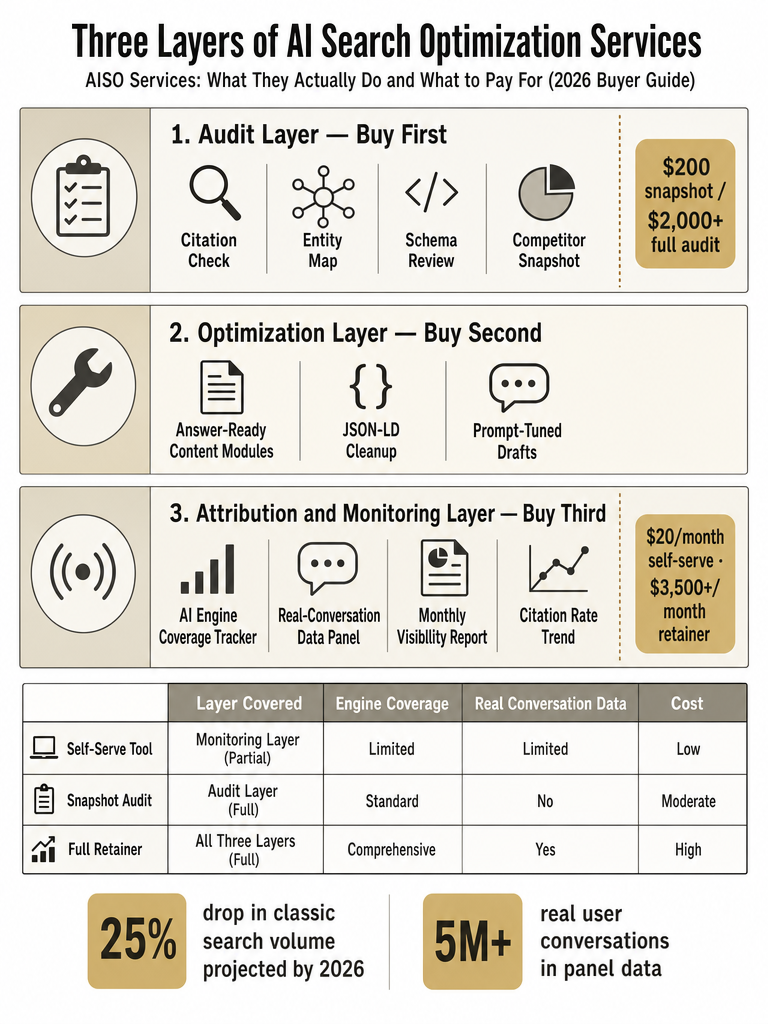
Buy diagnostic clarity before you buy ongoing work. AISO services split into three layers — audit, optimization, and attribution or monitoring — and most teams overpay because they sign a retainer before they know where their brand actually stands in AI answers. An audit tells you which engines already cite you and which competitors own the answers you want. AISOdog prices its AI Visibility Snapshot at $200, credited toward a later audit, and its full AI Visibility Audit starts at $2,000+ depending on scope.
The reason to sequence this way is money. Ongoing optimization retainers start at $3,500+ per month (Source: AISOdog), so a diagnostic that costs a fraction of one month tells you whether the retainer is even worth signing. An audit also protects your existing Google performance — you want proof a provider can improve AI citation readiness without harming rankings before it touches your archive.
Ready to see where your site stands in AI answers? Get My Site GEO Optimized.
What is AISO?
AISO is AI Search Optimization — the practice of making content discoverable, extractable, summarized, and cited by AI-powered search and answer systems. Instead of competing for a ranked link, AISO work aims to make your brand the source an AI assistant quotes when someone asks about your category. Shubham Kushwaha defines it as "structuring, writing, and presenting your content in a way that AI-powered search engines can understand, trust, and actively choose to cite."
The stakes are concrete. Cintra cites Gartner predicting traditional search engine volume will drop 25% by 2026 as AI chatbots absorb more research queries. HubSpot reports that 42% of buyers now use AI search during evaluation. When the answer replaces the results page, being understood by the model matters as much as ranking.
For a deeper definitional treatment, see what AISO means in 2026.
What is the difference between SEO and AI search optimization?
AISO layers on top of SEO rather than replacing it. Classic SEO earns rankings and clicks through crawlability, keywords, and links; AI search optimization adds citation readiness, entity clarity, extraction structure, and answer formatting so AI systems will quote your page inside a generated response. The ranking foundation still has to hold — an AI engine can't cite a page it can't crawl or trust.
Chris Abraham frames the contrast plainly: traditional SEO might repeat "best coffee shop" to rank on Google, while AISO structures content to answer conversational queries like "Where's the best place to grab a coffee near me?" in a way AI systems can relay directly. Cloro's buyer guide describes AISO as one layer up — SEO optimizes for ranked links, while an answer engine produces a single synthesized answer.
The two disciplines share source material and QA. AISO turns a page that already ranks into one an AI engine will quote. If you're mapping how the acronyms relate, the 2026 acronym decoder for AEO, GEO, LLMO, AIO, and AISO separates them by surface and metric.
AISO services vs AISO tools: what are you actually buying?
A service engagement is people doing the work; AISO the tool is software you operate yourself — and they are not interchangeable. Cintra describes AISO the product as a conversation intelligence platform built on real user AI conversations rather than synthetic prompts, launched in May 2025 as a bootstrapped company. It taps a consent-based panel of 5M+ users across ChatGPT, Gemini, and Claude, and its standout feature is fan-out analysis showing the exact Google sub-queries ChatGPT runs to build its answers.
The company behind it is getaiso.com, founded by Ben Tannenbaum with Alon Koren as CTO. Cintra lists the agency tier at $20/month with 15 tracked topics per client, plus a free trial of 3 searches and no credit card. The company claims 500+ brands and a 4.9/5 rating from practitioners. Cintra's verdict: best-in-class intent research, but not an execution platform, and it covers only ChatGPT, Gemini, and Claude.
| What you buy | AISO the tool | An AISO service |
|---|---|---|
| Core value | Conversation intelligence, fan-out data | Audit, content execution, monitoring |
| Who does the work | Your team | The provider's team |
| Entry price | $20/month agency tier | $200 snapshot / $2,000+ audit |
| Engine coverage | ChatGPT, Gemini, Claude | Up to 6 engines (AISO Hub) |
Buying the tool gets you data. Buying a service gets you data plus someone to act on it.
What does an AISO agency actually deliver?
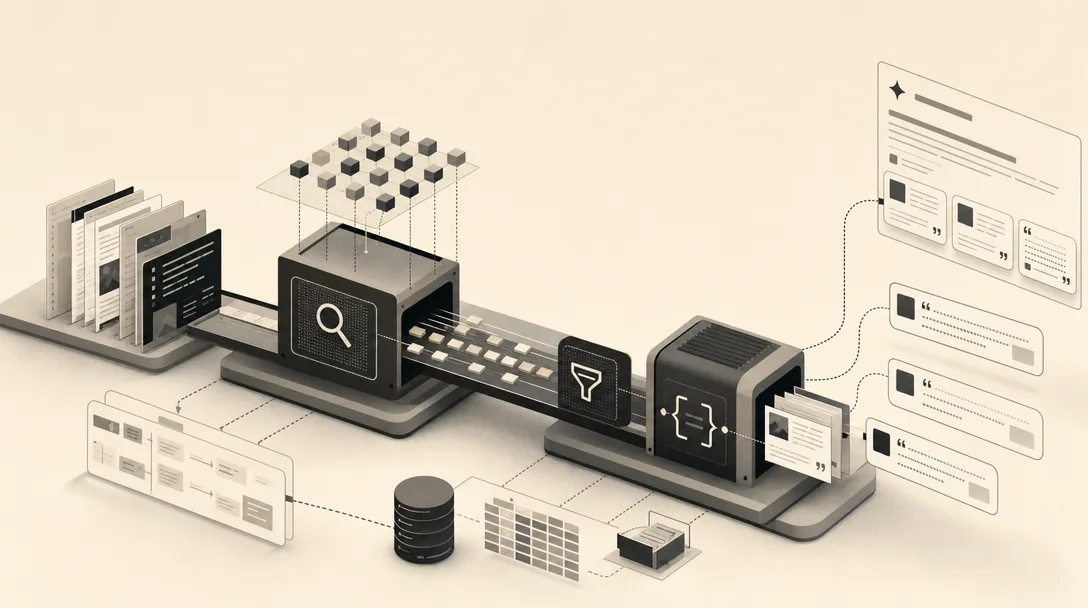
A strong AISO agency delivers four inseparable components, per AISO Hub: an AI visibility audit, entity graph governance, AI-liftable content modules, and monthly monitoring. The audit sets a baseline across engines; entity governance publishes a single canonical JSON-LD served from one source of truth to stop drift between pages and locales; content modules are FAQs, definitions, comparisons, and tables built to be cited verbatim; monitoring reports inclusion per engine and citation share against competitors.
AISOdog describes the ongoing side as monthly strategy plus AEO content optimization built to grow AI citation share and organic visibility. Beyond those four pillars, service pages commonly list schema or JSON-LD cleanup, competitor review, and prompt monitoring in their monthly reporting.
Here's the deliverables map most sources converge on:
- AI visibility audit — baseline citations, competitors, and gaps across named engines
- Entity graph governance — one canonical, versioned JSON-LD as the source of truth
- AI-liftable content modules — short, sourced FAQs, definitions, and comparison tables
- Schema and JSON-LD cleanup — structured data an AI engine can parse
- Competitor and prompt monitoring — who owns the answers you want
- Monthly reporting — inclusion per engine and citation-share evolution
If content execution is the piece you lack, see what a B2B SaaS AI search content engine actually does.
What should an AISO audit actually examine?
An AISO audit should examine citations, answer quality, competitors, prompts, schema, entities, engine coverage, and SEO-safe risk to your existing Google performance — before you sign any retainer. AISO Hub's baseline audit spans 6 AI engines — ChatGPT, Perplexity, Gemini, Microsoft Copilot, Grok, and DeepSeek — using 377+ monitored prompts, and reveals where you're already cited, where a competitor is, and where AI is giving generic answers it should be giving in your name.
The SEO-safe dimension matters most for teams with an existing archive. A credible audit shows how proposed changes preserve and reinforce current Google rankings rather than risking them. AISO Hub explicitly frames its approach as SEO-safe, where every optimization protects existing rankings.
Use this as your pre-retainer checklist:
- Citation baseline — which engines already cite you, and for which prompts
- Answer quality — is the AI describing your brand accurately
- Competitor share — who owns the answers you want
- Prompt set — how many prompts, across which engines
- Schema and entities — is your structured data parseable and consistent
- Engine coverage — which assistants are monitored, and which are missing
- SEO-safe risk — proof the work won't harm current rankings
Should you prioritize monitoring, content optimization, or attribution first?
Prioritize the job that answers your unanswered question. One buyer guide from Attrifast argues AEO tools fall into three distinct jobs — monitoring ("did AI engines cite or mention me?"), optimization ("how do I get cited more?"), and attribution ("did the cited traffic pay me?") — and that almost every vendor claims all three while almost none deliver all three to the same depth.
That framework maps cleanly to AISO service spend. If you don't know where you stand, buy monitoring or an audit first. If you already see the gaps and can't fill them, buy optimization — the content and entity work that ships citable pages. Attribution comes last and is the hardest: Attrifast says doing it properly requires a payment-processor join that a GA4 integration cannot fake.
| Job | Question it answers | Buy it when |
|---|---|---|
| Monitoring | Did AI engines cite or mention me? | You lack a baseline |
| Optimization | How do I get cited more? | You see gaps but can't ship pages |
| Attribution | Did the cited traffic pay me? | Citations exist and you must prove ROI |
Most teams over-invest in monitoring and under-invest in the optimization that actually changes the score. If you're already tracking gaps, turning visibility signals into published pages is usually the higher-leverage next move.
What does AISO cost and what do you get?
AISO pricing spans from $20/month software to $3,500+/month retainers, and the number only makes sense once you know which layer you're buying. Cintra lists the AISO tool's agency tier at $20/month with 15 tracked topics per client and a 3-search free trial. Service pricing runs higher because it includes labor.
Here's how the source-backed prices stack up:
| Offering | Type | Price | What it covers |
|---|---|---|---|
| AISO agency tier (Cintra) | Software | $20/month | Conversation intelligence, 15 topics/client |
| AISO free trial (Cintra) | Software | Free | 3 searches, no card |
| AISOdog Snapshot | Service | $200 | AI Visibility Snapshot, credited to audit |
| AISOdog Audit | Service | $2,000+ | Full AI Visibility Audit, scope-dependent |
| AISOdog retainer | Service | $3,500+/month | Ongoing strategy + AEO content optimization |
| HubSpot AEO (HubSpot) | Software | $50/month | AEO software, 28-day free trial |
The pattern is consistent across sources: cheap software gives you visibility data, mid-tier productized audits give you a diagnosis, and monthly retainers give you execution. Sources do not publish a verified market median, so treat these as reference points, not a benchmark — public detail on median AISO service pricing is limited as of this writing. A $200 snapshot and a $3,500 retainer sit on different rungs of the same ladder.
How much AI engine coverage do you need?
Engine coverage should drive vendor selection, because a tool blind to your buyers' engines can't optimize for them. Cintra flags the sharpest example: AISO the tool covers only ChatGPT, Gemini, and Claude, missing Perplexity, Microsoft Copilot, and Google AI Overviews. For a team whose buyers live in Perplexity or Copilot, that gap alone can disqualify an otherwise strong tool.
Service audits tend to cast wider. AISO Hub's baseline spans 6 AI engines — ChatGPT, Perplexity, Gemini, Microsoft Copilot, Grok, and DeepSeek. The right coverage depends on where your category's answers actually get generated, not on how many logos a vendor lists.
Decide coverage before price:
- Three-engine tools fit teams focused on ChatGPT, Gemini, and Claude buyer-intent research
- Six-engine audits fit teams that need Perplexity, Copilot, Grok, and DeepSeek in the baseline
- AI Overviews matter most for teams with heavy Google organic dependence
If a specific surface is your priority, MentionWell publishes engine-by-engine guides, including how to show up in Perplexity in 2026 and how to show up in Google AI Overviews in 2026.
When is a low-cost self-serve AISO tool enough?
A low-cost self-serve tool is enough when your job is research, not execution. Cintra's verdict on AISO the tool is direct: it's a best-in-class intent research tool at $20/month, best for agencies, freelancers, and brand strategists building content strategy from real buyer-intent data — but it's "not an execution platform." Its fan-out analysis, showing the exact Google sub-queries ChatGPT runs to build answers, is the kind of input a strategist can act on manually.
The tool becomes limiting on two fronts. First, execution: it tells you what to write, not who writes or ships it. Second, coverage: Cintra notes it misses Perplexity, Copilot, and AI Overviews, so teams reliant on those engines need something broader.
Which AEO, GEO, LLMO, and AISO tools fit each job in 2026?
The tools split by job, not by acronym — group them the way Attrifast's buyer framework does: monitoring, optimization, and attribution. Attrifast presents its comparison as "an honest, founder-tested comparison of 12 answer engine optimization tools in 2026" and warns that published AI-traffic and engine-coverage claims are often misleading, so verify vendor pages before buying.
Based on the sources in this corpus, here's where named tools land:
| Job | Tools sources associate with it |
|---|---|
| Monitoring / visibility | Profound, Peec AI, Scrunch AI, AthenaHQ, Otterly.ai, Semrush, Ahrefs Brand Radar, Meltwater, AIclicks, Evertune |
| Optimization / content workflow | Goodie, AirOps, AthenaHQ, HubSpot AEO |
| Add-ons for existing SEO users | Semrush, SE Ranking, Otterly.ai, Ahrefs Brand Radar |
| Attribution | Attrifast |
Cloro groups these into end-to-end workflow tools (HubSpot AEO, AirOps), SEO-adjacent add-ons (Semrush, Otterly.ai, SE Ranking, Ahrefs Brand Radar), and deeper monitoring platforms (Profound, Scrunch AI, Meltwater, AIclicks, Peec AI). Verify these groupings against the Attrifast and Cloro source pages before you shortlist, since vendor positioning shifts. HubSpot lists its own AEO software from $50/month with a 28-day free trial.
No single tool covers monitoring, optimization, and attribution to the same depth — assume a stack, not a savior.
For an independent read on where cheap monitoring stops short, see why cheap AI visibility is easy to find and hard to trust.
When do you need a content engine instead of an AISO dashboard?
You need a content engine when your gap is publishing, not visibility. Dashboards from monitoring vendors tell you which prompts you're missing; they don't write the citable page or refresh the outdated archive that would close the gap. Attrifast's own framework separates optimization ("how do I get cited more?") from monitoring precisely because they're different products — and optimization is where pages actually get shipped.
That's the boundary a content engine sits on. A blog engine or content engine builds citation-ready pages — the AI-liftable modules AISO Hub describes as FAQs, definitions, comparisons, and tables designed to be cited verbatim — and refreshes existing posts so answer engines can extract them. Mentionwell is one example of that execution layer: an automated blog engine that ships research-grounded articles with AEO, GEO, LLMO, and SEO built into each draft, then publishes into an existing CMS or headless stack. It handles the write-and-publish side rather than the monitoring dashboard.
If your archive is the asset, refreshing old SEO posts for AI citations is often faster than net-new production.
Want the execution layer running on your site? Get My Site GEO Optimized.
How do you choose an AI Search Optimization agency?
Choose on verifiable deliverables, engine coverage, and SEO-safe proof — not acronyms or claims. Before signing, require each agency to show the specific outputs it ships, the engines it monitors, and evidence it can improve AI citation readiness without harming existing Google performance. AISO Hub frames its entire approach as SEO-safe, where every optimization preserves and reinforces current rankings — make that a hard requirement, not a bonus.
Run every provider through this checklist:
- Clear deliverables — audit, entity governance, content modules, and monitoring named explicitly, per the four-component model
- Engine coverage — which assistants are tracked; confirm Perplexity, Copilot, and AI Overviews if your buyers use them
- Prompt methodology — how many prompts, how selected; AISO Hub's baseline uses 377+ across 6 engines
- Source-backed reporting — inclusion per engine and citation share against competitors, not vanity metrics
- Content execution plan — who writes and ships the citable pages
- SEO-safe method — proof current rankings are preserved
Because attribution is the weakest link across the category — Attrifast says proper revenue attribution needs a payment-processor join a GA4 integration can't fake — don't let a vendor's ROI dashboard substitute for its content and audit evidence.
How AEO, GEO, LLMO, and SEO fit into an AISO services brief
A good AISO services brief aligns four layers on one page: AEO direct answers, GEO citation signals, LLMO entity clarity, and SEO foundations. AEO structures the liftable answer at the top of each section; GEO adds the sourced signals that make an AI engine trust and cite the page; LLMO governs the entity and schema clarity that keeps your brand consistent across engines; SEO keeps the page crawlable and ranking so it's eligible to be cited at all.
Keep them distinct in the brief rather than collapsing them into "AI SEO." Each maps to a different deliverable and a different check.
- Start with the AEO, GEO, LLMO, AIO, and AISO acronym decoder so everyone uses the terms the same way
- Use the 7-part writer brief template for AEO and GEO to turn the brief into drafts
- Fold in archive refresh work for AI citations so existing URLs earn citations without a rebuild
Brief for all four jobs on one page, and your service scope stops being a mystery to price.
Sources
- 2026 Buyers Guides for AI and Data Platforms - ISG Researchresearch.isg-one.com
- Optimize for AI Search with Advanced AISO Serviceschrisabraham.com
- AI Search Optimization Agency in Portugal — 2026aiso-hub.com
- What is AI Search Optimization (AISO)? The Future of SEO ...shubhamkushwaha.com