What should SaaS teams standardize in programmatic SEO templates?
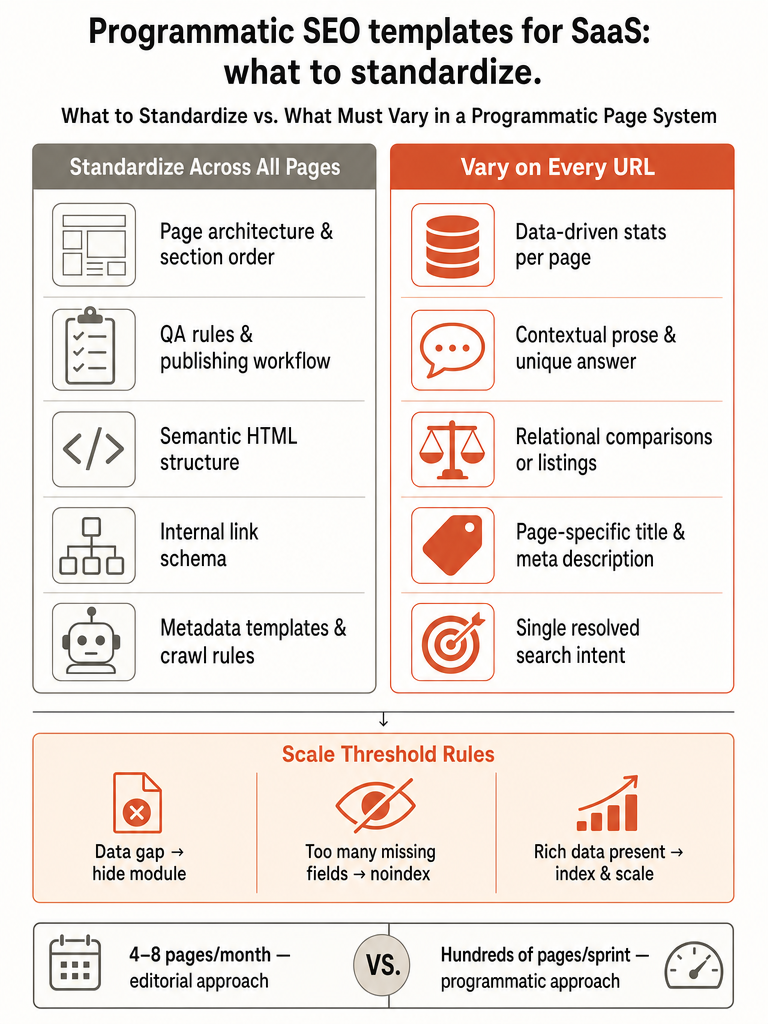
Standardize structure, not uniqueness. In a SaaS programmatic template, the fixed layer is page architecture, publishing workflow, and QA rules; the variable layer is page-specific data, contextual prose, and relational comparisons. SEOGraphy states every template needs at least three distinctly different uniqueness vectors: a data-driven stats block, a contextual prose section, and a relational comparison or listing. Digital Applied puts the floor at 300+ words of real content per programmatic page.
The mistake most teams make is inverting this. They keep the prose fixed and swap only a keyword, which produces the boilerplate Google filters as spam. Digital Applied is blunt about the line: template quality determines whether pages rank or get filtered, and copy-paste boilerplate with only data swapped will not rank.
So the standardized layer should cover the parts that benefit from consistency: the semantic HTML skeleton, the required section order, metadata patterns, internal-linking rules, and a go/no-go check before any URL ships. Keep those uniform across the whole set, and brand messaging stays consistent by default (Source: Contensify).
The variable layer carries the value: the numbers, the named comparisons, and enough contextual copy to answer one search intent per URL. Standardize the frame, then let the data and the answer differ on every page.
When should SaaS companies use programmatic SEO?
Use programmatic SEO when you have structured, repeatable data that varies meaningfully across the keyword variations you want to target. Digital Applied frames the decision this way: the pivot point is whether your dataset differs enough page to page to make each URL genuinely useful. If the data is shallow or the template too repetitive, the same source warns you get thin, duplicate, or low-value pages.
The keyword pattern is the second signal. Americaneagle.com notes programmatic SEO works best for keyword sets with repeatable patterns, such as head terms combined with modifiers like {integration}, {use_case}, {industry}, or {competitor}. If your buyers ask thousands of specific questions that follow one grammar, a template can answer them at a scale no manual team matches.
Rocket Reach built most of its organic acquisition on this model, ranking for roughly 4.5 million keywords and driving close to a million organic visitors per month from a few seed patterns like name-plus-phone and email-format queries (Source: Rock The Rankings).
Skip programmatic production for anything that needs original expertise. Digital Applied is clear that tutorial-style content requiring genuine judgment does not suit templated generation. Reserve those for editorial.
If you can't point to a structured dataset that changes per URL, you don't have a programmatic program yet, you have a spam risk.
Which SaaS page types make strong programmatic SEO templates?
The strongest SaaS template candidates map to bottom-of-funnel search demand: integration directories, comparison pages, alternative lists, and industry or use-case pages. Discovered Labs identifies the proven B2B patterns as aggregator lists, comparison matrices, integration directories, and local pages. Digital Applied reports Zapier ranks for over 40,000 keywords on a single [App A] + [App B] integration template.
Each type earns its scale from a distinct data source. Here is how the common SaaS classes line up.
| Template type | Data source | Search intent | Real example |
|---|---|---|---|
| Integration directory | Product/API catalog | "connect X with Y" | Zapier app pairings (Source: Digital Applied) |
| Comparison matrix | Competitor feature/pricing data | "X vs Y" | G2 versus pages (Source: Digital Applied) |
| Aggregator list | Curated entity lists | "best X for Y" | Discovered Labs "Best X for Y" template |
| Location / vertical page | Geo or industry attributes | "X for [industry]" | Tripadvisor location review pages (Source: Digital Applied) |
| Dynamic data page | Live feeds | long-tail conversions | Wise currency-converter pages (Source: Contensify) |
G2 owns software comparison search with programmatically generated versus pages, and Tripadvisor dominates travel with location-specific review aggregation (Source: Digital Applied). Wise captures long-tail finance queries with pages that carry live conversion rates, charts, and input fields (Source: Contensify).
Across all of them the template repeats, but the payload (integration details, competitor specs, live rates) is unique per URL.
What must vary on every SaaS programmatic URL?
Every generated URL needs enough page-specific substance to answer one distinct search intent, or it should not exist. SEOGraphy sets a concrete floor: each template requires at least three different types of uniqueness, a data-driven stats block, a contextual prose section, and a relational comparison or listing. Digital Applied adds a word floor of 300+ and lists the non-negotiables as unique verifiable data, meaningful page-specific content beyond the data, and proper semantic HTML.
Concretely, these elements must differ on every URL:
- Data-driven stats block. Real numbers pulled from your dataset, not templated filler: pricing, feature counts, integration specs, live figures.
- Contextual prose. Copy specific to this variant that a reader couldn't get from the raw data table alone.
- Relational listing or comparison. Related integrations, competing tools, or adjacent pages. This also feeds internal linking.
- Page-specific metadata. Distinct title, meta description, headings, and image alt text driven by the data layer (Source: Americaneagle.com).
- A single clear intent. Each page answers one query, not a bundle.
That last point matters for AI citation. Answer engines like ChatGPT and Perplexity need structured, verifiable, entity-rich content to cite a page (Source: Discovered Labs). A URL with three real uniqueness vectors is extractable; a keyword-swapped shell is not.
Unique value per page is the only line separating programmatic SEO from content spam (Source: Digital Applied).
What should happen when key data fields are missing?
Handle missing fields with a rule set, not a default fallback string. SEOGraphy's guidance is direct: modifiers with too many missing fields are candidates for a noindex list, because structurally thin pages should not be indexed. The order of operations matters, since a page that hides its weakest module beats a page that pads it with placeholder text.
Apply this decision sequence per field and per URL:
- Fallback only when it preserves value. If a missing field has a sensible generic substitute that still helps the reader, use it. If the fallback is just filler, don't.
- Hide empty modules. When a data block has no real content, remove the section entirely rather than shipping an empty header or "N/A" grid.
- Noindex structurally thin variants. When enough fields are missing that the page drops below your uniqueness floor, add it to a noindex list. Don't submit it to the sitemap.
Protect the whole page set, not just the weak URL. Indexation management is the primary ongoing challenge in programmatic SEO (Source: Digital Applied), and Google does not index every submitted URL. Publishing thin variants wastes crawl budget on pages that never rank and drags down how the crawler treats the rest of the inventory.
Programmatic SEO vs. traditional SEO: what's the difference?
Traditional SEO and programmatic SEO solve different scaling problems and should run together, not against each other. Traditional SEO fits expertise-heavy, narrative content written one page at a time; programmatic SEO fits repeatable intents backed by structured data. Americaneagle.com frames them as complementary rather than competing strategies.
The output economics make the split obvious.
| Dimension | Traditional SEO | Programmatic SEO |
|---|---|---|
| Output cadence | 4-8 posts per month | Hundreds of pages per sprint |
| Best for | Expertise, narrative, tutorials | Integrations, comparisons, directories |
| Value driver | Editorial depth | Structured data per URL |
| Ranking timeline | Varies | ~6 months typical |
The cadence figures come from Discovered Labs, which contrasts 4-8 posts per month for traditional SEO against hundreds of pages per sprint programmatically. Digital Applied cites a 40% traffic increase from topic clusters and a typical 6-month time to ranking results.
Use editorial for your thought-leadership, methodology, and tutorial pages. Use templates for the long-tail intents that follow one grammar. The two feed each other: editorial pages earn authority, and internal links from that authority help the template set get crawled and indexed.
How to build programmatic SEO page templates that rank
Build from the keyword pattern backward to the data source, then forward through template, links, and indexation checks. The workflow is repeatable and the order matters, because internal linking and indexation are where most programs stall, not the writing.
- Define the keyword pattern. Pick a repeatable grammar such as
{integration},{competitor} vs {competitor}, or{tool} for {industry}(Source: Americaneagle.com). - Lock the data source. Use a proprietary database, third-party API, scraped public data, or user-generated content. It must stay accurate, updated, and differentiated across pages (Source: Digital Applied).
- Map template fields. Assign each dynamic input (
{feature},{price_range},{use_case}) to a title, heading, body block, metadata, alt text, internal link, and CTA (Source: Americaneagle.com). - Enforce three uniqueness vectors. Ship a stats block, contextual prose, and a relational listing at 300+ words minimum per page (Sources: SEOGraphy, Digital Applied).
- Use semantic HTML. Keep a proper heading hierarchy so crawlers and answer engines can extract the page (Source: Digital Applied).
- Build cluster internal links. Link related integration, comparison, or category pages. Internal linking compounds organic traffic and distributes crawl priority across the inventory (Source: Digital Applied).
- Segment the XML sitemap. Split large sets so you can monitor indexation by segment (Source: Digital Applied).
- Run crawl checks. Use a crawler to confirm rendering and link depth before scaling.
- Monitor indexation in Google Search Console. Track which pages get indexed and ranked, and prune or fix the rest.
Indexation management, not page generation, is the primary ongoing challenge in programmatic SEO (Source: Digital Applied).
What are the best programmatic SEO tools for SaaS websites in 2026?
There is no single best tool; the right stack depends on program size, technical comfort, and how often the dataset changes. Gatilab defines programmatic SEO tools as a small set of platforms that let one team produce, sync, and ship thousands of pages without hand-coding each one, and organizes them into four categories: data sources, page builders and CMSes, sync and automation, and scraping or enrichment.
Gatilab's published workflows map cleanly to program size:
| Program size | Recommended stack | Category coverage |
|---|---|---|
| 1,000–5,000 pages | Airtable + Whalesync + Webflow | data → sync → CMS |
| 5,000–30,000 pages | Google Sheets + WP All Import + WordPress + ACF | data → import → CMS |
| 50,000+ pages | Postgres + Make + Next.js + Vercel | database → automation → framework |
Gatilab reports working on programs from 800 pages in Webflow to 47,000 currency pages on Next.js and Postgres, and warns explicitly against three shortcuts: all-in-one pSEO platforms, pure AI content generators without a data layer, and generic site builders like Wix or Squarespace for larger programs.
For research and monitoring, the fan-out queries in this space point to a familiar set: Ahrefs and Semrush for keyword data, Screaming Frog for crawl and JavaScript rendering checks, Rank Math for bulk title and description edits, Apify for scraping, and Google Search Console for indexation and query reporting. Treat that as a starting checklist, not a ranking.
Most programmatic SEO failures are tool-selection failures, not tool failures (Source: Gatilab).
Should SaaS teams use syntax-based templates, generative AI, or a hybrid workflow?
Choose by data cleanliness, then add generative AI only where prose needs depth the data can't supply. Syntax-based templates work when your structured fields are clean and complete: Americaneagle.com describes them as fixed phrases wrapped around dynamic inputs like {city}, {product_type}, or {feature} pulled from a database, spreadsheet, or API. That is deterministic and cheap to run at scale.
Generative AI is different. Americaneagle.com defines it as creating new copy from prompts, source material, product data, and editorial instructions, useful for the contextual prose section a syntax template can't write on its own.
The hybrid model is where most strong SaaS programs land: syntax for the structured stats and metadata, generative AI for the contextual paragraph, and a data layer plus editorial review underneath both. Americaneagle.com is explicit that AI copy still needs enough structured data and editorial review to stay accurate and useful.
Pick your model this way:
- Syntax-only: clean, complete fields; minimal prose needed.
- Generative-assisted: each page needs a genuine contextual explanation.
- Hybrid with review: high scale plus a QA gate on generated prose.
Generative AI without a structured data layer produces exactly the low-value templated pages programmatic SEO is supposed to avoid (Source: Americaneagle.com).
How should teams budget for scaled template production?
Budget by comparing per-article economics against per-page-set economics, because the two models price differently. Longread reports SEO content writing costs $75 to $600 per article in 2026, with most businesses paying $175 to $350 for a well-researched 1,500-word post. Agency rates start around $400 and climb past $1,200 for comprehensive pieces.
The market splits into three tiers, per Longread: budget AI-assisted content under $100, mid-range human-written work at $150-$500, and premium strategic content above $600. Specialist writers charge 2-3x more than generalists.
Now apply the output math. At Discovered Labs' figures, traditional editorial produces 4-8 posts per month, while a programmatic system produces hundreds of pages per sprint. Paying $175-$350 per page across a 500-page integration set is not viable; the template amortizes one build across the entire inventory, and the recurring cost shifts to data maintenance and QA rather than per-page writing.
| Model | Cost basis | Fit |
|---|---|---|
| Manual editorial | $175-$350 per 1,500-word post | Depth, expertise pages |
| Agency editorial | $400-$1,200+ per piece | Enterprise, original research |
| Template system | One build + data upkeep | Repeatable long-tail intents |
Template systems win on cost per URL only when the data source is already structured and worth maintaining.
When is a blog engine better than a hand-built programmatic stack?
A blog engine beats a hand-built stack when you need citation-shaped output across AEO, GEO, LLMO, and SEO without assembling and maintaining the full tool chain yourself. Building programmatic infrastructure means wiring data sources, sync tools, a CMS, crawl checks, and Search Console monitoring, then keeping all of it consistent across every URL. Gatilab is candid that most failures come from getting that selection and upkeep wrong.
Mentionwell is one option for teams that would rather run a content engine than build a stack. It ships research-grounded articles with AEO, GEO, LLMO, and SEO structure built into each draft, and runs that as a consistent editorial pipeline across one domain or hundreds. The relevant question here is whether you want to own the rendering stack or own the editorial consistency; an engine answers the second.
Choose the hand-built route when your data is highly proprietary and your engineering team wants full control of the rendering layer. Choose an engine when the constraint is editorial consistency and citation readiness at scale, not raw page volume, and when structured, verifiable content is what answer engines actually cite (Source: Discovered Labs).
Sources
- Programmatic SEO Examples: 10 Real-World Templates ...discoveredlabs.com
- Best Programmatic SEO Examples for B2B SaaScontensifyhq.com
- What is Programmatic SEO? Tools, Examples, and How ...www.americaneagle.com
- Programmatic SEO for SaaS: How to Do It + Mini Case Studywww.youtube.com
- How B2B SaaS founders use programmatic SEOwww.digitalapplied.com
- How to Build Programmatic SEO Page Templates That Rank | SEOGraphy Learngrowthhackerdev.com