What Does AthenaHQ Do?
AthenaHQ is a Generative Engine Optimization (GEO) platform that tracks brand visibility across major AI answer engines and generates task-style recommendations to improve how a brand gets cited inside generated answers. Its homepage tagline — "Become the Brand AI Trusts" — frames the category: classic ranking is not the win condition, citation inside ChatGPT, Google AI Overviews, Perplexity, Claude, Gemini, Microsoft Copilot, Meta AI, and Grok is.
The company positions itself as an "end-to-end AEO & GEO platform" and a unified command center for AI search optimization. According to a LinkedIn post from a team member, Athena helps 200+ brands including SoFi, ZoomInfo, Julius, and Gruns grow on GenAI search. Trakkr's review notes that AthenaHQ was founded in 2025, is venture-backed, and was built by leaders from Google Search, DeepMind, and ServiceNow.
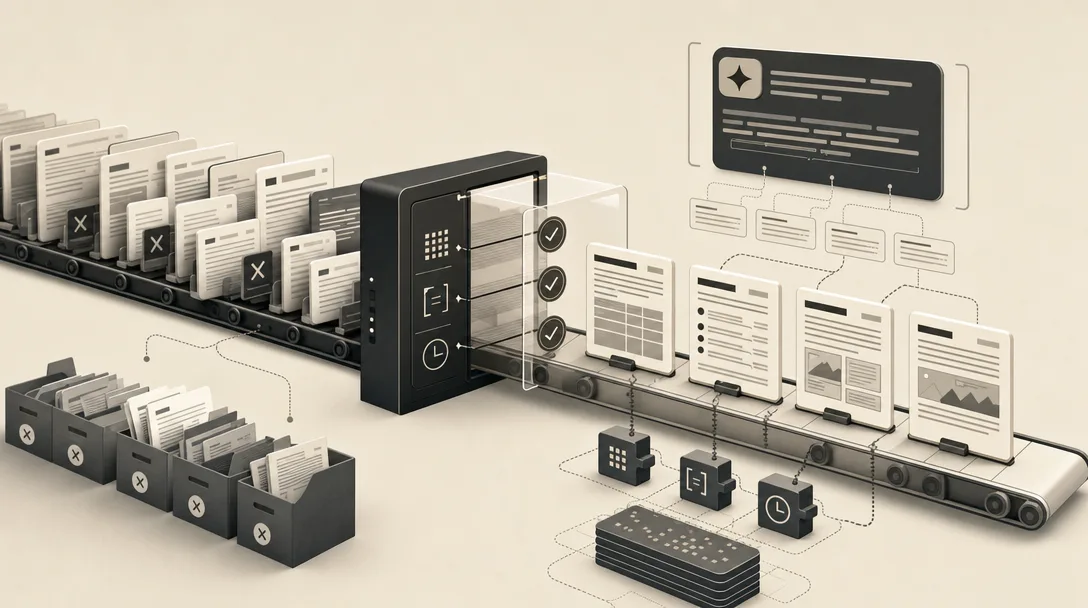
AthenaHQ is a measurement and recommendation layer for AI search visibility, not a publishing pipeline that produces citation-ready articles end to end. That distinction matters because the marketing language ("end-to-end") implies execution, but the corpus of independent reviews — Trakkr, Profound, Quattr, and TryAnalyze — consistently describes AthenaHQ's outputs as visibility data, prompt tracking, source analysis, and task suggestions. The actual writing, editing, CMS delivery, and archive refresh work still sits with the marketing team.
Which AI engines does AthenaHQ track on every plan?
AthenaHQ monitors eight AI engines on every plan: ChatGPT, Google AI Overviews, Perplexity, Claude, Gemini, Microsoft Copilot, Meta AI, and Grok. According to Trakkr's 2026 review, this 8-platform coverage is one of AthenaHQ's strongest baseline features and applies to Self-Serve and Enterprise alike — not gated behind the higher tier.
That confirmed list is narrower than the marketing copy suggests. AthenaHQ's homepage describes coverage as "8+ major LLMs", but the corpus does not show DeepSeek, Mistral, or other emerging surfaces inside AthenaHQ's tracked set. Teams with retrieval interest in DeepSeek or smaller regional engines should treat the "8+" framing as aspirational and confirm during onboarding.
| Engine | Tracked on every AthenaHQ plan? | Source |
|---|---|---|
| ChatGPT | Yes | Trakkr |
| Google AI Overviews | Yes | Trakkr |
| Perplexity | Yes | Trakkr |
| Claude | Yes | Trakkr |
| Gemini | Yes | Trakkr |
| Microsoft Copilot | Yes | Trakkr |
| Meta AI | Yes | Trakkr |
| Grok | Yes | Trakkr |
| DeepSeek | Not documented | — |
The data flows into prompt-by-prompt response capture, citation source analysis, and the Olympus dashboard, which TryAnalyze describes as the surface that shows which prompts trigger visibility, which sources AI relies on, and how share of voice shifts over time. Ask Athena layers a conversational interface on top of those analytics so operators can query the dataset without writing reports.
What does AthenaHQ automate, and what stays manual?
AthenaHQ automates the measurement side of the AI-search workflow: prompt monitoring, response capture, citation source analysis, share-of-voice tracking, and recommendation generation. It does not automate the publishing side. Briefs, drafts, editorial QA, internal linking, CMS delivery, refreshes, localization, and multi-site governance remain human work in every account the corpus describes.
The product surfaces map cleanly to that boundary. Action Center generates task-style optimization items — what Quattr describes as "recommendations [that] surface through Action Center, but execution remains largely manual." Ask Athena is an analytics interface, not a writing tool. The Enterprise-only ACE Citation Engine, per Trakkr, "uses machine learning to predict citation probability and suggest content changes" — still suggestion, not delivery.
Here is the actual division of labor most operators discover after onboarding:
| Workflow stage | AthenaHQ | Manual / external |
|---|---|---|
| Prompt tracking across 8 engines | Automated | — |
| Citation source analysis | Automated | — |
| Content gap identification | Automated (suggestions) | — |
| Subreddit and off-page opportunity surfacing | Surfaced (Profound) | Outreach execution manual |
| Research brief creation | — | Manual |
| Article drafting | — | Manual |
| Editorial QA and brand voice | — | Manual |
| CMS publishing | — | Manual |
| Internal linking | — | Manual |
| Archive refreshes | — | Manual |
| Multi-site / multi-brand governance | Not documented | Manual |
The honest read is that AthenaHQ tells you where the citation gaps are; it does not write, ship, or maintain the pages that close them. That is a fair design choice — visibility tools and content engines are different categories — but it should shape how you budget headcount and tooling around it.
Mentionwell turns AthenaHQ-style gap data into citation-shaped articles, internal links, and refreshes — across one site or hundreds. Get My Site GEO Optimized.
What is the difference between AthenaHQ Self-Serve and Enterprise?
Self-Serve and Enterprise are meaningfully different products under one brand, and the homepage's "end-to-end" framing collapses that distinction. According to Trakkr, AthenaHQ Self-Serve is $295/month for 3,600 credits, single-country, and excludes the ACE Citation Engine — the feature most independent reviewers cite as the actual reason to pick AthenaHQ. Enterprise pricing is not publicly documented; AI Rank Checker's comparison estimates $295+ to $595+ per month, with Enterprise costing more.
Profound's review goes further, stating that the Athena Recommendation Engine and Athena Citation Engine are also enterprise-only. So the buyer-relevant decision is not "AthenaHQ yes/no" — it is which AthenaHQ.
| Capability | Self-Serve ($295/mo) | Enterprise |
|---|---|---|
| 8-engine prompt tracking | Yes | Yes |
| Action Center recommendations | Yes | Yes |
| Ask Athena (analytics chat) | Yes | Yes |
| ACE Citation Engine | No | Yes |
| Athena Citation Engine | No (per Profound) | Yes |
| Athena Recommendation Engine | No (per Profound) | Yes |
| Multi-country tracking | No | Yes |
| Reddit intelligence | No (per Trakkr) | Not clearly documented |
| Crawler analytics | No (per Trakkr) | Not clearly documented |
| Google Analytics / GA4 connection | Available (per Profound) | Available |
A few edge cases are worth flagging during evaluation. Trakkr says Self-Serve has no Reddit intelligence, while Profound says AthenaHQ surfaces "subreddits to join" as off-page opportunities — those statements may both be true if the subreddit suggestions exist as text recommendations rather than as a Reddit-monitoring product. Trakkr also notes that crawler analytics are not documented in the Self-Serve experience, which matters if your team wants visibility into how GPTBot, ClaudeBot, PerplexityBot, or Google-Extended actually access your site.
How does AthenaHQ's credit-based pricing work?
AthenaHQ Self-Serve costs $295/month and includes 3,600 credits, where each AI response consumes 1 credit, according to Trakkr. That model shifts the cost calculation from seats and features to query volume — which sounds flexible until you multiply it out across prompts, engines, countries, and reporting cadence.
The math is straightforward once you treat one prompt, one engine, one run as one credit:
- Decide your prompt set. A focused B2B SaaS team typically tracks 50–200 priority prompts.
- Multiply by engines. Tracking all 8 engines (ChatGPT, Google AI Overviews, Perplexity, Claude, Gemini, Microsoft Copilot, Meta AI, Grok) means each prompt run consumes 8 credits.
- Multiply by reporting cadence. Daily tracking compounds faster than weekly.
- Multiply by countries. Self-Serve is single-country per Trakkr, so multi-market teams need Enterprise.
A team tracking 100 prompts across all 8 engines daily would consume 800 credits per day, exhausting the 3,600-credit Self-Serve allotment in roughly 4–5 days. The same 100 prompts on a weekly cadence consume 800 credits per week, fitting comfortably inside the monthly allotment with room for refresh testing.
| Scenario | Prompts | Engines | Cadence | Monthly credits |
|---|---|---|---|---|
| Lean weekly | 50 | 8 | Weekly | ~1,600 |
| Standard weekly | 100 | 8 | Weekly | ~3,200 |
| Aggressive daily | 100 | 8 | Daily | ~24,000 |
| Single-engine deep tracking | 200 | 1 | Daily | ~6,000 |
Trakkr references "credit overages" without publishing rates, so any team near the threshold should confirm overage pricing during onboarding rather than assume linearity.
Is there any difference between GEO and SEO?
Yes. SEO optimizes for search engine ranking on the SERP; GEO optimizes for whether and how your brand is mentioned inside an AI-generated answer. Athena's own glossary-style framing puts it cleanly: SEO is one-dimensional and cares about ranking position, while GEO is two-dimensional — being mentioned matters, but how you are mentioned (sentiment, framing, source citation) matters just as much.
For an operator, the four disciplines split along workflow lines:
- SEO — keyword targeting, on-page structure, backlinks, technical health, and SERP performance in Google and Bing.
- AEO (Answer Engine Optimization) — direct-answer page structure, schema, and FAQ formatting that lets answer engines extract a clean response. See our AEO explainer for the full breakdown.
- GEO (Generative Engine Optimization) — entity signals, citation-worthy framing, and content shape that improves the odds of being mentioned inside generated answers. Our GEO guide covers the structural patterns.
- LLMO (Large Language Model Optimization) — durable brand and entity signals across the open web that influence what models recall about you. We unpack this in What Is LLMO in 2026?.
AthenaHQ sits in the AEO/GEO measurement layer; SEO and LLMO live next to it, not inside it. Teams that want a single workflow covering all four disciplines need to pair visibility tracking with a publishing engine — see our AEO vs GEO vs LLMO breakdown for the operating model, and What Is AI SEO in 2026? for how the disciplines combine in practice.
Can AthenaHQ help your brand generate more traffic and leads?
AthenaHQ can connect AI visibility signals to web analytics, but the public corpus does not contain verified before-and-after proof that its recommendations lift citations, organic traffic, leads, or revenue. According to Profound, AthenaHQ offers a Google Analytics connection to track how AI engines use a brand's website, which means teams can build attribution workflows in GA4, Google Search Console, and Google Looker Studio-style reporting — but the lift evidence is not in the public material.
The proof landscape is fragmented rather than absent. Trakkr, Profound, TryAnalyze, and Quattr each describe specific capabilities — Olympus dashboards, Action Center tasks, Ask Athena queries, citation source analysis — and each notes meaningful limitations. Promptloop and broader market sources reference AthenaHQ alongside outlets like Forbes and Wall Street Journal in market positioning contexts, but the official AthenaHQ pages reviewed do not substantiate detailed customer-result claims.
Is AthenaHQ a content publishing engine or a visibility-and-recommendation platform?
AthenaHQ is a visibility-and-recommendation platform. It tracks AI-search exposure, analyzes citation sources, and surfaces tasks; it does not produce briefs, draft citation-shaped articles, push to a CMS, manage internal links, run programmatic SEO templates, or refresh archive pages. Quattr's framing is the cleanest summary: "Athena HQ is primarily a GEO visibility tool; it tracks where your brand appears across AI engines and surfaces recommendations through its Action Center, but execution remains largely manual."
That positioning is consistent with the broader category. Tools like Scrunch AI, Ahrefs Brand Radar, HubSpot AI Search, and Semrush AI Toolkit all sit on the monitoring side of the line — they show you the gap, then hand the work back to your team.
The execution side is where Mentionwell fits. Once AthenaHQ-style data identifies which prompts, entities, and citation gaps matter, Mentionwell operationalizes the publishing pipeline:
- Research-grounded briefs shaped for AEO, GEO, LLMO, and SEO simultaneously.
- Citation-ready drafts with direct-answer openings, attributed statistics, and entity-dense structure.
- CMS delivery into existing stacks or headless workflows.
- Internal linking and programmatic SEO templates governed by editorial controls.
- Archive refreshes that keep older pages aligned with current prompt patterns.
| Capability | AthenaHQ | Mentionwell |
|---|---|---|
| Prompt and citation monitoring | Yes | Out of scope |
| Action Center / gap identification | Yes | Inputs accepted |
| Brief generation | No | Yes |
| Citation-shaped drafting | No | Yes |
| CMS publishing | No | Yes |
| Internal link governance | No | Yes |
| Archive refreshes | No | Yes |
| Multi-site / agency operations | Not documented | Yes |
The two categories are complementary, not competing. A team that runs AthenaHQ for measurement and Mentionwell for execution gets the full loop: detect, decide, ship, refresh.
How to Choose the Right Athena HQ Alternative
The right AthenaHQ alternative is whichever tool — or combination of tools — closes the gap between your monitoring stack and your publishing stack. AthenaHQ alone is sufficient only if your team already has a working content pipeline and just needs visibility data; most teams discover after a quarter of recommendation reports that they need both monitoring and execution, and that the monitoring tool was the easy purchase.
Use this six-step decision path:
- Define the target surfaces. List which engines matter most — ChatGPT, Google AI Overviews, Perplexity, Claude, Gemini, Microsoft Copilot, Meta AI, Grok, DeepSeek — and whether you need single-country or multi-country coverage.
- Confirm plan-level feature access. Verify in writing whether ACE Citation Engine, Athena Citation Engine, Athena Recommendation Engine, Reddit intelligence, and crawler analytics are included on the plan you can actually buy.
- Model prompt-credit usage. Multiply prompts × engines × cadence × countries against the 3,600 credit allotment before signing.
- Test whether recommendations produce publishable work. Run a 30-day pilot and count how many Action Center tasks resulted in a shipped, citation-ready page versus a backlog item.
- Verify CMS and refresh workflow. Map who writes the brief, who drafts, who publishes, and who refreshes — and whether the visibility tool plays any role in those stages.
- Decide: monitoring, publishing, or both. If the answer is "both," budget for two tools, not one.
Segment fit by team type:
| Team type | What they typically need |
|---|---|
| Enterprise marketing | AthenaHQ Enterprise + Mentionwell for execution + GA4/Looker Studio attribution |
| Agencies and multi-site operators | A publishing engine first (Mentionwell), monitoring layered on per client |
| Growth and SEO teams with existing CMS | Mentionwell for the pipeline, lighter monitoring (Peec AI, Otterly AI, or AthenaHQ Self-Serve) |
| Small businesses | A single tool that covers AEO, GEO, LLMO, and SEO publishing without enterprise spend |
Comparable tools to evaluate — each lives somewhere on the monitoring-to-execution spectrum: Atomic AGI, AI Rank Checker, Narrato AI, MarketMuse, Surfer SEO, Writesonic GEO, Promptwatch, Goodie AI, Peec AI, Otterly AI, Scrunch AI, Ahrefs Brand Radar, HubSpot AI Search, and Semrush AI Toolkit.
If your evaluation lands on "we have visibility data, we just cannot ship the content fast enough," that is the gap Mentionwell was built to close. Turn AEO and citation gaps into a repeatable publishing pipeline across one site or hundreds — Get My Site GEO Optimized.
Sources
- Surveyors UK Welcomes Metrix as Strategic Partner - LinkedInwww.linkedin.com
- AthenaHQ Review: Does It Offer Competitive AI Visibility?www.tryprofound.com
- AEO and GEO Platform for AI Search | AthenaHQwww.athenahq.ai
- AthenaHQ AI Review 2026: Is It Worth the Investment?www.tryanalyze.ai