What is Meta AI and how does it work?
Meta AI is Meta's general-purpose AI assistant built into Facebook, Instagram, Messenger, WhatsApp, and Meta.ai (Source: WebFX). It runs on the Llama model family and, according to AIsoSystem, uses Bing as its primary web search engine to supplement responses with current sources. Meta describes Meta AI as able to answer questions, describe photos, generate images or animations, edit writing, and assist with code from a single prompt (Source: Meta Help Center).
"Showing up in Meta AI" is not one outcome — it's four distinct ones, and optimizing for each requires different moves:
| Visibility surface | What it looks like | Primary input |
|---|---|---|
| Web citation in a Meta AI answer | Your URL referenced when users ask a question on Meta.ai or inside Messenger/WhatsApp | Bing-indexed, retrievable page content |
| Business recommendation | Meta AI suggests your business when a user asks for options | Completed Facebook/Instagram/WhatsApp Business profiles |
| Meta profile result | Your Facebook Page or Instagram Business profile surfaces directly | Profile completeness and activity |
| Meta Business AI response | Your own conversational agent answers from your catalog and site | Meta Business AI configuration |
The single word "Meta AI" covers both a consumer assistant serving 3+ billion users across Meta platforms and a business-grade agent — and you do not optimize for them the same way. (Source: AIsoSystem; WebFX). The rest of this guide treats each surface as its own job.
What data sources does Meta AI use?
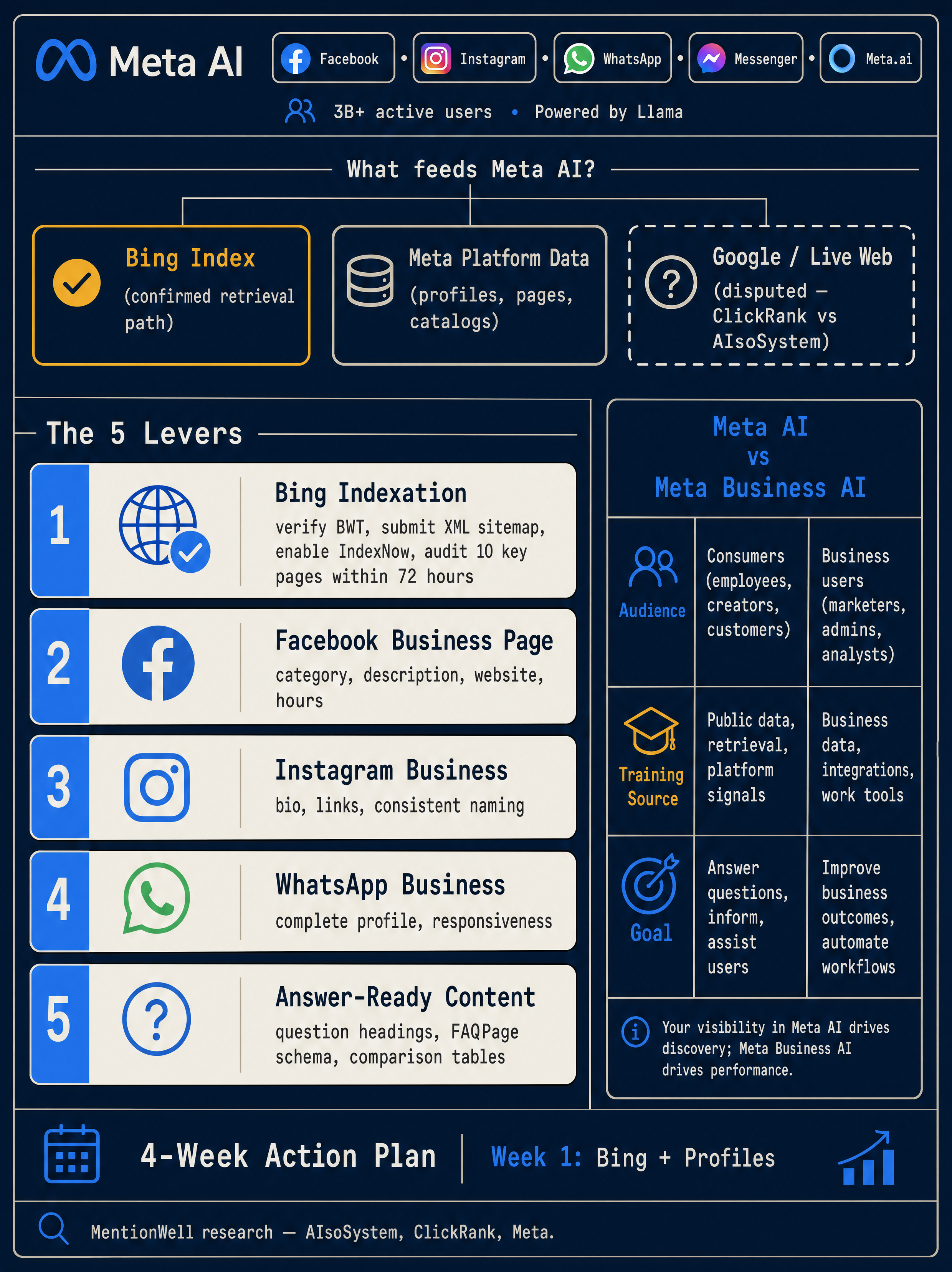
Meta AI draws on three input layers: Meta platform data (public Facebook Pages, Instagram Business profiles, WhatsApp Business profiles), live web retrieval, and the Llama model's training. No public Meta documentation specifies ranking factors, so anything beyond those confirmed inputs should be treated as hypothesis.
The sources disagree on the web retrieval path:
- AIsoSystem states that Meta AI "relies on Bing for web searches" and that sites must be indexed on Bing to appear in Meta AI responses.
- ClickRank claims Meta AI combines Llama with live data "from search partners including Google and Bing," and describes a Retrieval-Augmented Generation flow that searches internal knowledge plus the live web before synthesizing snippets.
Both can coexist operationally — Bing is the clearly attested retrieval path, and any Google involvement is secondary and unverified. ClickRank also claims Meta AI uses an agent called Meta-ExternalFetcher to scan sites on demand for fresh information, and that it retrieves specific chunks of content, favoring paragraphs and tables that directly answer the prompt. None of this is confirmed by Meta.
For Meta AI visibility, the only input you can verifiably control is whether your site is indexed on Bing and whether your Meta business profiles are complete and active. Everything else is optimization on probability, not certainty.
How does Meta AI access external website content?
Meta AI accesses external websites primarily through Bing's index, and — per ClickRank's unverified claim — through an on-demand fetcher called Meta-ExternalFetcher that pulls fresh content when the Llama model needs current information. Neither path is a ranking mechanism; both are eligibility mechanisms. If your content isn't reachable through Bing or a live fetch, it cannot be cited regardless of how well it's written.
Three practical consequences for publishing teams:
- Indexation is the gate. Pages not in Bing's index are not retrievable by Meta AI's confirmed web path. This is the same constraint that governs Copilot and Grok visibility.
- Chunkability matters. ClickRank says Meta AI retrieves specific sections, favoring paragraphs and tables that directly solve the immediate prompt. Pages structured as walls of text are harder to quote than pages with tight answer blocks, comparison tables, and labeled FAQ sections.
- Access rules apply. A page blocked by `robots.txt`, a `noindex` directive, authentication, or aggressive bot filtering cannot be indexed by Bing or fetched on demand — regardless of content quality.
Citation eligibility ≠ citation guarantee. Getting indexed and structured correctly is the price of admission; being the clearest answer for a specific prompt is what earns the quote.
How do you set up Bing, sitemaps, and IndexNow for Meta AI visibility?
Start with Bing because Bing is the strongest repeated retrieval signal across every source that discusses Meta AI's web access (Source: AIsoSystem). Without Bing indexation, the other levers do nothing.
The operational workflow:
- Verify your domain in Bing Webmaster Tools. Use DNS, meta tag, or XML file verification. Import from Google Search Console if your GSC setup is current — it's the fastest path.
- Submit your XML sitemap. One sitemap per site is sufficient for most setups; use a sitemap index if you exceed 50,000 URLs or split by content type.
- Enable IndexNow. IndexNow pings Bing (and other participating engines) the moment a page is published or updated, instead of waiting for a crawl. Most modern CMSs and edge platforms support it natively or through a plugin.
- Audit your 10 priority pages. AIsoSystem recommends starting with the 10 key pages that carry your highest-intent content: category/pillar pages, comparison pages, pricing, top glossary entries, and any FAQ-heavy hubs.
- Check indexation within 72 hours. AIsoSystem's guidance is to verify that those priority pages show as indexed in Bing Webmaster Tools within 72 hours of submission. If they don't, troubleshoot before adding more pages.
- Troubleshoot blockers. Common culprits: `noindex` meta tags left over from staging, `robots.txt` disallow rules, canonical tags pointing elsewhere, thin content Bing skips, or JavaScript rendering that hides the primary content from the crawler.
| Checkpoint | Timing | What "pass" looks like |
|---|---|---|
| Bing Webmaster Tools verified | Day 1 | Domain shows as verified; sitemap submitted |
| IndexNow active | Day 1 | New URLs appear in Bing within hours |
| 10 priority pages indexed | 72 hours | All 10 show "URL is in Bing" status |
| Crawl stats review | Weekly | No spikes in blocked or 4xx URLs |
Bing indexation is the one step that every credible Meta AI visibility source agrees on — do it first, verify it within 72 hours, and monitor it weekly.
Can I submit my business to Meta AI?
There is no publicly documented direct-submission flow for adding a business to Meta AI's index. Instead, Meta AI draws on the public information in your Facebook Business Page, Instagram Business profile, and WhatsApp Business profile (Source: AIsoSystem). Completing and aligning those three assets is the submission process.
What to fill out — and keep consistent across all three:
- Business name: identical spelling, capitalization, and punctuation on every profile and on your website.
- Category: choose the most precise option Meta offers. Vague categories reduce matchability against user queries (Source: AIsoSystem).
- Description: lead with the product category and niche. MarketAspex argues that clear niche positioning makes a brand easier for Meta AI to match to user queries, and that Meta AI recommends businesses it can "clearly understand and verify."
- Website link: point to a canonical URL that is Bing-indexed. Do not link to a redirect chain.
- Hours, location, pricing, availability: fill these where the business model supports them — they feed the practical-information retrieval AIsoSystem recommends.
- Reviews and social proof: MarketAspex says these strengthen both trust and visibility signals.
- Responsiveness and activity: reply to messages quickly; publish regularly. Inactive profiles signal a weaker entity.
- Consistent messaging: the positioning on Facebook, Instagram, WhatsApp, and your website should say the same thing. Drift between surfaces is a verification problem.
You don't submit to Meta AI; you make yourself verifiable on the Meta surfaces it already reads.
How should website pages be structured for Meta AI retrieval and citation?
Structure pages the way Meta AI retrieves them: in chunks. ClickRank says Meta AI pulls specific sections and favors paragraphs or tables that directly solve the user's immediate prompt, which means your unit of optimization is the answer block, not the page. AIsoSystem adds that direct-question content — question-format headings, a direct answer in the first paragraph, and an FAQ section with FAQPage schema — is one of its five visibility levers.
The editorial template:
- Question-format H2s. Write headings as the questions real users ask ("How does Meta AI access external content?"), not as topics ("External access").
- First-paragraph direct answer. Open each section with a 1–2 sentence answer that is self-contained and quotable in isolation.
- Short answer blocks. Follow the direct answer with a tight supporting paragraph, then expand. Keep the citable unit under 60 words.
- Comparison tables. When you compare options, costs, or surfaces, render a table. ClickRank specifically flags tables as retrieval-favored.
- Evidence-backed claims. Attribute every number and claim to a named source. Unattributed statistics are filtered out by most retrieval systems.
- Entity-rich language. Name products, models, tools, and companies by their full proper names on first mention. Entity co-occurrence is how LLMs decide what to surface.
- E-E-A-T signals. Author bios, publication dates, source links, and revision history all strengthen citation readiness (Source: AIsoSystem).
- FAQPage schema on FAQ sections, `Product` schema on product pages, `Organization` schema on About pages. Schema makes the retrievable structure explicit.
- Practical details where they exist. Pricing, integrations, use cases, locations, hours, and availability — whichever your business model supports. AIsoSystem lists these as retrieval signals for consumer-recommendation queries.
| Page type | Priority structure | What Meta AI likely extracts |
|---|---|---|
| Category/pillar | Question H2s + FAQ + schema | Definitional snippets |
| Comparison | Table + direct verdict | The comparison table itself |
| Product/feature | Use cases + pricing + integrations | Capability and fit statements |
| Glossary | Term + one-line definition + context | The one-line definition |
| FAQ | Q-shaped H3 + 40–80 word answer | The answer paragraph |
Write every section so a Meta AI answer could paste the first two sentences verbatim and still be correct on its own.
Meta AI vs Meta Business AI: which visibility goal are you optimizing for?
Meta AI and Meta Business AI are two different products with two different optimization jobs. Meta AI is the broad consumer-facing assistant across Facebook, Instagram, Messenger, WhatsApp, and Meta.ai. Meta Business AI, per WebFX, is a business-grade conversational agent designed to automate sales and support interactions across the Meta ecosystem — trained on your catalog, website content, and past campaign performance.
WebFX describes Meta Business AI as a three-part architecture:
- Learning engine — absorbs signals from your catalog, website, ads, social content, and brand voice.
- Conversational intelligence — answers questions, recommends products, resolves objections, and guides customers toward purchase.
- Optimization layer — tunes responses based on conversion outcomes over time.
| Dimension | Meta AI | Meta Business AI |
|---|---|---|
| Audience | 3+ billion users across Meta apps | Your prospects and customers |
| Surface | Facebook, Instagram, WhatsApp, Messenger, Meta.ai | Your Meta business surfaces (DMs, ads, Pages) |
| Your job | Earn citations and recommendations | Configure, train, and monitor your agent |
| Primary input | Bing-indexed site + Meta profiles | Catalog, site content, campaign history, brand voice |
| Success metric | Prompt coverage, cited URLs, recommendation rate | Conversion rate, AOV, support deflection |
If the goal is to be cited or recommended by the consumer assistant, you're optimizing Meta AI. If the goal is to convert your own traffic inside Meta surfaces, you're configuring Meta Business AI. Don't conflate them — the work, the signals, and the measurement are different.
How can B2B SaaS companies show up without a storefront or WhatsApp-heavy sales motion?
Skip the local-business playbook and optimize for the two surfaces a B2B SaaS company actually competes on: web citation in Meta AI answers and category recommendation when a user asks for software options. Most Meta AI visibility guides lean heavily on hours, locations, WhatsApp catalogs, and consumer reviews — none of which apply to a SaaS buyer asking "what's a good AI blog engine for agencies?"
The adapted playbook:
- Niche positioning at the top of every surface. State the product category, who it's for, and the specific job it does. MarketAspex argues clear niche positioning is a primary matchability signal.
- Use-case pages. One page per primary use case, with question-format H2s and direct-answer openings. These are retrieval gold for "how do I…" queries.
- Comparison pages. `{Your product} vs {category leader}`, with a clean table and a verdict. Tables are chunkable and citable.
- Integration pages. One page per major integration, because users search for tools through their stack.
- Glossary coverage. Define every category term you operate in (AEO, GEO, LLMO, programmatic SEO). Glossary pages earn definitional citations, which is how LLMs build topical authority. See our breakdown in [AEO vs GEO vs LLMO: which workflow fits your team](/aeo-vs-geo-vs-llmo-which-workflow-fits-your-team).
- Documentation and pricing clarity. Public docs and public pricing are both retrievable and verifiable. Hiding pricing makes you a worse match for "affordable" or "pricing" queries.
- Facebook/Instagram Business profiles with SaaS-appropriate categories — not a storefront category. Link to the canonical product page.
For B2B SaaS, Meta AI visibility is a content problem before it's a profile problem: glossary, use-case, comparison, and integration pages do most of the work.
Does Meta AI replace Google Search, ChatGPT, Copilot, Grok, or Perplexity?
No. Meta AI is a different visibility surface with a different audience and different retrieval inputs — not a replacement for classical search or for other assistants. Zapier frames it directly: Meta AI is best for lightweight tasks inside WhatsApp, Instagram, Facebook, and Messenger, while ChatGPT is stronger for professional productivity, research, data analysis, and workflow automation.
Plan coverage as a portfolio, not a single bet. Each assistant has its own retrieval stack, its own surface, and its own structural quirks:
- [How to show up in ChatGPT in 2026](/how-to-show-up-in-chatgpt-in-2026)
- [How to show up in Microsoft Copilot in 2026](/how-to-show-up-in-microsoft-copilot-in-2026)
- [How to show up in Grok in 2026](/how-to-show-up-in-grok-in-2026)
- [How to show up in Perplexity in 2026](/how-to-show-up-in-perplexity-in-2026)
- [How to show up in Google AI Overviews in 2026](/how-to-show-up-in-google-ai-overviews-in-2026)
- [How to show up in Google Gemini in 2026](/how-to-show-up-in-google-gemini-in-2026)
- [How to show up in Claude in 2026](/how-to-show-up-in-claude-in-2026)
- [How to show up in DeepSeek in 2026](/how-to-show-up-in-deepseek-in-2026)
Meta AI is additive to your AEO, GEO, LLMO, and SEO coverage — it's the assistant users reach without leaving Meta's apps, not the one they switch to for deep research.
How do you test whether Meta AI mentions or cites your brand?
Build a recurring prompt-testing workflow across every Meta AI surface, because there is no Meta-provided visibility dashboard. Treat it as measurement against documented assumptions, not proof of ranking.
The workflow:
- Define a prompt set. 15–30 prompts covering your top categories, comparisons, use cases, and branded queries. Keep it frozen so you can compare over time.
- Test across surfaces. Run every prompt in Meta.ai, Messenger, WhatsApp, Instagram (where available), and Facebook. Meta AI responses can differ by surface.
- Vary account and region. Use at least two accounts and, where possible, two regions. A Fixphile tutorial notes Meta AI availability varies by country, so regional variation is a real factor in what users see.
- Log what you see. Record: did Meta AI mention your brand? Cite a URL? Recommend you in a list? Return a Meta profile result? What did competitors get instead?
- Track Meta Business AI separately. If you've configured Meta Business AI, test its responses against your expected sales and support flows — that's a different measurement loop.
- Review weekly; profile-audit monthly. Prompt results change as the model and index update. Profile alignment changes as your business does.
| What to log | Example |
|---|---|
| Prompt | "Best AI blog engine for agencies" |
| Surface | Meta.ai, web |
| Region/account | US, account A |
| Brand mentioned? | Yes/No |
| URL cited? | Which URL |
| Competitors cited | List |
| Date | 2026-01-15 |
You can't measure Meta AI visibility from a dashboard; you measure it by running the same prompts across the same surfaces on a schedule and logging what changes.
How long does it take to see improvement, and is this something you need to revisit?
No source gives a defensible timeline for Meta AI visibility improvements. Anchor your expectations to observable checkpoints you control, not to promised ranking windows.
A realistic cadence:
| Checkpoint | Cadence | What you're verifying |
|---|---|---|
| Bing indexation of priority pages | 72 hours after publish (Source: AIsoSystem) | Pages are eligible for web retrieval |
| Prompt-set test | Weekly | Mention, citation, and recommendation changes |
| Meta profile audit | Monthly | Name, category, description, link consistency |
| Content refresh on top 10 pages | Quarterly | Freshness, updated stats, new entities |
| Full archive refresh | Annually | Outdated pages rewritten or pruned |
Meta AI visibility is not a launch — it's a maintenance discipline. Models update, indexes shift, competitor content gets published, and your own profiles drift. AIsoSystem frames the initial setup as a 4-week action plan, but the ongoing work is recurring: weekly prompt testing, monthly profile audits, quarterly refreshes on priority pages.
This is where a publishing engine earns its keep. Mentionwell runs the site profile, editorial pipeline, and archive-refresh loop as a system — producing research-grounded, AEO/GEO/LLMO/SEO-shaped articles on a schedule, across one site or hundreds, without rebuilding the CMS underneath it.
What can block Meta AI visibility or access?
Meta AI visibility fails at two layers: user access and brand eligibility. On the user side, Meta AI may not appear at all because of outdated WhatsApp installs (a Login Giants tutorial notes the app must be updated and cache cleared), regional rollout gaps (a Fixphile tutorial shows users routing through US VPNs to reach Meta AI), device-account issues, or staged feature availability.
On the brand side, eligibility breaks when:
- Pages carry `noindex` tags or `robots.txt` disallows that keep them out of Bing's index
- Canonical tags point to the wrong URL, so Bing indexes a version you didn't intend
- Facebook, Instagram, or WhatsApp Business profiles are incomplete, stale, or inactive
- Business names, categories, or descriptions drift across profiles and your website
- Niche positioning is vague, so Meta AI can't confidently match you to user queries (Source: MarketAspex)
- Content is written as walls of prose instead of chunkable answer blocks with tables and FAQs
Audit for these quarterly. One stale profile or one misconfigured canonical can quietly remove you from the surface for months.
Ready to run Bing indexation, Meta-profile alignment, answer-chunk structure, and refresh cycles as one system across every site you publish on? Get My Site GEO Optimized with Mentionwell.
Sources
- How to Appear in Meta AI in 2026: Complete Visibility Guidewww.aisosystem.com
- How To Use Meta AI In Any Country 2026www.youtube.com
- How to Fix Meta AI Not Showing on WhatsApp (2026)www.youtube.com
- 🚨DID YOU KNOW THIS FOR 2026 ?! Here are the steps: ...cashmerevalleyrecord.com
- How to use Meta AI for business in 2026: Tips and how-toswww.youtube.com
- How to Use Meta AI on Facebook Messenger in 2026!www.clickrank.ai
- Meta AI SEO (2026) – Boost Visibility in AI Answersmarketaspex.com