How do I get cited by Perplexity? The B2B SaaS page checklist
A Perplexity citation checklist is a pre-publish set of page requirements that makes a B2B SaaS page easier for Perplexity to retrieve, extract, and cite. The recurring requirements across current research are crawler access, freshness, direct-answer structure, sourced evidence, and third-party authority. In Digital Applied's 500-site audit, answer-format H2s correlated with a +22% citation lift and a valid llms.txt file with +24%.
Treat this as GEO and AEO layered on top of SEO, not a replacement. LeadWalnut defines Perplexity SEO as optimizing your brand and content so Perplexity references you inside its answers, and it makes the point plainly: this discipline sits on top of traditional SEO, not in place of it. A page still needs to be indexable, relevant, and technically sound before any citation-specific work matters.
The checklist below runs across six layers: retrieval access, freshness, extraction structure, evidence density, comparison fit, and off-page authority. Some layers are backed by audit data. Others are repeated industry claims that are useful but softer. Both are flagged as you go.
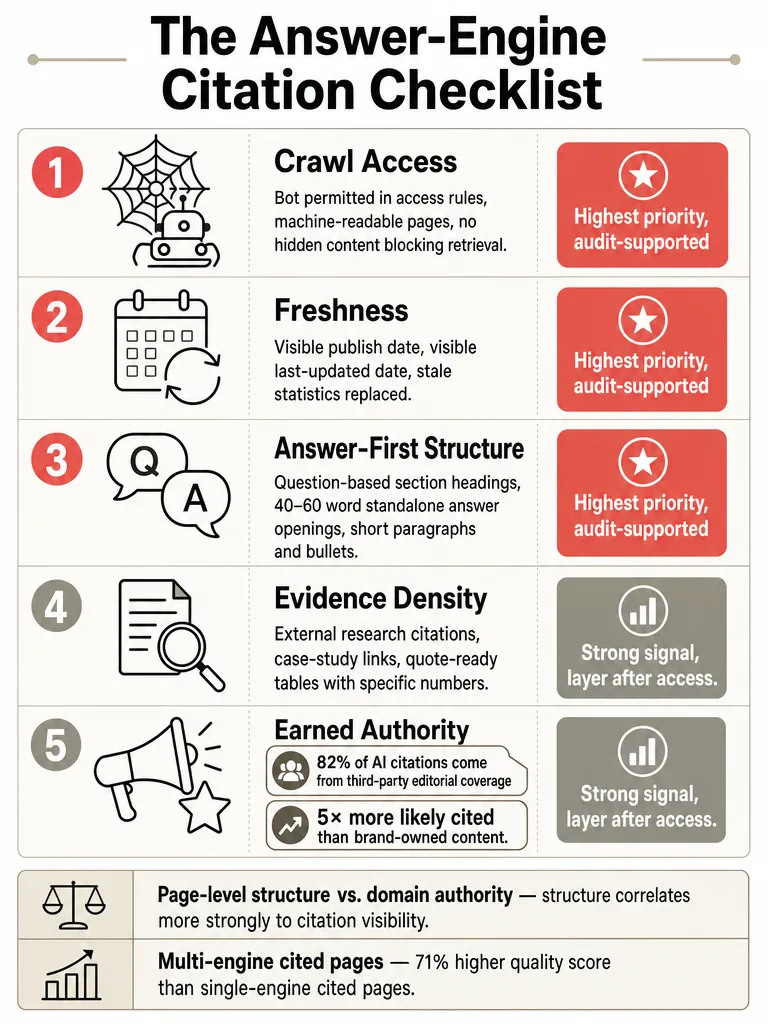
Which checklist items matter most first: crawl access, freshness, structure, sourcing, or authority?
Crawler access comes first, because a page Perplexity cannot fetch cannot be cited no matter how well it's written. After access, the highest-leverage on-page moves are answer-format structure and freshness, both of which are backed by audit data rather than opinion.
Digital Applied's audit of 500 SaaS landing pages gives the clearest ranking of on-page signals. The measured lifts:
| Signal | Citation lift | Type of evidence |
|---|---|---|
| Comparison section (vs named competitor) | +38% | Audit-measured |
| llms.txt at root | +24% | Audit-measured |
| Answer-format H2s | +22% | Audit-measured |
| Domain authority | +0.18 correlation | Weak, audit-measured |
The headline finding reframes priorities: the top quartile of audited SaaS pages got cited 8.4× more often than the bottom half, and domain authority explained almost none of the gap. Digital Applied logged 31 citations per month for top-quartile pages against 3.7 for the bottom quartile, with domain authority correlating only weakly at +0.18. Page structure tracked the split far harder.
So the sequence is: fix crawl access, then rebuild structure for extraction, then lock freshness, then raise evidence density, then earn third-party coverage. Authority still matters, but as AuthorityTech frames it, that authority lives mostly in earned media, not in your domain rating. Chasing DA before fixing page structure inverts the order the data supports.
How does Perplexity select sources?
Perplexity runs a live web search on nearly every query, retrieves a set of candidate pages, then cites only the small subset the model actually used to write its answer. That retrieval-to-citation gap is where most B2B SaaS pages lose. LeadWalnut reports Perplexity retrieves 10 to 20 candidate pages per query but cites only three to eight of them.
Being retrievable is not the same as being citable. A page can be indexed, relevant, and pulled into the candidate set, then dropped at the citation step because the model couldn't find a clean, attributable passage to quote. That distinction drives the rest of this checklist: access gets you into the candidate pool; extractable structure and evidence get you into the citation slots.
Source counts vary. LeadWalnut cites 2026 research putting Perplexity answers at about 5.01 links on average, but candidate and citation ranges differ across studies, so don't optimize toward a fixed number.
What does PerplexityBot need to access?
PerplexityBot needs an unblocked path to the page, its content in the initial HTML, and a machine-readable structure it can parse without executing heavy client-side rendering. If robots.txt blocks the crawler or the answer text only appears after JavaScript hydration, the page is invisible to citation regardless of quality.
Run these access checks before anything else:
- Allow the crawlers in robots.txt. PipeRocket's checklist names both
PerplexityBotandPerplexity-Useras the user agents to permit. Also allowBingbot, since Perplexity's retrieval has historically drawn on Bing's index. - Confirm the answer is in server-rendered HTML. Content hidden behind tabs, accordions, or client-only rendering may not be extracted. The RevvGrowth AEO checklist warns against hidden tabs for exactly this reason.
- Add a valid llms.txt at the root. Digital Applied measured a +24% citation lift for pages on sites with a valid llms.txt file. See what llms.txt is and where it fits.
- Validate schema and dates. Article or BlogPosting schema with
datePublishedanddateModified, checked through a schema validator.
Once access is clean, a GEO scan of your target prompts shows which of those pages Perplexity actually cites today.
What content structure helps Perplexity cite a page?
Answer-first structure helps most: a question-shaped H2 followed immediately by a short, standalone answer the model can lift without reading anything above it. Perplexity extracts passages, it doesn't read pages top to bottom, so each section has to make sense pulled out of context. Digital Applied measured a +22% citation lift for pages using answer-format headings.
The RevvGrowth checklist specifies the shape competitors are already using:
- Follow each H2 with a 40 to 60 word direct answer that stands alone with no dependency on prior paragraphs.
- Make 30 to 50% of your H2s questions using "how," "what," or "why," mirroring how buyers prompt AI rather than how they type keywords.
- Open the answer with a definition-style sentence.
- Keep paragraphs under four lines and use bullets or tables where a list or comparison is implied.
- Repeat the core answer across intro, body, and any FAQ, since Perplexity often pulls from multiple positions on the page.
The mechanism is extractability. A section that reads correctly when quoted in isolation is a section Perplexity can cite; one that depends on the paragraph above it is one it will skip. If you're retrofitting existing posts, the same structure applies, see how to get cited in ChatGPT using posts you already have for the restructure-versus-rewrite call.
How often should I update pages for Perplexity citations?
Perplexity carries an unusually strong freshness bias, so visible dates and current stats are a genuine citation signal. LeadWalnut reports that 70% of Perplexity's top citations show a visible publish or update date within the last 12 to 18 months. For a citation-driven page, that sets a rough outer bound on how stale you can let it look.
Freshness is three separate checks, not one:
- Visible publish date on the page, not just in schema.
- Visible last-updated date when the content has materially changed, backed by an accurate
dateModified. - Stale-stat replacement. Swap out numbers, years, and product claims that a reader would recognize as dated.
The refresh-versus-rewrite decision depends on what's stale. If the structure is sound and only facts have aged, refresh on the same URL to keep equity. If the page can't answer the question in a liftable passage, rewrite the sections that can't. For high-value pages, a quarterly review cadence matches the distribution rhythm AuthorityTech recommends. See how to refresh old SEO posts for AI citations for the full triage logic.
What evidence makes a SaaS page citation-worthy?
Evidence density is what turns a well-structured page into a quotable one. Perplexity cites passages it can attribute and verify, so pages carrying specific numbers, named sources, and quote-ready tables outperform pages making unsupported claims. The RevvGrowth checklist calls for two to three external citations per page from research reports or case studies as a baseline.
The evidence layer for a B2B SaaS page:
- External research citations to primary sources, named in-line, not vague "studies show" gestures.
- Case-study or proof links that a buyer, and the model, can follow.
- Original data or updated stats with the specific number and a timestamp. Growtika's testing recommends building data tables AI can quote verbatim, with specific numbers and dates.
- Expert quotes attributed to a real, named person.
- Quote-ready tables where you're comparing options, costs, or specs.
There's a compounding effect worth noting. AuthorityTech reports that pages cited across multiple engines score 71% higher in overall quality than single-engine citations, and that pages hitting its structural thresholds reached a 78% cross-engine citation rate. The practical read: evidence built for Perplexity tends to travel to ChatGPT, Claude, and Google AI Overviews too. Bake the source-density spec into your GEO content brief so it's not an afterthought.
When should a B2B SaaS page include a comparison block?
Add a comparison block whenever the query implies vendor choice: "best X," "X alternatives," "X vs Y," or category-selection and evaluation-criteria searches. This is the single highest-lift structural move in the audit data. Digital Applied found explicit head-to-head comparisons against named competitors lifted citation rates by +38%, its biggest measured factor.
The lift held whether the comparison lived on a dedicated /vs/competitor page or as an embedded block inside a pricing or feature page. Both ChatGPT and Perplexity aggregate comparisons into answers, so a page that lays out named options in a scannable table is doing the model's synthesis work for it.
| Query shape | Comparison block? | Why |
|---|---|---|
| "best [category] for [use case]" | Yes | Perplexity aggregates ranked options |
| "[vendor] alternatives" | Yes | Answer is a list of named competitors |
| "[vendor A] vs [vendor B]" | Yes | Direct head-to-head is the query |
| Pure definition or how-to | No | Comparison would be off-intent padding |
Don't force a comparison onto an informational page, but where the query is evaluative, the comparison block is the highest-yield section you can add. Live GEO scans across content-engine and AI-search-service prompts show the same pattern from the demand side: when a brand is absent from ranked lists, the recommended fix is consistently a comparison page. For the template layer, see how to brief writers for AEO and GEO.
Owned pages vs earned media: where should citation work happen?
Owned pages win citations for informational, how-to, and definitional queries, where a clean answer passage on your domain is the direct answer. Earned media wins the higher-trust vendor-evaluation queries, where Perplexity leans on third-party editorial. AuthorityTech reports that Perplexity cites earned media 5× more often than brand-owned content.
That figure traces to the UC Berkeley GEO-16 study, which analyzed 1,702 AI citations across three major engines and found 82% came from third-party editorial coverage in outlets like TechCrunch, Forbes, and the Financial Times. AuthorityTech also notes Perplexity has the lowest quality threshold of the major engines at a mean GEO score of 0.300, which makes it the most accessible starting point for a B2B brand trying to earn citations.
The split tells you where to spend:
- Owned page work for explainer, glossary, docs, and how-to queries the model can answer directly from your site.
- Earned media work for "best," "vs," and shortlist queries, where recent, well-structured coverage from a trusted publication can beat older content on your own domain.
Growtika's version of this is to find the pages Perplexity already cites for your target queries, then get your data, stat, or expert quote added to those pages, faster than building new authority from scratch. Owned and earned aren't competing lanes; they cover different query types, and a serious Perplexity program runs both.
Why is Perplexity not citing my page?
A page that ranks in Google or gets indexed but never appears in Perplexity is failing at one specific step, and the fix depends on which one. Work through the failure modes in order rather than rewriting blindly.
The diagnostic ladder:
- Access failure. robots.txt blocks PerplexityBot or Perplexity-User, or the answer text only renders client-side. The page never enters the candidate set. Fix crawl access first.
- Weak extraction. The page is retrieved but has no standalone, liftable passage. Content is buried under long intros or depends on surrounding context. Add answer-format H2s and 40-to-60-word direct answers.
- Stale evidence. Numbers, years, or product claims read dated, and Perplexity's freshness bias down-ranks them. Update stats and surface a visible last-updated date.
- Missing attribution. Claims aren't sourced, so the model can't verify what it would quote. Add named external citations.
- Lack of consensus. A claim appears only on your page. Growtika's framing is that AI treats a single mention as rumor and multiple independent mentions as fact, so seed key claims across several trusted sources.
- Insufficient third-party authority. For evaluation queries, earned media is doing the citing, not your domain. That's an off-page problem no page edit fixes.
Most SaaS pages fail on two or three of these at once. Digital Applied found the median audited site scored just 3 of 8 on its structural rubric, and only 12% scored 7 or 8. See AI Overviews citations: why your blog still gets skipped for the parallel diagnosis on Google.
How should a team verify citation readiness before publishing or refreshing?
Run a fixed QA pass before every publish or refresh, in the same order every time, so citation readiness is a gate rather than a hope. The workflow below folds every earlier checklist layer into one pre-flight sequence a marketer or operator can execute in a single sitting.
- Prompt audit. Run your target queries in Perplexity and log which pages it cites today. Those are your infiltration targets and your benchmark.
- Crawler access. Confirm robots.txt allows PerplexityBot, Perplexity-User, and Bingbot, and that the answer is in server-rendered HTML.
- Schema and dates. Validate Article or BlogPosting schema,
datePublished, anddateModified, plus a visible last-updated date on stale-refreshed pages. - Answer blocks. Check each H2 opens with a 40-to-60-word standalone answer, and that 30 to 50% of headings are questions.
- Tables and source links. Confirm quote-ready tables carry specific numbers, and that two to three external citations link to primary sources.
- Comparison fit. For evaluative queries, verify a named-competitor comparison block exists.
- Refresh cadence. Set the next review date, quarterly for high-value pages.
This is the repeatable pipeline MentionWell builds into every draft: research-grounded articles shaped for AEO, GEO, LLMO, and SEO, published into your existing CMS and refreshed on cadence across one site or hundreds. Pair this checklist with the deeper guides on showing up in Perplexity in 2026, ChatGPT citations, Google AI Overviews, and GEO content strategy for sites with old blogs.
Sources
- We analyzed 1400+ ChatGPT and Perplexity citations for ...authoritytech.io
- How to Get Your B2B Brand Cited in Perplexity AIwww.leadwalnut.com
- Perplexity SEO: The B2B Playbook for Earning AI Citationswww.linkedin.com
- How to Get Cited by ChatGPT, Perplexity, and Google AI ...www.digitalapplied.com
- 500 SaaS Sites Audited: AI Citation Visibility 2026piperocket.digital
- The Perplexity SEO Checklist for 2026 (Download PDF + Excel)www.austinheaton.com