How to show up in Google AI Overviews without starting over
The fastest path into Google AI Overviews is improving pages you already rank with, not building a separate AI strategy. According to HowWorks, Google states there are no additional requirements to appear in AI Overviews or AI Mode beyond its normal Search systems, so the job is to stay indexed and snippet-eligible, then rewrite passages so Google can quote them. HowWorks cites Sundar Pichai at Google I/O 2026 putting AI Overviews at over 2.5 billion monthly active users.
That reframes the work. You don't chase a hidden AI index; you sharpen the pages Google already trusts.
Two bars matter, and they're different. The technical bar (indexed and eligible for a snippet) is low. The competitive bar (structured so a single section answers the query on its own) is much higher. Most teams pass the first and fail the second.
This guide separates eligibility from extraction, then maps rewrites to how Google's generative Search actually retrieves answers.
What triggers a Google AI Overview?
Google shows an AI Overview when its systems decide generative AI is especially helpful, such as when a user wants to quickly understand information from a range of sources. That's the language in Google's own Search help documentation, which also warns that AI responses may include mistakes. AI Overviews are available to all users in the United States and dozens of other countries and languages listed there.
Query type is the strongest predictor. Arthur Dosik reports that AI Overviews appear most often on informational, question-shaped searches: how-tos, definitions, comparisons, multi-part questions, and advice queries. They show up far less on navigational, transactional, freshness-dominant, and sensitive YMYL searches.
If your target keyword is a synthesizable question, it's a strong AI Overview candidate; if it's a brand name, a price, or a "near me" lookup, it usually isn't.
They're also intermittent by design. Stackmatix notes Google does not show an AI Overview for every eligible search, so absence on one query isn't proof your page failed.
Do AI Overviews pull from page one results?
Ranking in the top ten and getting cited are correlated, but the corpus does not contain a verified study measuring citation rate by exact ranking position. Arthur Dosik reports that pages ranking in the top ten for a query get cited in that query's AI Overview far more often than pages that don't rank there. Treat that as directional guidance, not a proven coefficient.
The practical read: top-ten ranking looks like a strong prerequisite for citation, not a guarantee of it. Google retrieves candidate passages from pages it already surfaces, so a page buried on page three has little chance of feeding an Overview no matter how clean its structure is.
No public source in this corpus quantifies how domain authority or content format changes citation odds. Anyone claiming a precise "cited X% more" figure by position is filling a gap the evidence doesn't cover.
What follows from this is a sequencing rule. Fix ranking first, extraction second. Rewriting passages on a page that doesn't rank spends effort where Google isn't looking.
What is the minimum technical bar for AI Overview eligibility?
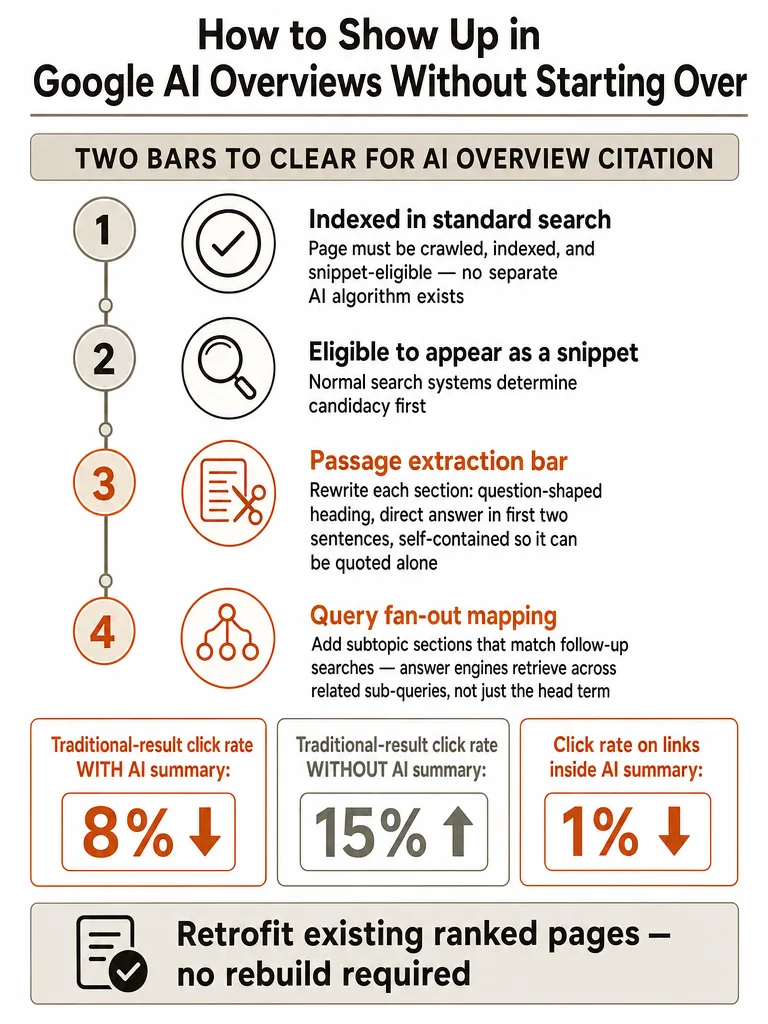
The technical eligibility bar is low: a page must be indexed in Google Search and eligible to appear as a snippet. Arthur Dosik states this directly, which means most pages that already rank clear the bar without any AI-specific configuration. There is no separate AI Overview setting to enable.
That's the good news and the trap. Passing eligibility feels like progress, but eligibility only makes a page available for citation. It does nothing to make a section quotable.
Think of it as two gates:
| Gate | Requirement | Who fails |
|---|---|---|
| Eligibility | Indexed and snippet-eligible in Google Search | Blocked crawlers, noindex tags, orphaned pages |
| Extraction | Self-contained sections with a direct answer up top | Pages ranking well but buried in narrative prose |
Most SEO archives already pass the first gate. According to Google's help documentation, AI Overviews draw on the normal Search index, so if a page ranks, it's almost certainly indexed and snippet-eligible.
Eligibility is table stakes; extraction is where citations are won or lost. The rest of this guide lives at the second gate.
How do I optimize content to get cited in AI Overviews?
Put a direct answer in the first one or two sentences below a question-shaped heading, because AI systems extract passages rather than whole pages. That's the core rewrite pattern Arthur Dosik recommends, and it maps cleanly onto how AI Overviews assemble a response from quotable fragments across multiple sources.
The rewrite is mechanical and repeatable:
- Turn the H2 into the literal question a reader types. "How much does X cost?" beats "Pricing overview."
- Answer it in the first sentence, with the key term in the opening words. Lead with the claim, not with background.
- Add one context sentence, then one sentence carrying a specific number or named source. Give the model something concrete to lift.
- Make the section self-contained. Dosik stresses that each section should be quotable independently, so kill "as discussed above" and "this" references that only resolve with the rest of the page.
- Keep sections short. A tight, single-topic block is easier to extract than a 600-word wall.
None of this requires a rebuild. You're editing passages inside pages that already rank, which is why an existing archive is usually the fastest route to citations. Teams with a legacy blog can work through how to refresh old SEO posts for AI citations URL by URL rather than starting a new content program.
Ready to move faster? Get My Site GEO Optimized.
How should query fan-out change your section plan?
Query fan-out means one search becomes many. HowWorks reports that Google's generative Search features rely on retrieval-augmented generation and query fan-out, issuing multiple related searches across subtopics and data sources before synthesizing a response. So a single page rarely answers an AI Overview alone; Google stitches together passages that each answer a different sub-question.
That changes how you plan sections. Instead of one long article on a head term, build a set of self-contained sections that each own a distinct follow-up query. Every H2 becomes a candidate answer for one branch of the fan-out.
Practically, map your outline to the real sub-questions:
- The head query gets the definition and direct answer.
- Each likely follow-up ("what triggers it," "do you need schema," "how do clicks change") gets its own extractable section.
- Comparisons and how-tos get tables and numbered steps, since those are the shapes Google lifts cleanly.
A page structured as a bundle of independent answers gives Google more surfaces to cite than one continuous essay on the same topic. This is the operational difference between writing for a ranking and writing for retrieval. Guidance that stops at "do good SEO and add schema" skips it entirely.
Do you need schema to appear in Google AI Overviews?
Schema is not a proven trigger for AI Overview citation, and this corpus does not support claims that FAQPage or any other markup directly causes it. The strongest evidence points to normal Search eligibility and answer quality: Arthur Dosik ties citation to being indexed, ranking in the top ten, and writing extractable passages, not to a specific markup type.
Structured data still earns its place. It helps Google understand entities and can support snippet eligibility, which is the gate you must clear first. What the sources don't show is a measured link between a schema type and citation rate.
The honest hierarchy: rank first, structure passages second, add schema as supporting infrastructure. If you want the deeper picture of where markup fits alongside answer structure, see the broader breakdown of why blogs still get skipped by AI Overviews.
How should you prioritize AI Overview visibility when clicks can drop?
Prioritize AI Overview presence, but budget for lower click-through, because the summary answers many users before they click. HowWorks cites a Pew Research Center study in which users clicked a traditional result 8% of the time when an AI summary appeared, versus 15% when it did not. In the same study, users clicked a link inside the AI summary just 1% of the time.
That's roughly a halving of traditional clicks on affected queries, plus a thin recovery from the summary's own links.
| Scenario | Traditional result click rate | In-summary link click rate |
|---|---|---|
| AI summary shown | 8% | 1% |
| No AI summary | 15% | n/a |
Source: Pew Research Center figures as cited by HowWorks.
So the value of a citation isn't only the click. It's the mention: being named in the answer millions of users read. With AI Overviews at over 2.5 billion monthly active users per HowWorks, visibility inside the summary is brand exposure even when the click doesn't follow.
The strategic move is to prioritize AI Overview citation for informational, high-volume queries where you were already losing clicks to the summary anyway, and keep classic ranking work for transactional queries where Overviews rarely appear.
How do you know whether the problem is indexing, query mismatch, or weak passage structure?
Diagnose in order: eligibility, then query type, then passage structure. Each failure mode has a different fix, and rewriting passages won't help a page that isn't indexed or a keyword that never triggers an Overview in the first place.
Work through it top to bottom:
- Is the page eligible? Confirm it's indexed and snippet-eligible in Google Search. If crawlers are blocked or the page carries noindex, nothing downstream matters. This is the low bar Arthur Dosik describes.
- Does the query trigger AI Overviews at all? Test the actual search. Dosik notes Overviews cluster on informational, question-shaped queries and appear far less on navigational, transactional, and YMYL searches. Stackmatix adds that they're intermittent even on eligible queries, so test a few times.
- Do you rank in the top ten? Dosik reports top-ten pages get cited far more often. Below that, extraction fixes are premature.
- Are your passages extractable? If you rank and the query triggers an Overview but you're not cited, the likely culprit is structure: no direct answer under a question heading, or sections that only make sense in context.
Most teams assume a structure problem when the real issue is query mismatch: the keyword simply doesn't produce an Overview. Rule that out before you rewrite. For a version organized around trigger, extraction, verification, and freshness, the AI Overviews citations breakdown walks each failure point.
Which existing pages should you refresh for AI Overview citations next?
Refresh ranking URLs on informational, question-shaped queries first, since they clear the eligibility bar and match the searches most likely to produce an Overview. Prioritize pages that already sit in the top ten, target definitions or how-tos, and currently bury their answer in narrative prose. Those are the fastest wins because the ranking is done and only the passage structure needs work.
A working priority order:
- Top-ten informational pages with weak answer structure. Highest leverage: ranking is in place, extraction isn't. Retrofit these using how to retrofit old SEO posts for AI Overviews.
- Legacy SEO posts on question-shaped keywords. Update facts and add a direct answer up top with the refresh workflow for old posts.
- Glossary and definition pages. These answer "what is X" queries cleanly; tighten each entry as a standalone passage using the guide to updating glossary pages for AI search citations.
- Fragmented archives across a domain or multiple sites. For teams triaging at scale, the GEO content strategy for B2B SaaS sites with old blogs covers keeping winners and refactoring the rest.
Nothing here asks you to rebuild. Mentionwell runs this as a repeatable pipeline: onboard a domain, define the site profile, and refresh ranking pages into citation-shaped drafts across one site or hundreds, so AEO, GEO, LLMO, and classic SEO stay aligned in a single workflow.
Sources
- Find information in faster & easier ways with AI Overviews ...support.google.com
- Suddenly today AI overview is not showing up when I do a ...www.stackmatix.com
- Google AI Overviews Not Showing Up: Why and How to Fix ...support.google.com
- How to disable AI overview - Google Search Communitywww.androidauthority.com
- How to turn off AI overviews in Googlehowworks.ai