How do you brief an agency for answer-engine citations?
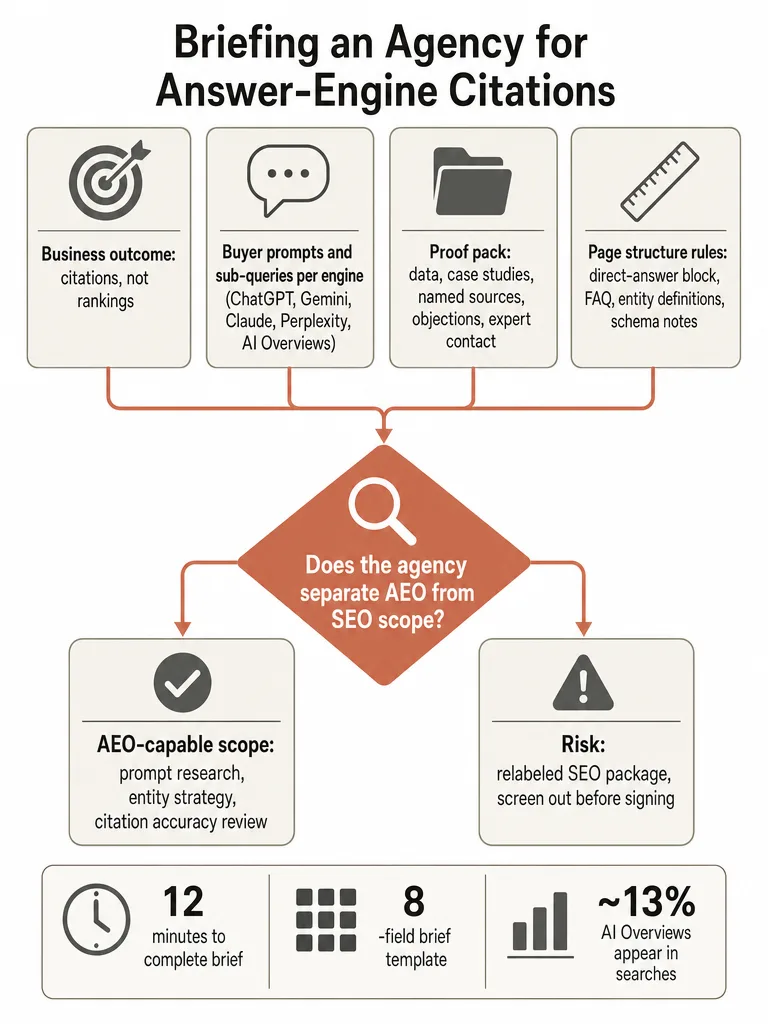
A brief built for AI citations names the business outcome, hands the agency the exact buyer prompts to win across ChatGPT, Gemini, Claude, Perplexity, and Google AI Overviews, supplies proof the agency can quote, and sets citation-based success metrics instead of rankings or traffic.
Briefing an agency for AEO also means keeping that document separate from your SEO brief. DerivateX's guide to briefing an SEO or GEO agency notes the two disciplines take different inputs and get measured in different ways, so folding them into one vague scope is the fastest way to get generic deliverables back. The same guide ties the urgency to a Gartner forecast from 2024 that traditional search volume would fall by roughly a quarter in 2026 as buyers moved their questions to AI chatbots and other answer engines, a shift DerivateX says is now underway.
A good brief fits on one page and answers four questions before the agency opens a draft: what business outcome you're buying (demos, signups, pipeline, not a ranking position), which queries and AI prompts you need to win, what proof you can hand over, and who approves what and how fast. Skip any one of those and the agency fills the gap with guesswork, usually the safe, generic kind.
The sections below walk through each input in order: the prompts to hand over, the proof the agency needs before drafting, who owns approvals once drafts start moving, the page structure to require, and the scorecard to lock in before the contract starts.
How is an AEO brief different from a standard SEO brief?
An SEO brief is built around a keyword, a concise phrase a author can target and rank. An AEO brief is built around a prompt, the buyer's full situation that an AI system fans out into several sub-queries before it writes an answer. Google ranks pages for a keyword; AI engines cite sources for a prompt, and that distinction changes nearly every assumption in the brief.
Answer-engine optimization (AEO) is the practice of structuring a page so an AI system can extract, trust, and cite it inside a generated answer, instead of simply ranking it on a results page.
The gap shows up first in how you pick competitors to study. Profound's guide to AI content briefs points out that a brief built around only the keyword's top-ranked pages can benchmark against the wrong set entirely, because the sources an AI system cites for a buyer's full prompt are often not the pages sitting at the top of the blue-link results. A brief that hands the agency a SERP screenshot and calls it competitive research misses the citation gap it's supposed to close.
The second gap is extraction. A page can satisfy every traditional SEO target, the keyword in the title, the right word count, internal links, and still read too vaguely for an AI system to lift a clean passage from it. A deeper look at the priority order between AEO and SEO fixes covers which changes to run first when a site already ranks but isn't getting cited.
Which buyer questions and prompts should you hand the agency?
The agency needs the buyer's full prompt in question form, not a compressed keyword, plus a set of fan-out sub-queries and a named list of engines to track for each one. Profound's guide to AI content briefs argues that AI search runs on prompts answer engines expand into several sub-queries searched on the buyer's behalf, so a brief anchored to one keyword misses most of the actual searches that decide citations.
- Write the primary target as a question, not a keyword. Choco Media's GEO content brief template builds around a primary query in question form because a question maps to intent and naturally produces answer-first writing; its eight-field template takes about 12 minutes to fill out.
- List the fan-out sub-queries under that primary question, the follow-up questions a buyer or an AI system would ask next: pricing, alternatives, implementation time, specific integrations.
- Name which engines to track per prompt. Pull from ChatGPT, Gemini, Claude, Perplexity, and Google AI Overviews, since a prompt that wins in one engine doesn't automatically win in another. A checklist of retrieval and evidence requirements specific to Perplexity is worth handing over separately, since that engine's citation behavior doesn't map cleanly onto Google's results page.
- Hand over your own prompt history if you've already run informal checks on how your category gets answered, instead of asking the agency to guess at your buyer's language from scratch.
What proof should you hand the agency before drafting starts?
An agency can't write a claim an AI system will quote without the client supplying the evidence behind it. DerivateX's briefing guide lists the proof pack a client should hand over before drafting starts: original data, case studies with real numbers, named sources, common sales objections, and one expert who will answer questions directly.
- Original data: any first-party number, survey, or usage metric nobody else can quote. AI systems favor specific, verifiable claims over general statements.
- Case studies with real numbers, not "significant improvement" language. A figure with a name attached is citable; a vague outcome is not.
- Named sources for every existing claim on your site, so the agency can decide what still holds up rather than guessing which numbers survived a product change.
- Common sales objections, so pages answer the comparison questions buyers actually put to AI systems instead of only the questions marketing wants to answer.
- One expert who answers the agency's questions during drafting, not after a document review weeks later.
Without that pack, the agency defaults to summarizing what competitors already publish, the opposite of what gets a page cited over them.
Who approves what, and how fast should reviews move?
Decide one named approver and a turnaround expectation before the brief ships, not during the first review cycle. DerivateX's briefing guide frames this as one of the four questions a sharp brief must answer up front, alongside business outcome, target prompts, and proof. Skipping it has a cost the guide puts in concrete terms: a team working from a vague brief loses its first 30 days to discovery it already paid the agency for, while a team starting with a clear target can publish against it almost immediately.
In practice this means naming the one expert from your proof pack as the person the agency contacts directly while drafting, rather than routing questions through a committee that meets once a month. It also means stating explicitly who signs off on a page before it ships, one person, not a rotating group, since SEO and GEO work is briefed as separate objectives and may need separate sign-off if different teams own search traffic and AI visibility. A brief that names the approver and the expected turnaround removes a guess the agency would otherwise make by defaulting to the slowest, most cautious version of the work.
What should an AEO content brief require for page structure and schema?
An AEO brief needs structural requirements written out explicitly: a direct-answer opening, an FAQ section, named entity definitions, heading syntax that mirrors the target question, and schema notes scoped to what still works. The Enough Agency's AEO brief framework treats these as author instructions, not style preferences, because a brief that skips them tends to produce prose that reads fine and extracts badly.
| Brief requirement | What to specify | Why it helps extraction |
|---|---|---|
| Direct-answer opening | Open each section with a direct one- to two-sentence answer | Gives the AI system a self-contained passage to lift without rewriting |
| FAQ section | Answer real buyer questions directly under their own heading | Matches the question-shaped retrieval AI systems run against |
| Entity definitions | Name every product, competitor, and term on first use | Helps retrieval systems resolve what the page is actually about |
| Heading syntax | Headings phrased as the literal question a buyer asks | Mirrors the language the engine is already searching on |
| Schema notes | FAQPage and Article schema; skip HowTo | Google deprecated HowTo structured data in January 2026, per Animalz's citation guide, while FAQPage and Article schema remain effective |
One more tactic worth leaving out of the brief entirely: llms.txt. Animalz cites SE Ranking's analysis of roughly 300,000 domains, which found no measurable citation effect from the file. A breakdown of why pages still get skipped by AI Overviews covers the extraction failure points worth fixing instead: trigger, extraction, verification, and freshness.
How do you measure AEO success after publishing?
An AEO scorecard needs five fields locked in before work starts: answer inclusion, citation rate, citation accuracy, share of voice, and AI referral traffic. The Enough Agency's brief framework tracks all five post-publish, and citation accuracy carries its own weight: DerivateX's agency guide points out that being described incorrectly by an AI model isn't a win, even when the brand gets mentioned.
Answer inclusion is the binary check, whether the engine's response references the page or brand at all for a tracked prompt. Citation rate turns that into a percentage across the full prompt set. Citation accuracy checks whether the engine described you correctly when it did cite you, pricing, positioning, features, not just whether it named you. Share of voice compares your citation count against competitors across the same prompts, and AI referral traffic is the field with a dollar figure attached: sessions arriving from an AI engine's answer page.
What questions reveal whether an agency actually knows AEO?
Ask an agency to show its prompt research method, its entity strategy, and its citation-accuracy review process before signing. The Enough Agency frames all three as required parts of a real AEO brief. An agency that can't produce them is likely relabeling a standard SEO package rather than running a separate AEO process.
- Ask how they build the prompt and sub-query list for your category. A real AEO process starts there, not with a keyword tool.
- Ask how they decide which entities, your brand, competitors, category terms, need explicit definition on each page, and whether that direction gets written into the brief or left to the author's judgment.
- Ask what their citation-accuracy review looks like after publishing: do they check whether an AI system describes you correctly, not just whether it names you.
- Ask them to show a brief from a past AEO engagement, not a finished article. A document with a keyword, a word count, and a list of H2s is an SEO brief with a new label on it.
- Ask which engines they track and how often they re-check prompts, since citation standing shifts faster than ranking position does.
If the answers sound like a standard SEO retainer with "AI" added to the proposal title, a comparison of AEO platforms by pricing and feature set is a useful second opinion on what dedicated AEO tooling and process actually look like.