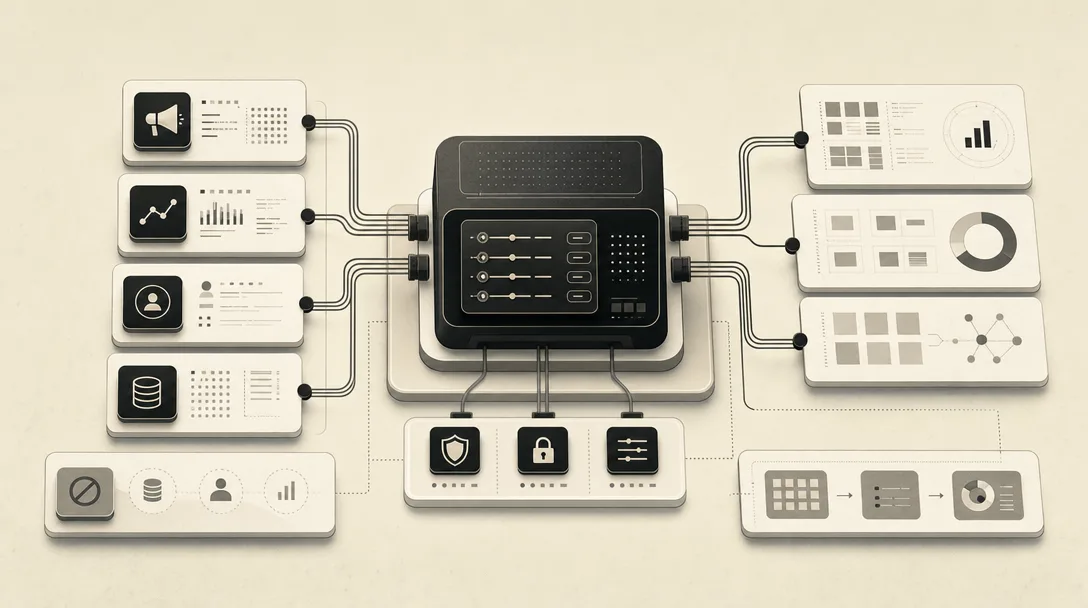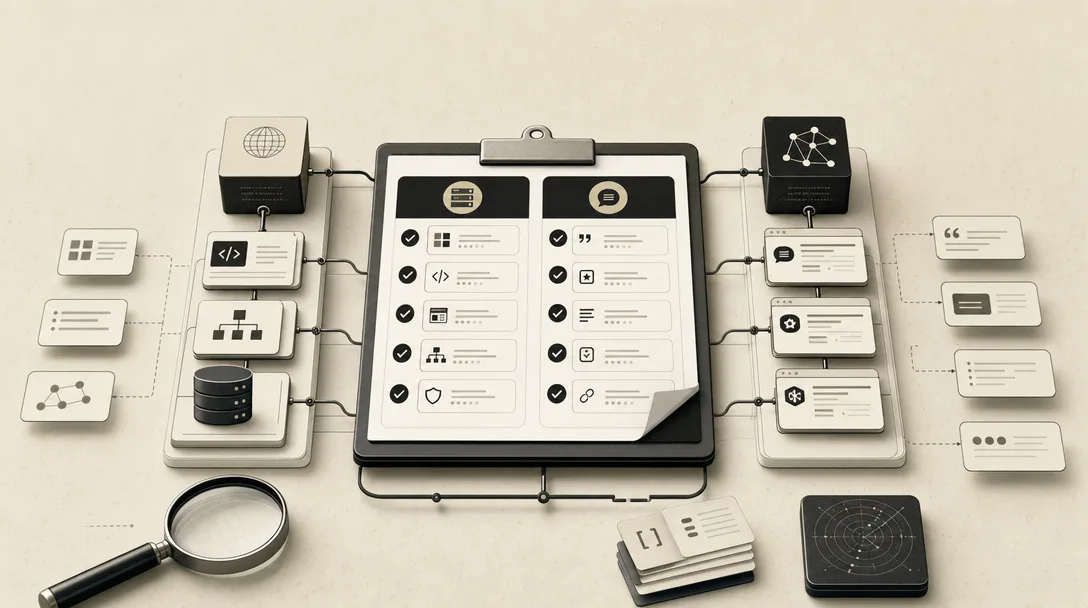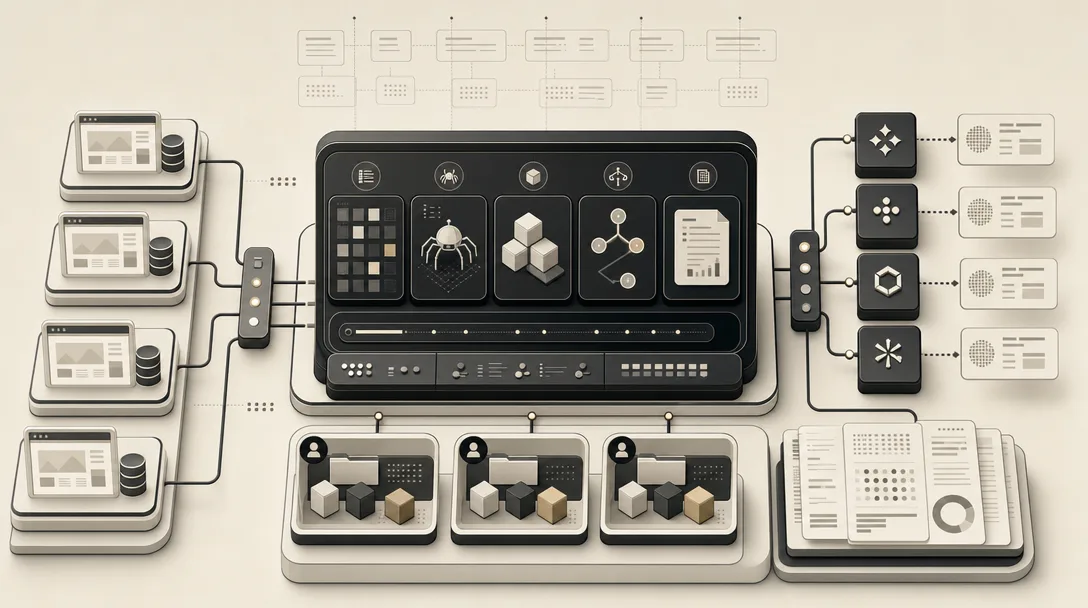
How do agencies manage AEO across multiple client sites?
Agency-scale AEO is a standing operating system built from four repeating steps: prompt tracking, crawler-access checks, content fixes, and scheduled re-measurement, run for every client account on a fixed cadence. Answer Engine Optimization (AEO) is the practice of improving how often and how accurately a brand appears in AI-generated answers on engines such as ChatGPT, Gemini, and Perplexity, according to HubSpot. Applied across a client portfolio, that practice only holds up if a team can build it once and reuse it for every account, per DeepSmith.
DeepSmith frames the trigger for this shift plainly: a client forwards a screenshot showing a competitor named in a ChatGPT answer while their own brand is absent, then two more clients ask the same question that week. Handling that for one account is a project you can push through manually. Handling it for a full book of clients needs a repeatable loop of audit, fix, and re-measure, with the mechanical steps running on a schedule and strategists reserved for the calls that actually need judgment. HubSpot's research adds commercial weight to the urgency: 42% of CRM software buyers now use AI search as part of their evaluation process.
Multi-client AEO succeeds or fails on whether that loop repeats without a rebuild each time.
How should agencies build a prompt inventory for each client?
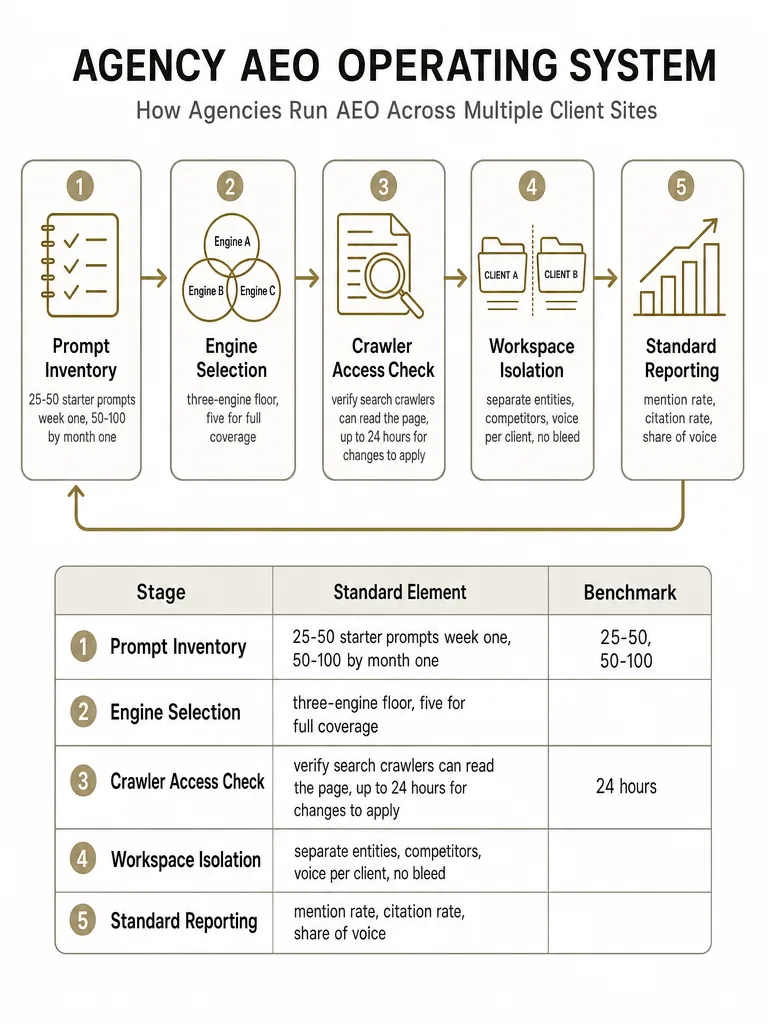
Every client's AEO program starts with a prompt inventory built from real buyer language, tagged by funnel stage, question type, and target engine, rather than a generic list imported from another account. DeepSmith recommends sitting with a client's sales and customer success teams to write down the questions buyers actually ask, in their own words, at each stage of the funnel.
Tag every prompt with three attributes: the funnel stage it belongs to, whether it's a brand question or a category question, and which engine the agency plans to check it on.
The most common failure here is copying a generic industry prompt list into every account; generic prompts produce generic reports a client can spot immediately. For a full framework on building these lists, see how to brief writers for AEO and GEO.
Which AI engines should an agency track for each client?
Agencies size engine coverage to each account instead of treating one dashboard as a stand-in for the whole answer-engine market. ChatGPT, Perplexity, Gemini, Google AI Overviews, Google AI Mode, and Microsoft Copilot each draw on different crawlers and different source pools, so a citation in one doesn't predict a citation in another, per DeepSmith.
DeepSmith recommends a floor of three engines for smaller accounts, typically ChatGPT, Perplexity, and Google AI Overviews or AI Mode, and five engines for enterprise clients who need broader coverage. DeepSmith's own product pricing scales the same way: a base tier tracking ChatGPT runs $99 a month, a mid tier adding Perplexity runs $199, and a top tier adding Gemini runs $399.
| Account size | Engine floor | Typical engines |
|---|---|---|
| Smaller or single-product client | 3 engines | ChatGPT, Perplexity, Google AI Overviews or AI Mode |
| Enterprise or multi-product client | 5 engines | Adds Gemini and Microsoft Copilot |
What crawler-access checks confirm a client page can actually be cited?
The first technical gate in a multi-client AEO program is crawler access. A page a crawler can't read can't be cited, no matter how well it's written; content-quality review only matters once that gate clears. DeepSmith's audit step runs the same check on every client site: confirm the crawler behind ChatGPT search can reach the pages, confirm the Perplexity crawler can, confirm Googlebot can, and confirm Bingbot can, then log the robots.txt rules, meta robots rules by page type, and canonical URL setup for each account.
Three details matter enough to check every time. Blocking OpenAI's training crawler does not remove a site from ChatGPT search; blocking the search crawler does, and the two are governed by different rules. Perplexity's robots.txt changes can take up to 24 hours to take effect, so a same-day access test can show a false failure. And robots.txt controls crawling, not indexing: if a client wants a page kept out of Bing, Copilot, or grounded answers entirely, a noindex directive is the correct control, not a robots.txt block.
For the full technical checklist, see what to check in an AI visibility audit.
How do agencies keep client entities and voice from bleeding into each other?
Cross-client contamination is a named risk in multi-client AEO work. PromptEye describes it as "brand bleed": an AI system accidentally associating one client's facts, products, or history with another client's. The fix is workspace isolation, built into the process from the start rather than patched in after a mistake surfaces.
PromptEye's discovery step starts by mapping each client's entities separately: the people, locations, core products, and proprietary technologies tied to that specific brand. DeepSmith extends the same principle into daily operations, keeping each account's competitor set, prompt list, brand context, and reporting inside its own isolated workspace rather than a shared spreadsheet filtered by client name.
The practical test is simple: if a strategist could accidentally paste one client's positioning into another client's brief, the workspace isn't isolated enough. Separate entity maps and separate prompt lists close that gap before it turns up in a monthly report.
Where does structured data fit into a multi-client AEO workflow?
Structured data helps answer engines parse a page's structure, but it isn't the mechanism that gets a page into Google's AI features. HubSpot recommends adding FAQ, HowTo, Article, and Product schema across client sites to give AI systems unambiguous data points about what a page covers.
DeepSmith is more specific about what schema does and doesn't control: nothing about Google's AI Overviews or AI Mode requires special markup or a separate file. A page still needs to be indexed and eligible to show a standard snippet, meaning classic SEO fundamentals, crawlability, and a clean canonical setup carry the same weight they always did.
For a multi-site agency, schema belongs in the standard template for every client: Organization and Article at minimum, FAQ where a page answers direct questions, Product where relevant. It's a supporting signal, not a substitute for a page actually ranking and being extractable.
AEO vs SEO: what changes and what stays the same across client accounts?
SEO and AEO chase different outcomes but share most of the underlying technical work. HubSpot frames the difference by goal: SEO's goal is qualified traffic, measured by rankings, click-through rate, and other page performance metrics, while AEO's goal is visibility inside AI-generated answers, measured by mentions and citations. Because both disciplines depend on crawlability, clear structure, and topical depth, agencies typically staff and budget them as one connected work stream rather than two separate line items.
| What changes | Under SEO | Under AEO |
|---|---|---|
| What you're chasing | Higher rankings and more clicks from human searchers | More mentions and citations inside AI-generated answers |
| Who reads it | People scanning a results page | An answer engine parsing the page, with people reading its output indirectly |
| How you know it's working | Rank position, click-through rate, impressions | Mention rate, citation count, share of voice, AI referral traffic |
| What you optimize | Backlinks, domain authority, keyword usage, technical health | Answer clarity, content structure, how cleanly a passage can be lifted out of context |
HubSpot notes that improvements in one discipline often lift the other, since both depend on the same foundation. For a breakdown of which change to make first on an existing site, see AEO vs SEO: what B2B SaaS teams should change first.
Which metrics belong in a recurring multi-client AEO report?
A defensible client report needs the same metric set for every account, checked the same way each time. DeepSmith's baseline for multi-engine AEO reporting covers mention rate, citation rate, share of voice, visibility trend over time, sentiment, average position within an answer, source diversity, page-level attribution, and prompt coverage.
Two of those nine deserve special attention when a number looks off. Source diversity, per DeepSmith, measures how many distinct domains an engine pulls from when answering a given prompt; a low count can mean the engine is leaning on one or two sources repeatedly, which limits how far a single content fix can broaden citation coverage. Page-level attribution ties a citation back to a specific URL, so a fix can be scoped to that page instead of the whole site.
Running the same measures across every client, on the same cadence, is what turns individual account snapshots into a comparable book of business an agency can review in one sitting instead of client by client from scratch.
How often should agencies audit and re-measure AEO across a portfolio?
DeepSmith's model runs audit, fix, and re-measure as a fixed loop per client, calendared so the mechanical parts, prompt re-runs, crawler checks, and reporting rollups happen on schedule rather than only after a client raises a concern.
For prompt volume specifically, DeepSmith recommends locking somewhere between 30 and 100 final prompts per client, and treats 30 prompts per quarter as the floor for numbers an agency can actually defend in a report. Below that floor, a single bad week in the data can look like a collapse; above roughly 100, teams tend to dilute attention across too many low-value questions.
A quarterly re-check against that locked prompt set, layered on top of the monthly reporting cadence, gives an agency a stable baseline for showing whether a fix actually changed citation behavior or whether the change was noise.
Which parts of multi-client AEO can run on autopilot, and which still need a person?
Most of the mechanical steps in multi-client AEO can run on a schedule: crawler-access checks, scheduled prompt re-runs across tracked engines, reporting rollups, and publishing fixes into a client's CMS are repeatable tasks that don't need a strategist re-deciding them every cycle, in DeepSmith's framing of "agentic AEO."
What still needs a person is judgment: mapping a client's entities correctly the first time, catching and correcting sentiment errors or hallucinations in how an engine describes a brand, and deciding which prompt gaps deserve a content fix versus an off-site play. PromptEye lists sentiment monitoring and correcting hallucinations as a core operational task precisely because that call can't be templated.
For agencies running this loop across dozens of client sites, the publishing and refresh layer, drafting citation-shaped pages and shipping them into each client's CMS on schedule, is the piece a content engine like Mentionwell is built to handle, freeing strategists to spend their time on entity mapping and client strategy instead of manual production.
Public detail on how individual agencies structure pricing, staffing, or margins for this service line is limited as of this writing; the operating steps above reflect what the available sources document about the workflow itself.