What Is the Best Automated Blog Engine for SaaS Marketers?
The best automated blog engine for SaaS marketers is whichever platform matches your growth stage and CMS setup while running a full editorial pipeline, not just drafting. Citation-readiness for AI answer engines now sits alongside classic SEO as a selection criterion, since AEO, GEO, and LLMO outcomes depend on structure a drafting tool alone cannot guarantee.
QueryMint's 2026 buying guide for marketing automation argues the correct evaluation sequence is growth model first, requirements second, tools third, a reversal of how most comparison posts are built. It treats email tools and full automation platforms as distinct categories and warns that picking the wrong one forces a migration that can run $5,000 or more later. The same logic applies to blog engines: a drafting assistant and a full-pipeline engine solve different problems, and buying the wrong category means re-platforming your content operation mid-year.
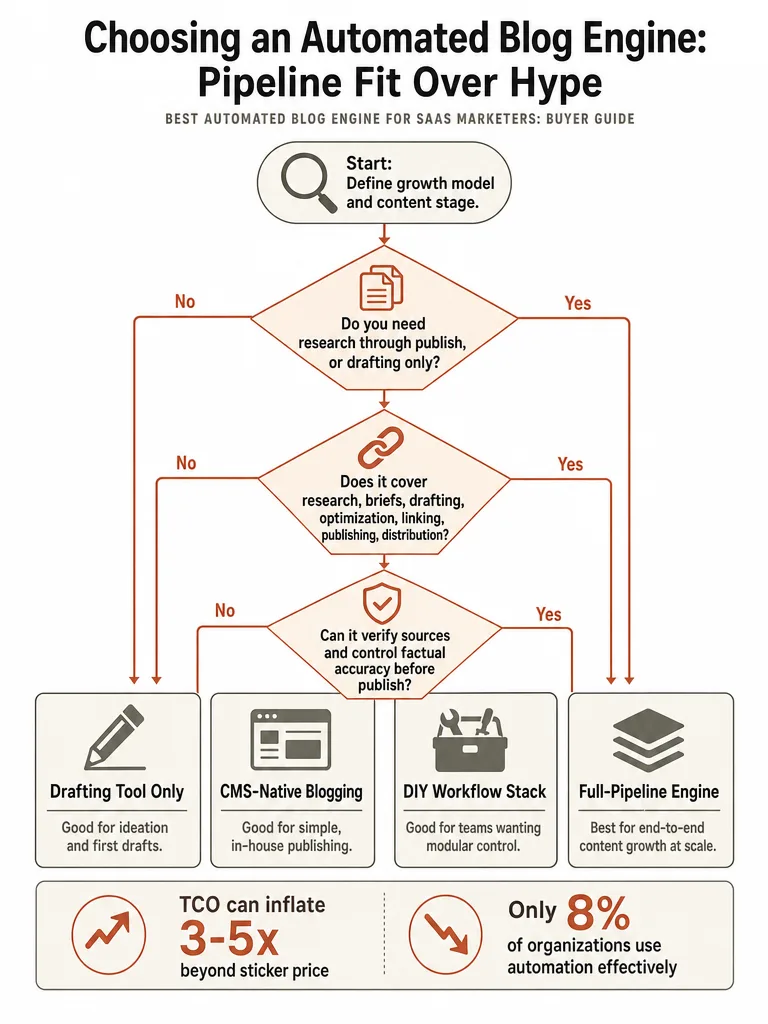
A cleaner way to separate the category is to ask whether a tool only generates article text or also handles research, briefs, optimization, internal linking, publishing, and distribution. Most tools on the market still automate one or two of those stages, usually drafting, which is why teams expect hours back and don't see them show up on the calendar.
Drafting Tool vs Full-Pipeline Engine vs CMS-Native Platform vs DIY Stack: Which Fits Your Team?
Automated blog tools split into four workable categories, and the split matters more than any single feature comparison. TheStacc's 2026 review of 10 blogging tools, built on 90 days of testing across four small-business sites, separates the market into full-pipeline platforms that research, draft, optimize, and publish; optimization layers that help an existing author improve a draft; and bulk generators that produce templated articles at scale. CMS-native blogging and DIY integration stacks round out the picture for SaaS teams with existing publishing infrastructure.
| Category | What It Automates | Example Tools | Best Fit |
|---|---|---|---|
| Drafting-only | Article text from a prompt or keyword, with no surrounding pipeline | KoalaWriter | Solo creators who still run research, optimization, and publishing by hand |
| Full-pipeline (self-described) | Research, drafting, optimization, internal linking, and publishing in one workflow | theStacc, BlogSEO | Teams that want the whole process automated, not just the writing step |
| CMS-native blogging | Hosting, templating, and basic SEO fields built into the CMS | WordPress, Webflow, Ghost | Teams with an existing content team that need a home for output, not generation |
| DIY workflow stack | Syncing or generating CMS records from an external source of truth | AirOps, Byword, Whalesync paired with Airtable | Teams with engineering capacity to own integrations |
TheStacc and BlogSEO both describe themselves as full-pipeline platforms on their own marketing pages; neither claim has been checked by an independent third party, so treat the label as a starting point for due diligence rather than a verdict.
A drafting tool bolted onto a CMS you already run is not the same purchase as a full-pipeline engine, even though both ship articles. The first still requires someone to handle research, briefs, optimization, and internal linking by hand. The second is built to remove those steps entirely. Teams evaluating an AI search content engine for citation outcomes specifically should start by confirming which of these four categories a vendor actually falls into, since marketing pages rarely say so directly.
Which Blog Engine Is Actually Best for AI Search Citations, Not Just Classic SEO?
Citation-readiness means a page is structured so an AI answer engine can lift a passage, check the claim inside it, and quote it without rewriting it first. That is a separate requirement from classic SEO ranking ability. An automated blog engine that gets a page ranking on Google doesn't automatically get that page cited by ChatGPT or Google AI Overviews, because answer engines extract and verify passages before they'll quote them.
The stakes are higher than a ranking miss. Leading AI models hallucinate between 15% and 27% of the time, according to figures cited by 1mind, and Deloitte found that 47% of enterprise AI users have made a major business decision based on incorrect AI output. An automated blog engine that publishes unverified claims at scale isn't producing weak content. It's feeding the exact failure mode buyers are trying to get away from.
The available sources do not include an independent, cross-engine benchmark naming one automated blog engine as the best-performing source for citations across ChatGPT, Perplexity, Claude, Gemini, and Copilot. Vendor comparisons tend to measure organic traffic lift, not citation rate, which are related but not the same outcome. Buyers evaluating this specifically should read AEO vs SEO: what to change first before assuming a traffic-focused tool solves a citation problem.
What Does Pricing for an Automated Blog Engine Actually Look Like?
Published prices for automated blog engines in 2026 run from $0 for AirOps Insights to $15,000 or more a month for enterprise content platforms, and neither number reflects what you'll actually spend. US Tech Automations' 2026 review of Webflow programmatic SEO tooling lists SEOmatic at $149 a month, Byword Create at $99, and Whalesync Starter at $40, each covering one slice of the pipeline rather than the whole thing. At the top end, 1mind's 2026 buyer's guide for AI marketing automation platforms puts enterprise content platforms at $1,250 to $15,000 or more a month, with $7,000 to $50,000 in implementation costs on top of the subscription.
| Tool / Tier | Price Floor | What's Included | Hidden Cost Driver |
|---|---|---|---|
| AirOps Insights | $0/mo | Workflow gates, content ops tooling | Paid tiers required once volume grows |
| Whalesync Starter | $40/mo | CMS-to-database sync | Needs a separate review layer before publish |
| Byword Create | $99/mo | Drafting at the CMS record level | Still requires manual internal linking and optimization |
| SEOmatic | $149/mo | Webflow-native content generation | Narrow to Webflow; broader pipeline needs another tool |
| Enterprise content platforms | $1,250 to $15,000+/mo | Full workflow automation, integrations | $7,000 to $50,000 implementation on top of subscription |
Pricing for AirOps, Whalesync, Byword, and SEOmatic comes from US Tech Automations' 2026 Webflow programmatic SEO review. Enterprise pricing comes from 1mind's 2026 buyer's guide for AI marketing automation platforms.
The same inflation pattern applies to blog engines priced as a single monthly line. A $99 drafting tool that still needs a separate research step, a separate internal-linking tool, and a reviewer's time isn't a $99 purchase. Price the whole pipeline, not the sticker.
How Do You Build an Automated Blog That Scales Across a SaaS Content Calendar?
Scaling a SaaS content calendar means automating seven connected stages, not writing faster. The creator of Right Blogger, in a 2026 YouTube breakdown of eight blog automation tools, frames the real process as research, briefs, drafting, optimization, internal linking, publishing, and distribution, and says most tools only touch one or two of those stages, usually drafting, which is why promised time savings don't materialize.
- Research: pull keyword, competitive, and topical-gap data before anything gets written, so the brief has a reason to exist.
- Briefs: turn research into a structured spec, including target entities, sources to cite, and the question the page answers.
- Drafting: produce the article against that brief, grounded in the sources it names.
- Optimization: add direct-answer structure, schema, and on-page SEO fixes.
- Internal linking: connect the new page to relevant existing posts in the archive.
- Publishing: push to the CMS or headless delivery layer without a manual copy-paste step.
- Distribution: route the published piece into whatever syndication or notification process the team already runs.
Programmatic SEO efforts fail at this same bottleneck: teams template the drafting stage and skip the rest. For a closer look at what should stay standardized versus what has to vary page to page, see programmatic SEO templates for SaaS.
How Do You Choose Between Competing Automated Blog Engines? A Buyer Checklist
Evaluating automated blog engines on writing quality alone misses most of the actual risk. Fast Copywriting's 2026 buyer framework for automated blog tools argues the real evaluation criteria are factual accuracy, source traceability, workflow and review controls, SEO support, privacy, pricing model, and CMS integration, not how fluent the output reads.
- Factual accuracy: does the tool ground claims in named sources, or does it generate from the model's own training data?
- Source traceability: can you trace every statistic or quote in a draft back to where it came from?
- Workflow and review controls: is there a draft-first gate before anything publishes, or does content go live unsupervised?
- SEO support: does it handle on-page structure, internal linking, and schema, or only prose?
- Privacy: where does your site and customer data go once it's fed into the tool?
- Pricing model: is cost tied to seats, articles, words, or sites, and does that match how your team actually works?
- CMS integration: does it publish into the stack you already run, or require migrating to a new one?
Mentionwell is one route into this checklist. The company describes its own workflow as research-grounded drafting with AEO, GEO, LLMO, and SEO structure built into every article, plus programmatic SEO support and delivery into an existing CMS or headless stack. That's a self-description, not an independent audit, and it should be checked against the same seven criteria as any other vendor on your shortlist. For a wider look at how platforms in this space differ on pricing and capability, see the top 10 AEO platforms compared.
Do You Need a Full-Pipeline Engine, or Will a Drafting Tool Plus Your Existing CMS Work?
A full-pipeline engine is the wrong purchase before your messaging, acquisition channel, and content foundation are defined; a drafting tool paired with your existing CMS is often enough until then. Mercury's guidance on automation for startups makes the point directly: automation amplifies what already works, and it's a poor fit when positioning or the nurturing process is still undefined. Buying a bigger engine doesn't fix an undefined content strategy, it just produces more of it faster.
QueryMint's decision rule, built for marketing automation but equally applicable here, is growth model first, requirements second, tools third. A team with a thin or outdated archive has a different requirement than a team sitting on years of ranking content that just needs AEO-shaped rewrites. The first team needs a full-pipeline engine to build an archive from nothing; the second needs a lighter tool that can retrofit what's already there.
If your blog already has volume but weak AI-engine visibility, the fix usually isn't a new platform, it's triaging the archive you have. That path is covered in GEO content strategy for B2B SaaS sites with old blogs, which walks through keeping the pages worth keeping before adding any new tooling on top.