Why Does ChatGPT Recommend a Competitor Instead of Your Brand?
ChatGPT picks a competitor over your brand when that competitor's pages give the model something to quote, cite, and trust that yours don't, according to Malik Browne, founder of ResilientNiche. This is a structural GEO (Generative Engine Optimization) problem: the model favors whichever page removes the most ambiguity from the buyer's question, and that page can be built in weeks rather than earned over years of reputation. Chatlo makes the same point more directly: a competitor usually wins the mention not because they're better at the work, but because more of what the model reads talks about them. That gap is fixable in a way "be better at your job" never was.
Three Failure Modes: Citation Gap, Association Gap, and Retrieval Gap
A competitor mention in ChatGPT breaks down into one of three distinct failures: a recommendation gap, a source-only gap, or an association gap, and each needs a different fix. Generic advice to "publish more content" assumes one cause, but the three failures point to different missing evidence and different remediation paths. This diagnostic split, not another content checklist, is what separates a fixable citation gap from months of wasted effort.
This is the core diagnostic problem in Generative Engine Optimization, the discipline of getting a brand cited and recommended by AI answer engines, and Answer Engine Optimization (AEO), the discipline of earning direct-answer placement. Neither treats "a competitor shows up instead of me" as one bug with one patch.
A recommendation gap is when the model names a competitor outright. A source-only gap is when it cites your domain as a reference but never says your brand name in the visible answer, an AEO measurement problem covered in more detail below. An association gap is when your brand doesn't show up anywhere, not even as a citation, because the model has no reliable entity record for you, an LLMO (large language model optimization) problem tied to how your brand is represented in structured data.
Formative Digital's Matt Griffin frames the first diagnostic split around retrieval mode: is the competitor recommendation coming from ChatGPT's trained knowledge, or from a live Search-mode lookup against Bing's index? He lists five common causes behind either mode: weak entity grounding, no comparison content on your own domain, thinner third-party citations, weaker schema, and stale pages. Most real cases combine more than one. A brand with no Wikidata entry and no comparison page is failing on association and recommendation at once, and the two failures don't share a fix.
How Does ChatGPT Decide Which Brands to Mention?
ChatGPT and Perplexity don't use Google rankings to decide who gets recommended. They aggregate signals across review platforms, category listicles, community threads, and comparison content, according to DerivateX. A brand that has built those signals at scale wins the recommendation regardless of its organic position.
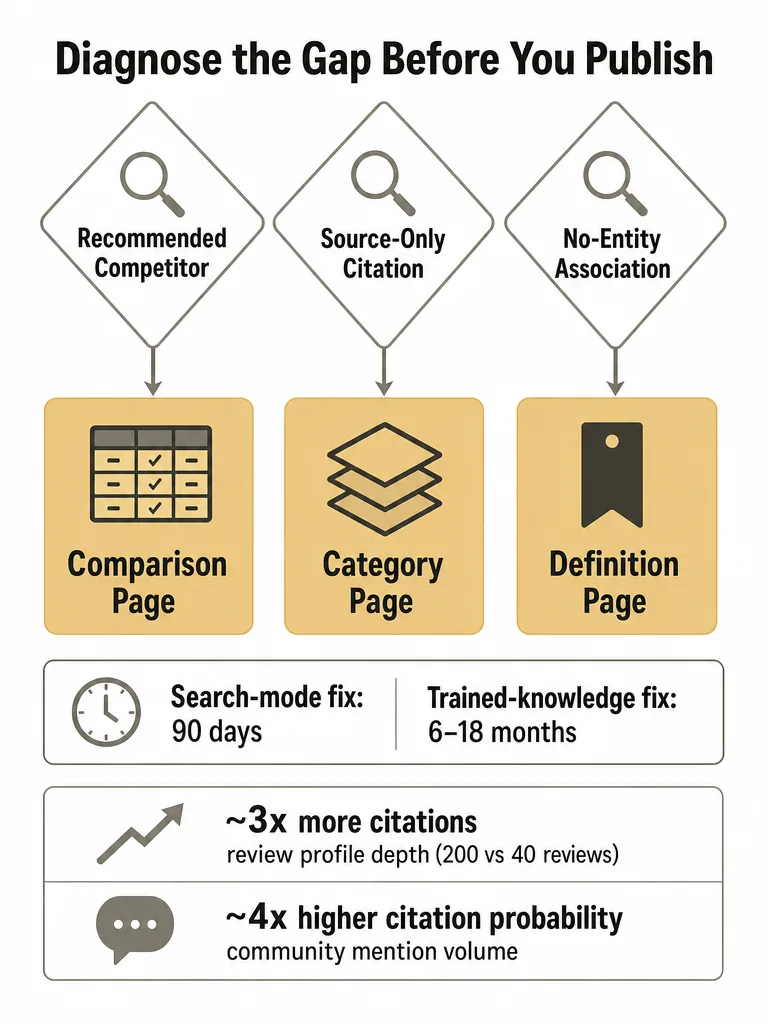
The gap is measurable and specific. DerivateX reports that a competitor with 200 G2 reviews and a complete feature comparison grid gets cited roughly 3x more often than a brand with 40 reviews and a stub profile. Listicle inclusion works the same way: if a competitor appears in 15 "best [category] tools" roundups on sites like G2, Capterra, SoftwareAdvice, and GetApp, and you appear in 2, you're losing 13 citation inputs per query before the prompt even runs. Community presence adds another layer, covered later in this piece.
None of these signals live on your own site. That's the part classic SEO audits miss: your homepage can be flawless and still lose the recommendation, because the model isn't reading your homepage to decide who leads the category.
Can ChatGPT Cite Your Page Without Naming Your Brand? A GEO Measurement Problem
Yes, and this is the failure mode most competitor-mention advice skips entirely. A domain can be cited as a source while the brand behind it is never mentioned in the answer text a user actually reads, which makes citation tracking and brand-mention tracking two separate AEO metrics rather than one. GetIntel measured this directly across 3,609 answers collected between 07/12/2026 and 08/08/2026: its domain was cited 190 times, but its brand name appeared in the visible text only 45 times.
That's a citation-to-naming ratio of roughly 4-to-1 in GetIntel's own data. It means citation tracking alone overstates visibility, because a page can be doing its job as a reference source, feeding facts into an answer, without doing anything for brand recall. The model treats "supporting evidence" and "recommended entity" as separate jobs, which is exactly why GEO and AEO programs track them as separate numbers instead of collapsing them into one visibility score.
If your analytics show citations climbing while a founder still can't get ChatGPT to say your name, this is almost certainly why. The fix is not more citable facts. It's language on the page that explicitly names and defines the brand next to the answer, the pattern covered in how to get cited in ChatGPT using posts you already have.
Trained-Knowledge Mode vs Search-Mode: Two Different Remediation Timelines
ChatGPT answers a category question in one of two modes, and each has a different remediation clock. Trained-knowledge mode, the default for evergreen questions, pulls from the pre-training corpus and is slow to move. Search mode, the default for current, local, or explicit-lookup queries, hits Bing's live index and can shift within weeks. Formative Digital gives concrete windows for each.
| Mode | What it draws on | Signal that it's this mode | Realistic fix timeline |
|---|---|---|---|
| Trained-knowledge | Pre-training corpus | Recommendation is consistent across accounts and survives a fresh conversation | 6 to 18 months |
| Search-mode | Bing's live index | Answer cites specific URLs and changes when those URLs change | About 90 days |
Most real competitor-recommendation problems are mixed: trained knowledge gives the competitor a baseline preference, and Search-mode reinforces it because their content is structurally cleaner. That means fixing one layer without the other produces a partial result: ChatGPT Search cites your new page within weeks while the plain "who's best at X" conversational answer keeps naming the competitor for another year. Diagnose which mode is actually driving the answer you're worried about before you build anything.
How to Check Whether ChatGPT Mentions Your Brand Before You Fix Anything
Build a fixed prompt set before touching a single page. This is the core AEO tracking method behind everything in this piece: instead of guessing which fix to try first, you log the same three outcomes on the same prompts every time, the way you'd track keyword rank, except the tracked unit is a mention, a citation, and a competitor name instead of a position. Ranklytics recommends 15 to 25 buying-intent prompts covering the actual questions a prospect would type, not your keyword list. Run each one across ChatGPT and the other engines you care about, and log three separate outcomes per run.
- Brand mention: does your brand name appear anywhere in the visible answer text?
- Citation: is your domain listed as a source, even if the name never appears?
- Competitor name: which competitor, if any, gets named or recommended in your place?
Logging all three separately is what exposes which of the three failure modes from earlier you're actually dealing with. A page that shows citations with zero brand mentions is a naming problem. A prompt with zero citations and zero mentions is an association problem. A prompt where a named competitor shows up clean is a recommendation problem, and the fix for each is different. Re-run the same set on a schedule; single snapshots don't tell you whether anything moved.
Comparison, Category, or Definition Content: Matching Page Type to Failure Mode
The page you publish first should match the failure mode, not a generic content calendar. A recommendation gap, where a named competitor beats you outright, closes fastest with a direct comparison page that gives ChatGPT explicit language to pull from instead of the competitor's own "us vs them" framing, which Formative Digital flags as one of the five most common causes of a lost recommendation. An association gap, where you don't show up at all, needs a category or definitional page that establishes what you are before it can establish that you're a leading option in it. A retrieval gap, where technical access is the blocker, needs the crawl and schema fixes covered in the AI visibility audit checklist before any new content will register.
| Failure mode | Symptom | Page type to publish first |
|---|---|---|
| Recommendation gap | Competitor named outright | Direct comparison page ("Brand X vs Brand Y") |
| Association gap | No mention, no citation | Category or definitional page establishing the entity |
| Source-only / naming gap | Cited but not named | Existing page rewritten with explicit brand-name answer passages |
| Retrieval gap | No crawl or index access | Technical fix: crawlability, schema, sitemap coverage |
Teams running this across a full site archive, rather than one page at a time, are effectively doing programmatic SEO against a fixed set of failure-mode templates. That's where a blog engine like Mentionwell fits into the workflow: once a site profile flags which failure mode applies to a given topic cluster, the publishing stage can template the matching comparison or category page instead of drafting each one from a blank document.
Third-Party Signals That Move Competitor Mentions
Off-site evidence moves competitor mentions more than anything published on your own domain, because DerivateX found that AI engines weight review-platform depth, listicle inclusion, and community presence as separate, stackable inputs. Fixing your own page addresses the association gap; fixing these addresses the recommendation gap directly, since these are the sources the model is aggregating from in the first place.
The community-presence gap is the most overlooked of the three. DerivateX reports that brands with high mention volume on Reddit and Quora have roughly 4x higher AI citation probability than brands with minimal activity in those threads. That tracks with Chatlo's four-point check: is your competitor named in a roundup you're absent from, do they have an active forum presence you don't, do they publish prices and hours in machine-readable form versus your contact form, and are their reviews recent while yours sit stale for years. Chatlo notes fixing any two of the four tends to move several engines at once, because they share underlying sources, and the resulting movement arrives in clusters rather than one engine improving in isolation. Third-party evidence, not your own homepage, is usually the deciding input in a straight recommendation contest.
Why Entity Grounding on Wikidata and Schema Fixes the No-Mention Problem
An association gap, where your brand doesn't appear at all, usually traces to missing entity grounding rather than missing content. Formative Digital identifies a Wikidata entry as one of the five highest-leverage fixes, because Wikidata feeds Google's Knowledge Graph, and that graph in turn enters the corpora that ChatGPT, Perplexity, Gemini, and Apple Intelligence read from. A competitor with a Wikidata entry and connected Organization and Person schema has a structured, verifiable identity the model can retrieve with confidence. A brand without one is asking the model to infer identity from unstructured prose, which it won't do reliably in a recommendation-style answer.
Formative Digital also cites analysis attributed to Azoma indicating that pages carrying FAQ schema alongside inline citations are weighted approximately 40% higher in source selection. Schema doesn't replace the entity record Wikidata provides, but it reinforces it at the page level, giving the model a machine-readable answer shape to extract rather than a paragraph to interpret.
How to Tell If Your Competitor-Mention Gap Is Actually Closing
Rerun the same set of 15 to 25 buying-intent prompts on a recurring cadence and track three outcomes each time: whether your brand is mentioned in the visible answer, whether your domain is cited as a source, and which competitor, if any, gets named in your place. A single before-and-after check misses the pattern, because Chatlo's clustering effect means movement often shows up across several engines at once rather than gradually on one.
Freshness is part of what you're measuring, not a separate concern. Formative Digital reports that 76.4% of ChatGPT-cited pages had been updated within 30 days of citation, which means a page that closed the gap once can lose it again if it goes stale. Build the recheck into the same cadence as your refresh schedule rather than treating measurement as a one-time audit. Watching mentions climb while citations stay flat, or the reverse, tells you which of the three failure modes is still open, and that's the signal that decides what you publish next.