What Is an AI Visibility Audit?
An AI visibility audit is a structured review of how often a brand appears in AI-generated answers, where it appears, and how it is described, according to OutreachBloom's audit framework covering ChatGPT, Perplexity, Gemini, Claude, and Google AI Overviews. The audit rests on one distinction that changes strategy: a mention is your brand named inside an AI response, while a citation is a clickable source link, typically inside Perplexity, AI Overviews, or ChatGPT Search.
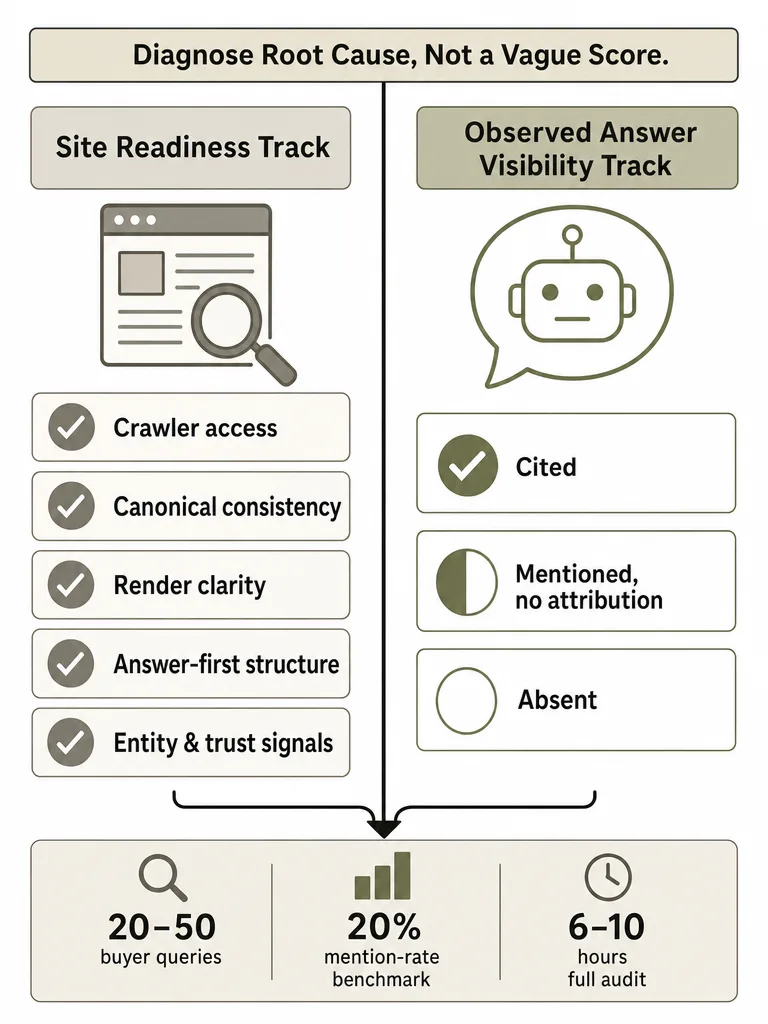
GEO-Pulse frames the audit as two separate evidence sets rather than one blended score: whether your pages are technically ready for AI systems to access and interpret, and whether your brand actually shows up for a fixed set of buyer questions. Confusing the two is the most common mistake teams make when they try to explain a bad audit result.
What Should an AI Visibility Audit Check?
An AI visibility audit checklist should check two distinct evidence sets: website readiness and observed answer visibility, each tested on a repeatable schedule rather than once. GEO-Pulse defines readiness as the observable condition of a site's own pages, covering response status, robots directives, canonical tags, rendered copy, headings, structured data, authorship, business identity, and internal links, while observed visibility comes from dated prompt tests run across the same AI platforms every cycle.
Observed answer visibility means dated captures of whether a brand, a specific page, or a named competitor appeared for the same defined buyer questions across the same configured engines, run on the same schedule so results are comparable over time.
Skipping the readiness half and jumping straight to prompt testing is why most audits produce a score without a fix list. A page can fail crawl access, canonical consistency, and rendering all at once and still get judged purely on whether ChatGPT happened to name the brand that day. The ten checks below split across these two tracks: checks one through seven cover readiness, check eight builds the prompt library that feeds the observed-visibility tests in checks nine and ten.
Why AI Visibility Audits Cannot Rely on Your Google Rankings
Ranking well in Google tells you almost nothing about whether AI engines will cite you. Ahrefs research cited by OutreachBloom found that roughly 80% of URLs cited in AI responses don't rank in Google's top 100, which means classic SEO position and AI citation are largely separate outcomes measured on separate surfaces.
The traffic math makes the stakes concrete. OutreachBloom reports that around 93% of AI search sessions end without a click to any website, so a missed mention isn't a minor ranking loss, it's a buyer conversation that never included you.
The Q2 2026 Quarterly Search Report from Search Engine Journal, referenced by Ed2Market, adds a sharper version of the same gap: across eight AI platforms, 96% of brands were described accurately in direct searches, yet 89% did not appear for broader category research queries. Brands the AI already knows still go missing the moment a buyer asks a general "who does this" question instead of asking about the brand by name.
Check 1: Can AI Crawlers Access Your Site Right Now?
Crawl access is the first true blocker check, because nothing downstream matters if AI bots can't reach a page. Test whether GPTBot, ClaudeBot, and PerplexityBot can retrieve your site by checking robots.txt directives and reviewing server log files, a method Lily Grozeva's audit checklist on LinkedIn runs using Screaming Frog log file analysis alongside Knowatoa.
ZipTie.dev frames this as the first step in any AI search readiness audit, ahead of content structure or entity work, since a blocked crawler makes every other fix irrelevant. If GPTBot is disallowed at the robots.txt level or a CDN rule is silently blocking known AI user agents, no amount of on-page optimization changes the outcome.
Check each bot separately rather than testing "AI crawlers" as one group. A site can allow GPTBot while blocking ClaudeBot through a firewall rule nobody remembers writing, and the difference only shows up when you check bot-by-bot.
Check 2: Are Your Canonical Tags and URLs Consistent?
Conflicting canonical tags and duplicate URL variants are enough to make a retrieval system treat one piece of content as several separate documents, or to cite a stale duplicate instead of the current URL. GEO-Pulse places this check directly after crawl access in its readiness sequence, since both failures block the same downstream reading of a page.
Public detail on exactly how AI retrieval systems resolve canonical conflicts is limited as of this writing. What the available guidance supports is the practical check: confirm each important page has one canonical URL, that internal links point to that canonical version consistently, and that URL depth for key assets stays flat rather than buried several folders deep, a fix Lily Grozeva's checklist also flags using Screaming Frog to flatten URL structure.
Treat this as a housekeeping pass tied directly to the crawl access check above, not a separate project.
Check 3: Does Your Content Render Clearly for AI Systems?
Rendered answer clarity checks whether the content an AI system actually sees matches what a human sees in a browser. GEO-Pulse lists this as a distinct readiness check because a page can pass every crawl and canonical test and still fail here if the visible text depends on client-side JavaScript that a crawler never executes.
ZipTie.dev names this failure mode directly, framing JavaScript-dependent rendering as one of the clearest ways a technically crawlable page still becomes invisible to AI extraction. If your answer, your key facts, or your pricing table load in after the initial HTML response, an AI system fetching the raw page may retrieve an empty shell instead of your content.
The fix is architectural, not cosmetic: server-side render or pre-render the content that matters most, especially the opening paragraph, headings, tables, and any data you want quoted. Test it the same way a crawler would, by viewing page source rather than the rendered DOM in a browser inspector.
Check 4: Do Your Pages Open With a Direct Answer AI Can Quote?
The opening sentence of a page determines whether an AI system can lift it as a quotable passage. OutreachBloom's audit framework checks five things on every high-priority page: a direct-answer opening sentence, FAQ schema, a dateModified timestamp, embedded citations, and a clear H2 and H3 hierarchy.
A page can rank well and still open with a scene-setting paragraph, a company anecdote, or a rhetorical question instead of the answer itself, which makes it a poor extraction candidate no matter where it sits in search results. The fix is structural: state the direct answer to the heading's implicit question in the first sentence or two, then let the H2 and H3 hierarchy carry the supporting detail so an AI system can trace which claim answers which sub-question.
This check pairs naturally with the entity and freshness signals covered next.
Check 5: Is Your Entity and Trust Context Clear Across the Web?
Entity and trust context asks whether your brand is unambiguously identifiable to AI systems, not just to a human reader landing on your homepage. GEO-Pulse lists this as its own readiness check, separate from on-page content quality, because AI systems draw identity signals from across the web, not from a single page.
ZipTie.dev frames the goal as making a brand unambiguously identifiable to AI engines, and treats this alongside E-E-A-T signals as a core part of AI search readiness. Ed2Market's audit similarly includes a dedicated step to assess E-E-A-T signals such as authorship, business identity, and evidence of expertise.
Practically, this means checking that your business name, leadership, and offerings are described consistently across your own site, third-party profiles, and any structured data you publish, so an AI system pulling from multiple sources builds one coherent picture of who you are rather than several conflicting ones. Original data and clearly attributed authorship both strengthen this signal.
Check 6: Are Your Internal Topic Links Strong Enough to Support Citation?
AI systems use link structure to infer which pages belong to the same topic cluster, and GEO-Pulse treats weak internal linking as its own readiness check, distinct from crawl access or rendering. A page that covers a subject well but sits isolated from related content sends a weaker topical authority signal than one embedded in a clearly linked cluster.
Lily Grozeva's checklist treats this as an active fix, not a passive audit item: improving internal linking across related content clusters, mapped visually with tools like Screaming Frog. Public detail on exactly how much internal linking moves AI citation odds is limited as of this writing, but the underlying logic follows classic topical authority: isolated pages are harder for any retrieval system, human or automated, to place in context.
When you build out GEO content briefs for new pages, treat internal linking to the surrounding topic cluster as a required field, not an afterthought added after publish.
Check 7: Do You Need Schema Markup, an llms.txt File, or Both?
Most sites need schema markup; almost none need a special AI-only file. GEO-Pulse resolves this directly by pointing to Google's own guidance for AI features and websites, which states that the normal technical and content foundations for Search still apply and that there is no special AI-only schema or file required. OpenAI separately documents crawler controls, including GPTBot behavior, in its publishers and developers documentation.
That's a meaningfully different answer than several checklists in circulation, which list "publish llms.txt" as a standard audit step alongside schema implementation, as seen in Lily Grozeva's checklist covering Person, Organization, FAQ, HowTo, and Service schema. Schema markup has a documented mechanism: it gives structured data validators and search systems an explicit description of your content type. An llms.txt file has no equivalent documented mechanism for improving citation, based on the guidance in this research.
The practical split: treat schema implementation as a real, verifiable readiness check with tools like a schema validator, and treat llms.txt as an optional crawler-access convenience rather than a citation lever. If you're weighing whether to add one, what llms.txt actually does is worth reading before you spend engineering time on it.
Check 8: How Do You Build a Buyer Prompt List for Testing?
A buyer prompt list is the input that makes observed answer visibility testable, and OutreachBloom recommends building one with 20 to 50 queries written the way real buyers phrase questions, not the way a brand describes itself. LLM Pulse suggests a similar range for a first audit, 30 to 50 prompts, enough to spot patterns without making the process unmanageable.
Lily Grozeva's checklist calls this step topical coverage and prompt alignment: build a core topic map tied to buyer intent, then extract long-tail prompts buyers might actually type into an LLM. In practice, a solid prompt library spans four shapes:
- Category-definition prompts – "what is [category], how does it work"
- Comparison prompts – "[brand] vs [competitor]," "best tools for [use case]"
- Recommendation prompts – "what should I use for [problem]"
- Use-case prompts – phrased around a specific job, team size, or budget
Skipping straight to branded prompts is the most common shortcut, and the weakest one. Ed2Market's data shows brands score well when asked about directly but disappear on the broader category questions that actually drive discovery, so the prompt list has to include both.
Check 9: How Do You Test and Log AI Answer Visibility Across Platforms?
Testing AI answer visibility means running the same prompt across multiple engines and recording exactly what came back, not just whether the brand appeared. GEO-Pulse's audit framework requires logging the prompt, the engine, the date, the response, and any cited sources for every test, because without those fields the result can't be compared to the next run.
Session conditions change outcomes, so control for them. LLM Pulse recommends running tests in private or incognito sessions, logged out where possible, and repeating the same prompt on different days since results can vary by session and user context. Ed2Market goes further, recommending each query run two or three times across the major AI tools because a single pass can miss platform-specific variation.
The workflow, in order:
- Open a private or incognito session for each platform.
- Run the prompt exactly as written, without brand hints.
- Record: prompt text, engine name and version, date, full response, cited sources, whether the brand appeared as a citation, a mention, or not at all.
- Repeat the same prompt two to three times across sessions before scoring it.
- Rerun the full set on a fixed cadence.
This is the part of the audit that turns a one-time snapshot into something you can actually track. It's also the layer where a citation-shaped publishing workflow like Mentionwell's earns its place, since fixing a gap this testing surfaces requires shipping a page that answers the missed prompt, not just noting that it was missed.
Check 10: What Benchmark Tells You If Your AI Visibility Is Healthy?
A healthy baseline, per OutreachBloom's audit framework, is a 20% mention rate on category-defining prompts. Below that, a brand is effectively invisible on the questions that drive category discovery rather than direct brand lookups. Ed2Market found the same pattern from a different angle: 89% of brands did not appear for broader category-research queries at all.
Mention rate isn't the only thing worth benchmarking. OutreachBloom cites Superlines' analysis of 34,234 AI responses, which found the same brand can carry sentiment scores of 0.769 on Perplexity versus 0.052 on ChatGPT, a 14.8x gap between platforms for the same underlying brand. A single blended "AI visibility score" hides that kind of platform-specific swing entirely, which is another argument for logging results per engine rather than averaging them.
Once you have a baseline, rerun it. OutreachBloom's benchmark comes paired with a quarterly re-audit cadence, treating this as a tracked metric rather than a one-time report. A checklist run once tells you where you stood on one day; run quarterly, it tells you whether the fixes from checks one through nine actually moved the number.