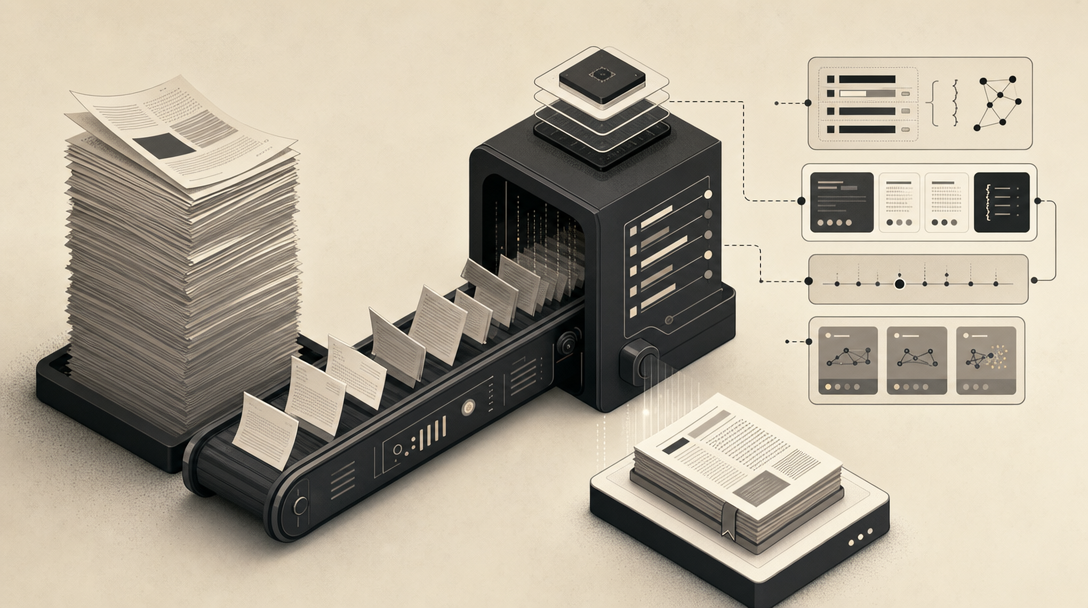
Does Koala Actually Write 500 Pages?
No public Koala source promises a literal "500 pages." The "500" framing is shorthand for high-volume article generation against a monthly word budget, not a fixed page count. According to KoalaWriter's pricing pages aggregated by AIMojo, plans run from $9/month for 15,000 words (Essentials) up to $350/month for 1,000,000 words (Elite), with a separate third-party review citing enterprise tiers as high as $2,000/month for 10,000,000 words. At Koala's stated average of 400 words per section and roughly 4 sections per 1,500-word article, a 1M-word plan produces somewhere around 600–650 articles — close enough to "500 pages" to be the working mental model.
The more useful question for operators is not whether the number is real, but whether throughput converts into citation yield in ChatGPT, Google AI Overviews, Gemini, Claude, Perplexity, Copilot, or Grok. Volume of published pages and volume of AI-engine citations are not the same metric, and no Koala source claims they are. Koala is built around classic SEO drafting at scale; AEO, GEO, and LLMO outcomes depend on page architecture, entity consistency, schema, and refresh cadence — work that sits outside the draft itself.
This article walks the Koala stack honestly — Bulk Writer, word controls, SEO features, pricing — and then draws the line between bulk SEO output and citation-shaped publishing for answer engines. For background on the framework, see AEO vs GEO vs LLMO: Which Workflow Fits Your Team?.
How to Use the Bulk Writer in KoalaWriter?
KoalaWriter's Bulk Writer is a queue-based generator: you enter a list of target keywords, click Bulk Create, and the articles are queued for asynchronous generation. According to KoalaWriter's official Bulk Writer documentation, output can be published one-click as-is, but Koala explicitly recommends spending more time tweaking inputs for the best results.
The same documentation includes a notable caveat: advanced options can significantly improve output when used properly, but may reduce quality when users do not know what they are doing. Bulk Mode is a throughput multiplier, not a quality multiplier — Koala's own support team flags that defaults are a floor, not a ceiling.
The practical Bulk Writer loop:
- Prepare a keyword list with consistent intent (don't mix transactional and informational queries in one batch).
- Configure advanced options once — tone, point of view, target audience, internal linking, real-time data — and reuse the preset.
- Submit the batch via Bulk Create; articles enter the queue and process in parallel.
- Review output in Polish Mode rather than auto-publishing.
- Push to WordPress, Shopify, Webflow, or Ghost via 1-Click Publishing.
| Bulk Writer use case | Fit | Why |
|---|---|---|
| Affiliate content sites | Strong | High-volume, SERP-shaped articles with predictable templates |
| Agency client backlogs | Moderate | Works if every client gets unique input tweaking |
| Programmatic SEO at scale | Weak without governance | No native taxonomy, brand profile, or refresh layer |
| AEO/GEO/LLMO citation pages | Weak | Bulk drafting is not optimized for answer-engine citation structure |
How to Limit Word Count in KoalaWriter?
You cannot. According to KoalaWriter's official support documentation, it is not possible to limit the article word count by providing an exact number — length is controlled by the number of sections instead. That single sentence corrects most third-party tutorials that imply a hard word target.
Koala's support team gives the working math:
- 400 words on average per section.
- Custom article length supports 1 to 48 sections.
- 3 sections produces around 1,200 words.
- 4 sections produces about 1,500 words.
There are also five preset article lengths mapped to section ranges:
| Preset | Sections | Approximate words |
|---|---|---|
| Shorter | 2–3 | 800–1,200 |
| Short | 3–5 | 1,200–2,000 |
| Medium | 5–7 | 2,000–2,800 |
| Long Form | 7–10 | 2,800–4,000 |
| Longer | 10–12 | 4,000–4,800 |
Is Koala.sh Good for SEO Content?
Yes for classic SEO drafting, with caveats for answer-engine work. KoalaWriter is built on OpenAI GPT models with access to real-time data, and according to Koala's product pages it ships with the feature set most SEO teams expect:
- Deep Research Mode, which Koala says uses 100x more context to research a topic and pulls from authoritative sources for factual, well-cited content.
- Real-Time SERP Analysis, which Koala says analyzes top-ranking content for a keyword in real time and identifies entities and semantic keywords to include.
- Automatic Internal Linking, which Koala says indexes the entire site and has created over 10 million links to date.
- Schema Markup generation for articles.
- 1-Click Publishing to WordPress, Shopify, Webflow, or Ghost with formatting and images intact.
- Outline Editor and Polish mode for post-generation refinement.
- Amazon Affiliate Articles templated for product-led sites.
According to Koala, more than 19,000 content creators use the product. A third-party review at Juliety reports generating over 200,000 words with Koala for content sites.
The honest read: Koala is a strong SEO drafting and SERP-mirroring engine, but mirroring the current SERP is not the same as engineering a page to be cited by ChatGPT, Perplexity, or Google AI Overviews. SERP-shaped content tells you what's already ranking; citation-shaped content tells an answer engine why your page is the cleanest extractable source on the topic. Those overlap, but they are not identical.
For the citation side of the workflow, see How to Show Up in ChatGPT in 2026 and How to Show Up in Perplexity in 2026.
What Editorial Work Still Happens After Koala Generates the Draft?
A lot more than the "1-click" framing suggests. According to a Best AI Tools UK tutorial, Koala generates a 1,500–2,000 word article in one to five minutes, but the full publish-ready workflow takes about 45 minutes per article — meaning roughly 40 of those minutes are post-generation labor.
A representative third-party Koala workflow from Weekend Growth looks like this:
- Build the outline in ChatGPT before generation.
- Run Koala to produce the draft.
- Use Polish Mode to tighten copy.
- Hand off to a VA for images and asset prep.
- Add internal links via Link Whisper.
- Insert affiliate links where relevant.
- Configure RankMath SEO settings.
- Final read-through, then publish.
That ratio matters when you scale. A 100-article batch in Bulk Writer represents 75+ hours of downstream editorial labor at the per-article rate above — before any AEO, GEO, or LLMO optimization is added on top.
Can You Generate Dozens or Hundreds of Articles at Once Using Koala Writer Tool?
Yes, through Bulk Writer in the UI or through the KoalaWriter API. According to Koala's API documentation, the KoalaWriter API is asynchronous: queue an article for writing, check the article status, and retrieve the full HTML once status is finished. The API is billed by words generated, and Koala says all paid plans include API access at no extra cost.
Realistic publishing volume by plan, using Koala's own ~400 words per section and a 1,500-word target article (~3.75 sections):
| Plan | Monthly words | Approximate 1,500-word articles |
|---|---|---|
| Free | 5,000 | ~3 |
| Essentials ($9/mo) | 15,000 | ~10 |
| Professional ($49/mo) | 100,000 | ~66 |
| Boost ($99/mo) | 250,000 | ~166 |
| Growth ($179/mo) | 500,000 | ~333 |
| Elite ($350/mo) | 1,000,000 | ~666 |
So the "500 pages" mental model lands somewhere between Growth and Elite. The cost math is real. The citation math is not part of the equation.
Content With Citations vs Content That Gets Cited by AI Engines
Content with citations and content that gets cited by AI engines are two different products with two different structural requirements. Koala says Deep Research Mode produces "factual, well-cited content" — meaning the article itself contains citations to sources. That is a quality signal for human readers and classic SEO. Getting cited by an AI engine is the inverse: your page becomes the source that ChatGPT, Perplexity, Gemini, Claude, Google AI Overviews, Copilot, or Grok quotes back to a user.
The structural requirements are different too. Pages that get cited by answer engines tend to share specific traits:
- Extractable direct answers in the first 1–2 sentences of every section, written so a model can lift them whole.
- Entity consistency — the same product, person, or concept named the same way across the article and across the site.
- Source transparency — visible citation lists with real URLs, not invisible training-data inheritance.
- Schema coverage — FAQPage and Article JSON-LD that map the page's structure for retrieval systems.
- Refresh cadence — archive pages updated when the underlying facts move.
- Crawler accessibility —
llms.txt, clean robots rules, and a per-article.mdmirror that retrieval systems can ingest cheaply.
A SERP-mirroring drafting tool optimizes for the first job. A citation-shaped pipeline optimizes for the second. For the deeper mechanics, see What Is LLMs.txt in 2026? and What Is AEO in 2026?.
Koala vs Mentionwell: Throughput Engine or Citation Pipeline?
KoalaWriter is a bulk SEO drafting engine; Mentionwell is a citation-shaped publishing pipeline. They share a category — AI-assisted content — but they sit at different points in the editorial stack and solve different operator problems.
| Dimension | KoalaWriter | Mentionwell |
|---|---|---|
| Core job | Bulk SEO drafting | Citation-shaped publishing |
| Length control | Section count, ~400 words/section | Pipeline-governed per article type |
| Research | Deep Research Mode, Real-Time SERP Analysis | 11-stage pipeline with live SERP, competitor pages, transparent source list |
| Optimization layers | SEO + schema | AEO, GEO, LLMO, and classic SEO on every article |
| Site governance | Bulk presets | Per-site brand profile, taxonomy, image style, reader API |
| Schema | Schema Markup | FAQPage and Article JSON-LD on every article |
| Distribution | 1-Click Publishing to WordPress, Shopify, Webflow, Ghost | WordPress, Webflow, Ghost, Shopify, Notion, plus public read-only API, RSS, JSON Feed, sitemap, per-article .md mirror, site-wide llms.txt |
| Optional inputs | Not available | GEO scan context: observed prompts, fan-out queries, cited-page claims, competitor gaps, schema patterns |
| Best fit | Affiliate sites, broad SEO coverage, draft acceleration | Multi-site brand control, archive refreshes, programmatic SEO with governance, AEO/GEO/LLMO delivery |
According to Mentionwell's product pages, every article runs through an 11-stage pipeline and ships with AEO, GEO, LLMO, and classic SEO layers, including short answerable subheadings, a TL;DR block, FAQ accordion, and a clean citation list. Articles can be served from a public read-only API or pushed into WordPress, Webflow, Ghost, Shopify, or Notion, and every article ships with FAQPage and Article JSON-LD, RSS, JSON Feed, sitemap support, a per-article .md mirror, and a site-wide llms.txt.
KoalaWriter and Mentionwell are not direct substitutes — one is a drafting engine, the other is a publishing engine designed around citation outcomes. Teams already using Koala for first drafts often layer a citation-shaped pipeline on top rather than replacing one with the other.
How to Choose Between 500 AI Articles and 15 Citation-Ready Pages
Pick the model that matches the job your content is actually doing.
Choose high-volume AI article generation (Koala-style) when:
- The goal is broad SEO coverage across long-tail keywords.
- You run affiliate content sites where article-per-keyword math drives revenue.
- You need draft acceleration for a human editorial team that will rework outputs.
- Search traffic — not AI-engine citation — is the primary KPI.
- Your CMS targets are WordPress, Shopify, Webflow, or Ghost with light governance needs.
Choose a smaller governed citation pipeline (Mentionwell-style) when:
- You need pages cited by ChatGPT, Google AI Overviews, Gemini, Claude, Perplexity, Copilot, or Grok — not just ranked.
- You operate across multiple client sites and need brand-consistent output with per-site profiles.
- Archive refreshes, taxonomy enforcement, and citation audits are part of the operating model.
- Programmatic SEO needs editorial governance, not just templates.
- AEO, GEO, LLMO, and SEO have to ship together on every page, not as a separate layer.
The honest reality: most serious teams need both. Koala or a similar drafting tool for breadth, and a citation-shaped pipeline for the 15–50 pages that have to win in answer engines. The mistake is publishing 500 SERP-mirrored articles and assuming AI citations follow. They do not.
For deeper reading on each piece of the citation stack, work through What Is GEO in 2026?, What Is LLMO in 2026?, and How to Show Up in Google AI Overviews in 2026.
If your editorial calendar already produces volume but your pages aren't being cited in AI answers, the gap is structural, not creative. Mentionwell runs the 11-stage pipeline, AEO/GEO/LLMO/SEO layering, schema, llms.txt, and CMS publishing on every article — across one site or hundreds. Get My Site GEO Optimized.
Sources
- Download book PDF - Springer Naturelink.springer.com
- 10 Mar 1938 - Advertising - Trovetrove.nla.gov.au