What should a SaaS comparison page brief check before it explains fit?
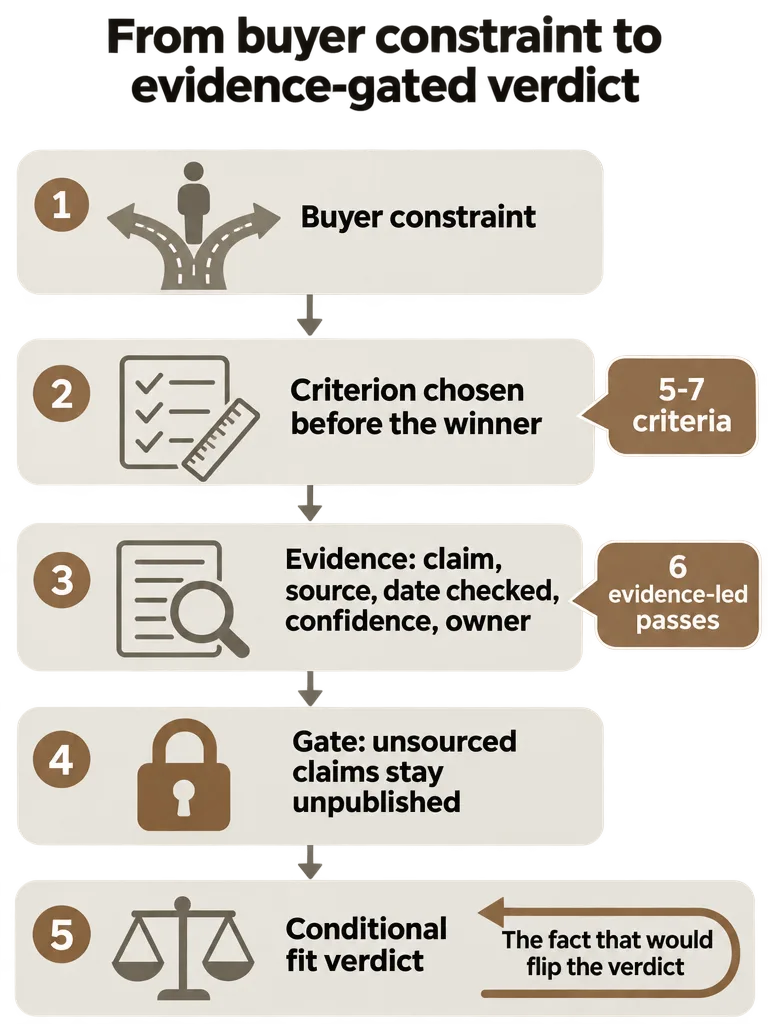
A SaaS comparison page brief that explains fit starts from the buyer's decision, not a chosen winner. It sets criteria that change the choice, then records source, checked date, confidence and owner per claim before any verdict is written. AIMKT organizes its guide around five buyer questions: decision, comparison basis, genuine differences, best-fit buyers, facts to verify.
The brief fixes the first question before anything else. In the buyer's wording: "What should I check about a content-publishing workflow before I trust a page that says it fits my team?"
The rest of this article is one worked, illustrative example. A SaaS team has an existing CMS and wants consistent, citation-shaped articles. Its buyer statements are invented to show the method and are not call evidence. The brief traces one constraint, "we can't rebuild our stack," through a criterion, an evidence sheet and a conditional verdict. Where no supporting document exists, the brief withholds the verdict instead of filling the gap.
Are the options substitutes, complements, or different jobs?
Options are substitutes only when they do the same job for the same owner. A publishing engine writes and ships articles. A monitoring tool observes where a brand appears in AI answers. A CMS stores and serves pages. A managed service supplies people. Search-grounded answers observed in this research mix these categories under overlapping buying queries, so the brief sorts them before comparing.
The option set should also include what the buyer does today. Unbounce's guidance says a SaaS comparison can cover direct competitors, manual workarounds and custom-built solutions, because the decision is which option fits the buyer's business.
Sort the set by the job being purchased:
- Publishing execution: articles must be produced and delivered.
- Measurement: brand mentions and citations must be observed.
- Both: a publishing product and a measurement product may be complements, not rivals.
The three terms sit on this split. Per HubSpot's optimization guide, AEO improves how often and how accurately a business appears in AI-generated answers. GEO targets AI assistants such as ChatGPT, though HubSpot itself groups it under AEO. LLMO is the broader effort to influence how models represent a brand. Because usage varies, the brief should say which meaning it uses for each task. SEO remains the foundation under all three.
For the measurement side, see this comparison of AEO platforms. This article makes no capability claims about named competitors, because the public documentation reviewed here does not verify any.
Which criteria belong in the brief, and which are feature noise?
A criterion belongs in the brief only when it traces to a buyer constraint and could change the choice. AIMKT recommends five to seven criteria chosen before researching a winner. That is editorial guidance, not a measured optimum. Unbounce suggests mining sales call recordings and deal data for current workarounds, evaluated alternatives and objections about price, functionality or implementation. Those objections become constraints.
| Illustrative buyer constraint | Criterion | Evidence needed | Buyer threshold that changes the choice |
|---|---|---|---|
| "We can't rebuild our stack." | Supported delivery into the existing CMS or headless setup | Documentation or written confirmation naming the buyer's CMS and delivery path | No supported path, or delivery requires migrating the CMS |
| "Nobody here edits drafts full-time." | Review ownership | Documented stages and who approves | Review work exceeds the buyer's editing capacity |
| "Our archive is five years old." | Refresh ownership | Documentation on refreshing existing posts | Refresh is out of scope or unowned |
| "Finance needs a number." | Pricing model | Public price page or written quote | Total cost exceeds the budget ceiling |
| "We run several sites." | Multi-site operation | Per-site configuration and support terms | Per-site setup must be repeated by hand |
Two layers stay separate. The right-hand column is a buyer decision threshold. A publication gate is different: any row with no supporting source stays unpublished, whatever the threshold says. The next sections follow row one only.
What should the evidence sheet record for each comparison claim?
The evidence sheet records the claim, source URL, date checked, confidence and owner, and it types each row. Observable product facts, attributed customer statements and measured outcomes are different proof and must not be mixed. Skayle's vendor-neutral framework adds that non-numeric evidence counts when labeled: documentation, workflow coverage and pricing transparency.
Build it in this order:
- List every claim the page will make, one per row.
- Attach a primary source URL (documentation, pricing page, dataset), not a summary of it.
- Confirm the cited passage supports the specific assertion. A URL alone does not.
- Record the date a named person actually checked it. If no one has, write "not recorded."
- Rate confidence: verified product fact, attributed inference, or unverified.
- Keep unresolved material capabilities out of affirmative fit verdicts.
| Claim | Source | Date checked | Confidence | Proposed owner | Type |
|---|---|---|---|---|---|
| Mentionwell runs eleven stages on every draft | Mentionwell features page, heading "Eleven stages. Every single draft." | Not recorded | Documented on supplied first-party page; current wording unverified | Product marketing | Product fact |
| Delivery into this buyer's CMS | Same page, heading "You choose how articles land"; no CMS named | Not recorded | Unverified; at most an attributed inference | Research lead | Unpublished |
| "Option B supports headless delivery" | None found | n/a | Unverified | Research lead | Unpublished |
| A hypothetical claim that customers cut setup time, with no customer statement or figure supplied | None | n/a | Unverified | Customer marketing | Customer statement, unpublished |
Who should choose each option, and what would reverse the verdict?
Each verdict carries a best-fit buyer, a rule-out condition, an evidence gate and the fact that would flip it. Prose's decision-page template supplies the frame: direct answer, tradeoffs, cost, speed, control, risk, failure modes and recommendations by scenario. Every option faces the same criteria. Rejection is reserved for a verified constraint failure.
The assumptions: an existing CMS, several sites, limited editor capacity.
| Option | Fits when | Rule-out only if verified | Open evidence gate | Fact that flips it |
|---|---|---|---|---|
| In-house workflow | Editor capacity covers the volume across sites | Time-per-article records show capacity falls short | The buyer's own time records | Editor capacity changes |
| Managed service | The buyer will hand off production and the scope keeps pipeline and delivery controllable | Written scope omits needed sites, delivery or refresh | Written scope and quote | Quote exceeds budget |
| Content engine (Mentionwell) | The buyer wants a profile-driven pipeline with AEO, GEO, LLMO and SEO coverage per draft, as the features page describes | Verified: no delivery path to the buyer's CMS | CMS delivery, pricing and plan limits | Documentation names the buyer's CMS |
| Monitoring tool | The need is observing mentions and citations | Publishing is also required, so it is a complement | Documentation of what is measured | The buyer needs publishing too |
Worked verdict for row one: compatibility is withheld. The documentation shows a choice of how articles land but names no CMS. Written confirmation naming the buyer's CMS and delivery path, ideally shown by a test delivery, would permit a fit verdict. Documentation showing no supported path, or a required CMS migration, would reverse it.
When public evidence is unavailable, the page says so and asks the vendor to confirm in writing:
- supported CMS and delivery paths for the buyer's setup
- who approves drafts, and who owns archive refresh
- what the price includes, and the plan limits
Is an AI citation the same as a product recommendation?
No. An AI answer can cite a page and still recommend something else. Ahrefs published 34 self-promotional pages across 5 domains and checked them against 9,886 AI answers. When AI cited Ahrefs' page about Ahrefs Evolve, it recommended a competing event 43% of the time.
That result is one company's experiment with a conference, and it does not generalize to SaaS comparison pages. Ahrefs reports a separate result for its already-known Brand Radar product: only 6% of new mentions came from its own pages. The experiment shows only that citation and recommendation can diverge.
The brief should count these as separate events and never report one as another:
- Citation: an answer uses the page as a source.
- Recommendation: the answer endorses the product.
- Qualified signup.
- Connected site.
- Delivered article.
- Paid customer.
An impression, a citation, a CTA click or a newsletter signup is not a paying customer. The ladder promises no uplift or ranking.
How should the page be structured so answer engines can extract the fit verdict?
Put the verdict where an extractor finds it first, and answer one question per section. Prose's citation test asks whether the core answer can be pulled from the first 20% of a page. That is an editorial test, not a proven threshold. HubSpot likewise recommends placing the core answer at the top with clean formatting under each heading.
Checklist:
- Core fit verdict in the opening paragraph, with scope and date.
- Question-led headings, one question per section.
- A comparison table using the same criteria for every option.
- Reversal conditions stated beside the verdict.
- Dated evidence with a review date.
Ahrefs notes that fan-out queries often sort into comparisons and alternatives, but fan-out is probabilistic: the same prompt can spin off different sub-queries on different days. Plan around recurring themes, not single queries. For related page-level requirements, see what AI Overviews need that classic SEO pages skip and the Perplexity citation checklist for B2B SaaS pages.
What should the next step be once the brief is approved?
Review documentation when a capability gap remains. Run a scoped workflow test on one site when operational uncertainty remains, such as review ownership or delivery. Start onboarding only after pricing, implementation and CMS-delivery requirements are confirmed. Each step answers a different unresolved question, and skipping ahead turns an open question into a commitment.
Mentionwell's supplied first-party material documents an eleven-stage pipeline per draft, AEO, GEO, LLMO and SEO coverage on every article, a choice of how articles land, a profile per site, archive refresh and a multi-site dashboard. Current pricing, plan limits, named CMS support, approval controls and detailed delivery requirements are not documented there. Confirm those at the source before committing.
Measure each stage separately: qualified signup, connected site, delivered article and paid customer. A delivered article is one activation milestone, not a payment.
Sources
- blog.hubspot.comblog.hubspot.com
- ahrefs.comahrefs.com
- blog.hubspot.comblog.hubspot.com