Do AISO search impressions mean a reader is ready for a product trial?
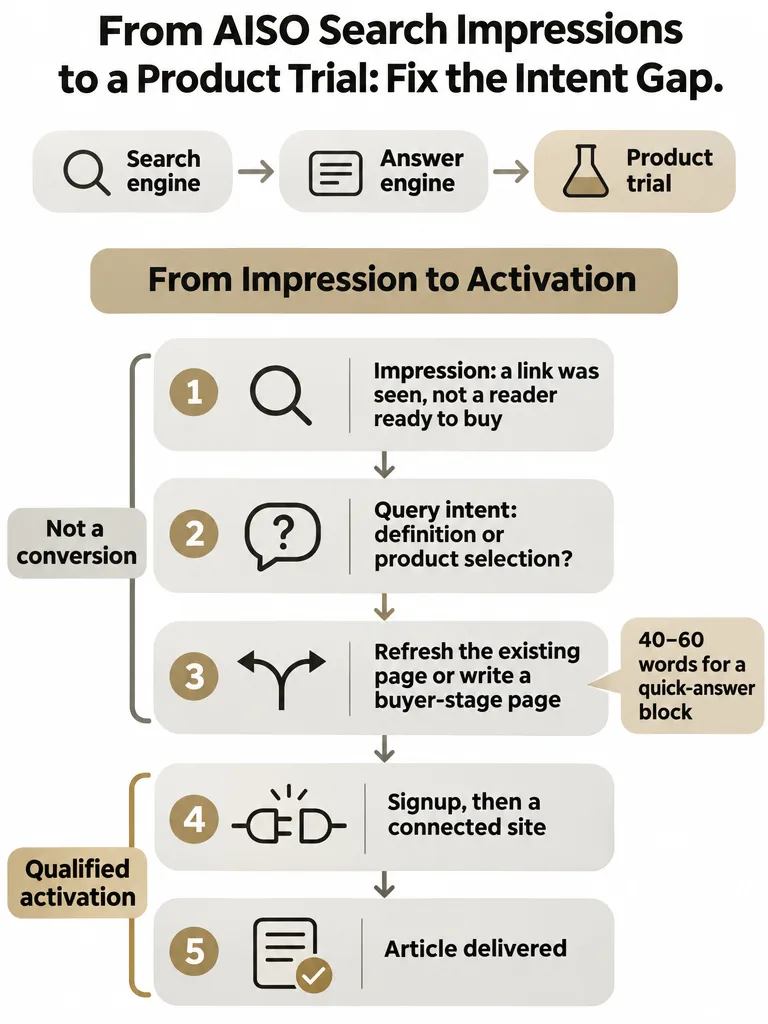
To move from AISO search impressions to a qualified product trial, verify query intent and ranking evidence, keep definition pages educational, create a buyer-stage page only for a distinct selection question, and measure signup, site connection, and article delivery as separate events.
A Google Search Console impression only shows that a link was seen or could have been seen, according to Google's documentation. The target outcome is a qualified signup that progresses to a connected site and a delivered article. An impression, an AI citation, a CTA click, or a newsletter signup is not a paid customer.
HubSpot reported that 42% of 3,063 CRM software purchase decision-makers used AI search in their evaluation. That is a buyer-behavior figure for CRM buyers, not an impression-to-trial rate.
What does a Search Console impression actually tell you?
A Search Console impression means a user saw, or potentially saw, a link to a site in Search, Discover, or News, per Google's documentation. What counts as "seen" varies by result type. Google also advises pursuing meaningful impressions from people who will find the content useful, not simply more impressions.
The publisher's supplied Google Search Console row shows how little one data point carries. The query "ai search optimization (aiso)" logged 2 impressions, average position 70, and 0 clicks, with /aiso as the landing page. AISO here means AI search optimization. The title of this article is not a measured keyword, and this adjacent row is the only supplied query evidence. It is one internal sample, not market-wide evidence or a customer success case.
Low CTR also doesn't prove an AI answer took the click. infuseOS lists other causes: ads taking attention, a featured snippet, a title that doesn't match intent, a page ranking too low, a SERP feature changing the layout, and a poor query-page fit. Low average position is one plausible explanation for zero clicks, but two impressions cannot establish the cause. For a first triage pass, see the related post on blog impressions but no clicks.
Is the AISO query a product-selection problem or a definition problem?
By its wording, the AISO query reads as a definition problem. "ai search optimization (aiso)" names a term and does not compare options. A trial CTA on a definition page would ask a definition-seeking reader to take an unrelated step. That is an inference from query wording, and two impressions can't confirm it.
Rankdots draws the line at intent shift: a query from a different buyer-journey phase gets a new brief, and a long-tail variation of the current topic gets a new section on the existing page.
| Signal | What it suggests | Action |
|---|---|---|
| Query names a term and the landing page defines it | Definition-seeking reader | Keep the page educational; refresh the definition if inspection shows a gap. No trial CTA. |
| Long-tail variation of the same topic | Same journey phase | Add a section to the existing page |
| Query contains vs, alternative, pricing, or best | Closer to commercial intent, per infuseOS | Candidate for a new buyer-stage brief |
| Good position, low CTR | Several possible causes: ads, snippets, SERP layout, title mismatch, query-page fit | Inspect the SERP and the page before changing the title |
| Two pages answer the same intent | Possible cannibalization | Review both pages' queries, then decide whether consolidation is appropriate |
The measured landing page is /aiso. The AISO explainer, What Is AISO? AI Search Optimization Explained, is a different page. Inspecting or refreshing one does not address the other. A separate buyer-stage article is justified only when the query shows a different phase, such as a reader comparing options.
What evidence should you collect before changing the page?
Collect six kinds of evidence before touching the page: Search Console query and page rows, the SERP and landing-page inspection, one controlling buyer question, AI prompt test results, and first-party customer questions. Record being cited as a source, being named as a recommendation, and a referred visit as separate fields.
- Export query and page rows from Google Search Console. Keep impressions, clicks, CTR, and position.
- Inspect the SERP and landing page by hand. HubSpot recommends a manual review. Record the actual ranking URL, the snippet, competing result types, ads or answer features, and whether an AI Overview or answer box appears, with the pages and domains it cites. Check whether the landing page answers the query quickly.
- Write the one controlling buyer question. One question per brief, not a list of keywords.
- Translate the query into natural AI prompts without changing intent. infuseOS notes that prompts run longer and more conversational than queries.
- Test the prompts in ChatGPT, Gemini, Claude, Perplexity, Microsoft Copilot, and Google AI Overviews. Record mentions, citations, competitors, and accuracy issues.
- Add first-party questions from sales calls, support tickets, and communities. HubSpot says these catch gaps that keyword tools and competitor audits miss.
Only then choose between a title change, a refresh, consolidation, or a new brief. The Exa scan dated 11/06/2026 behind this brief recorded observed search-grounded answers, not direct ChatGPT or Gemini measurements.
Do you need a blog engine, a visibility tracker, a CMS, or a research assistant?
For the output "researched articles delivered into a connected site," evaluate publishing or content engines first. Then check whether a visibility tracker, CMS, or research assistant covers the same job in the specific product under review. Public detail on how each product performs this job is limited in the research.
Wording changes what gets compared. In Exa search-grounded answers observed 11/06/2026, which are not direct measurements of the named AI engines, "blog engine" was interpreted as a CMS request. "Best AI search content engine free trial" was interpreted as a search or research product request.
The table lists buyer requirements to verify per product, not limits of any category.
| Category | Job it is typically bought for | Verify before choosing |
|---|---|---|
| Publishing/content engine | Researching, drafting, and delivering articles | Does it deliver finished articles into your site, and how is editorial review handled? |
| Visibility tracker | Measuring whether AI answers mention or cite a brand | Does it also produce the missing page, or only report on it? |
| CMS | Storing, rendering, and serving posts | Which research and drafting steps, if any, are included? |
| Research assistant | Answering questions with cited sources | Can its notes become published articles in your site, and by what route? |
Mentionwell is one example of a publishing engine. Its features page lists eleven stages on every draft, AEO, GEO, LLMO, and classic SEO on every article, a choice of how articles land, a profile per site, archive refreshes, and one dashboard across many sites. Verify current features and plan limits before relying on any of it.
What does the path from a query to a delivered article look like?
A query reaches delivery through six gated steps: cluster, controlling question, answer block, editor review, publication, and activation measurement. The worksheet below is illustrative, not a customer case, and its hypothetical parts are marked as such.
Real row (observed). The query "ai search optimization (aiso)" on /aiso logged 2 impressions, position 70, and 0 clicks in the publisher's Search Console data. Decision: don't create a buyer-stage page from it. Two impressions can't show buyer intent. Inspect the SERP first, and keep any change educational.
Hypothetical cluster (not observed). Suppose a team saw queries comparing AISO providers.
- Cluster. Group queries that share results and buyer phase.
- Controlling question. "Which kind of tool delivers researched articles to my site?" Different buyer phase, so Rankdots' rule calls for a new brief, not a new section on the definition page.
- Draft answer block. The playbooks.bot template suggests 40–60 words, a formatting recommendation rather than a tested threshold. Draft: "A publishing or content engine is the category to evaluate when the required output is researched articles delivered into a connected site. A visibility tracker measures mentions and citations, a CMS stores and serves posts, and a research assistant answers questions. Check each product's delivery step before comparing features or price."
- Acceptance criteria. Every number traces to a source, no ranking forecasts, product claims limited to verified first-party pages, and editor review before publishing, as playbooks.bot requires.
- Destination and CTA. Publish to the team's own CMS or headless stack. Geneo recommends a utility CTA after an extractable chunk, with UTMs on the link. Its examples are downloads and audits. A trial CTA belongs only on a buyer-stage page and only if a current offer is verified.
- Activation. Record signup, site connection, and article delivery separately. No result is claimed here.
Which events prove the trial step worked?
Signup, followed by site connection and article delivery, proves the trial step worked, provided a verified trial or signup path exists. Impressions, citations, and CTA clicks do not. Record each event separately even when events share a system of record. The research contains no defensible impression-to-trial benchmark or attribution model.
| Event | Where it's recorded | Must not be counted as |
|---|---|---|
| Impression | Search Console | A reader or a citation |
| AI citation | Manual prompt tests | A recommendation |
| Named recommendation | Prompt-test answer text | A visit |
| Referred visit | Google Analytics 4 (GA4) with UTMs and a custom channel group | A signup |
| CTA click | A click event such as cta_click | A lead or signup |
| Signup | Product signup record | A connected site |
| Site connection | Product records | A delivered article |
| Article delivery | Product records | Payment |
| Payment | Billing records | n/a |
Geneo separates CTA-click events from lead-submit events and suggests a GA4 channel grouping for AI sources. The sources document no product event names, identity joins, or consent handling, so define them before measuring.
When should you continue, change, or stop this workflow?
For the AISO-to-trial acquisition workflow, the rules are: continue while signups progress to a connected site and a delivered article. Change the page when clicks arrive but intent is wrong, such as definition readers meeting a trial CTA. Stop the trial-acquisition path when query wording, page inspection, and prompt tests show no buyer-question fit. Keep the educational content either way.
A measured evaluation connects one site and reviews one delivered article against your editorial standard. Check current offer terms and plan limits first, and don't assume a trial length, article allowance, or connector that isn't published.
None of this guarantees rankings, citations, or conversions.
Sources
- blog.hubspot.comblog.hubspot.com
- infuseos.cominfuseos.com
- rankdots.comrankdots.com
- playbooks.botplaybooks.bot
- geneo.appgeneo.app