Why does AI cite your article but recommend a competitor?
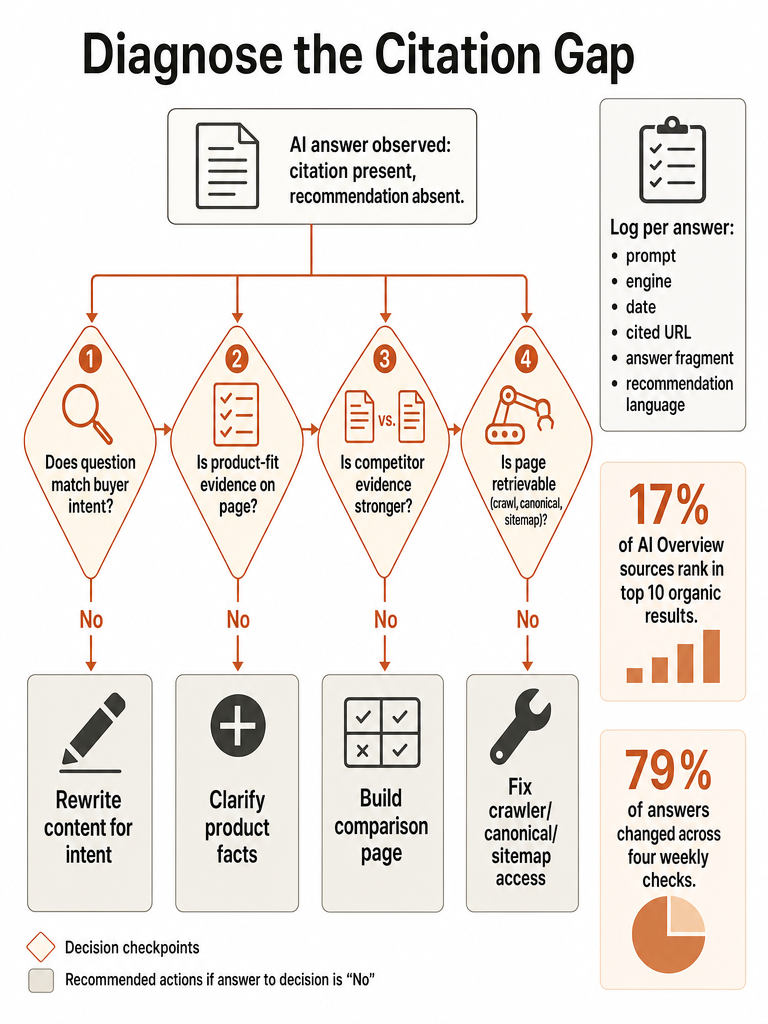
A citation and a recommendation are two separate judgments inside one AI answer: the engine used your page as evidence, then separately decided which brand to name. When AI cites your article but recommends another product, NeuraCite's diagnosis framework points to four likely causes: weak buyer-question fit, thin product evidence, stronger competitor evidence, or a retrieval block.
The citation happened because a passage on your page matched a fact the model needed, a definition, a step, a number. The recommendation is a different computation: which brand best satisfies the buyer question the model thinks it's answering. GeoRank.ai draws this same line, noting that an AI service linking to your article is treating it as a source, while naming your company as the pick is a separate act entirely. ZeroRank.ai frames the diagnostic version of this: a missing mention and a missing citation are different problems, and conflating them sends you fixing the wrong thing.
This matters operationally because the two fixes are not interchangeable. Adding more content doesn't help a retrieval block. Fixing crawler access doesn't help thin product evidence. NeuraCite recommends counting brand mentions, website citations, and positive recommendations as three separate tallies before deciding what to build next, rather than treating "we got cited" as a win that should have produced a recommendation too.
What's the difference between a citation, a brand mention, and a product recommendation?
A citation is the AI engine linking to or pulling a fact from a specific URL. A brand mention is the engine naming your company in the answer text, with or without a link. A recommendation is the engine presenting your product as the suitable choice for the buyer's stated need. All three can occur independently in the same answer, and GeoRank.ai treats them as distinct outcomes rather than stages of one funnel.
This distinction holds across ChatGPT, Gemini, Claude, Perplexity, and Copilot, though engines surface citations differently, and recommendation language sits in the generated prose regardless of citation format. Ranking well in classic search doesn't guarantee any of the three: HubSpot's analysis of BrightEdge data found that only about 17% of sources cited in AI Overviews also rank in the organic top 10.
What should you record before diagnosing the gap?
Diagnosis starts with a written record of the answer, not a memory of what you saw on screen. NeuraCite points out that the visible answer text can't reveal an engine's internal selection process on its own; any explanation for why a competitor got named is a hypothesis you test against evidence, not a fact you can assume.
Log these fields for every observed answer, before forming a theory about why it happened:
- Exact prompt wording. Small phrasing changes shift which sources and brands get pulled in.
- Engine and date. Engines behave differently and should be logged separately; answers drift week to week even with no changes to your site.
- Cited URL(s). The specific page or pages the engine linked to or pulled facts from.
- Answer fragment. The sentence or passage that used your content, copied verbatim.
- Recommendation language. The exact wording naming the competitor, including any qualifiers ("best for," "if you need," "most teams choose").
A single row tells you almost nothing. A spreadsheet of rows across repeated prompts and dates is what turns a hunch into a diagnosis.
Is the gap a content problem, an evidence problem, or a retrieval problem?
This question actually covers two related scenarios. Three of the failure modes below assume your page is already cited and the recommendation still went elsewhere; the fourth, retrieval or access block, describes a different situation where your page is never cited at all. NeuraCite's diagnosis framework puts both in the same table because the fix for each depends on which row applies, not because they're the same problem. Each row comes with one check that tests the hypothesis rather than confirms it outright; the answer text alone can't prove causation, so treat these as checks that narrow the diagnosis, not settle it.
| Failure mode | What it looks like in the answer | The one check that tests it |
|---|---|---|
| Weak buyer-question fit | Your page is cited for a tangential fact, not the core buyer decision | Reread the prompt as a buyer would ask it; does your page actually answer that question, or an adjacent one? |
| Thin product evidence | Competitor's specs, pricing, or use cases appear in the answer; yours don't | Check whether your product or feature pages state the same facts in plain, extractable sentences |
| Stronger competitor evidence | Competitor has reviews, comparisons, or press the answer draws on | Search for independent pages naming your product in the same context; count how many exist versus the competitor |
| Retrieval or access block | Your page is never cited at all, even for facts it clearly covers | Confirm the page has a public URL, a matching canonical tag, sitemap inclusion, and open crawler access |
Each row calls for a different asset. What to publish when ChatGPT names a competitor instead walks through matching the first three failure modes to page types. If the pattern looks like a retrieval problem specifically, why AI Overviews citations get skipped breaks down the trigger, extraction, and verification steps that block a page even when it ranks well.
Does a high-impression, low-click query need a page refresh or a new article?
Decide with the intent-shift test, not a coin flip: a query that represents a different phase of the buyer journey gets a new brief, while a long-tail variation of the same topic belongs as a new section on the existing page. Rankdots frames this as the hardest part of turning Search Console data into action, because standard keyword tools report volume and difficulty but can't tell you whether your current page is the right vessel for the demand.
Run the test this way:
- Pull the query and its metrics. Impressions, clicks, CTR, and position from Search Console, using as much history as the report allows; Rankdots notes the performance report filters up to 16 months.
- Read the query as a buyer question. Is it asking "what is X" or "which X should I buy"? Those are different journey phases.
- Compare it to your ranking page's actual answer. If the page answers a narrower or broader question than the query asks, that's a fit gap, not a framing gap.
- Check if it's a phrasing variant. If the words differ but the underlying question matches the page, update the title, meta description, or the page's direct-answer passage.
- Ship a new brief only on genuine phase shift. A comparison-stage query landing on a definition page needs its own asset, not a patched intro.
High impressions with low clicks isn't proof an AI answer stole the click; it's a reason to run this test. Blog impressions but no clicks covers the fuller decision tree for that specific signal.
When should you leave the page alone instead of publishing more content?
Hold off when the evidence is incomplete or the product genuinely doesn't fit the buyer requirement behind the question. Dageno frames this as a real, legitimate outcome of the diagnosis, not a failure to act: if your product can't honestly satisfy what the buyer is asking for, publishing a page that claims otherwise creates a mismatch the next AI answer will eventually expose.
This matters because the instinct after seeing a competitor named is almost always to publish something, fast. That instinct is wrong when the gap check from the earlier table comes back inconclusive, when you haven't yet logged enough observations to separate a pattern from normal variability, or when the honest answer to the buyer's question points somewhere other than your product.
The right move in that case is to say so internally and route the buyer question to a product roadmap conversation, not a content brief. Forcing a claim the product can't support doesn't close the recommendation gap; it just moves the failure from "not recommended" to "recommended and wrong," which is worse for trust once a buyer checks.
How many repeated checks prove a pattern instead of normal AI-answer variability?
Treat a single prompt run as a hint, not evidence; recommendation sets shift from week to week even with no changes to your site. A 2026 study examined 2,720 software recommendation answers across ChatGPT, Claude, Gemini, and Perplexity, reported by LSEO, and found that 79% of question-and-assistant combinations changed at least once across four weekly measurements.
That same study illustrates why brand recognition and recommendation frequency are different metrics entirely: Keap appeared in only 3 of 400 eligible CRM recommendation answers despite being correctly identified in every recognition test the researchers ran. A brand can be known to the model and still almost never get recommended for the buyer question that matters.
Set a minimum of several weekly observations, run across the engines you care about, before concluding a single competitor mention is structural rather than normal drift. How to measure AI citations without a $10k tracker shows how to build that repeated-check habit with a spreadsheet and a fixed prompt set instead of a full monitoring platform.
How should you choose the next fix: product evidence, a comparison page, or technical access?
Match the confirmed failure mode to one concrete next step, and don't ship a content fix for a technical problem or vice versa. NeuraCite's framework and the required-proof checklist below both point the same direction: confirm the mode first, then build.
| Confirmed failure mode | Next step | Proof before you call it fixed |
|---|---|---|
| Thin product evidence | Clarify specs, pricing, and use cases on your own product or feature pages | Updated facts live and written in plain, extractable sentences |
| Missing comparison content | Publish a comparison page naming real alternatives, including your product as one honest option | Page live, indexed, and reachable from internal navigation |
| Competitor has stronger third-party corroboration | Pursue independent reviews and citations rather than adding more owned content | External mention live, retrievable, and not behind a login |
| Retrieval or access block | Fix canonical tags, crawler access, and sitemap entries | Public destination URL, canonical URL, sitemap inclusion, and crawler access all confirmed |
That last row is worth taking literally: a retrieval or access block means the required-proof checklist, a public destination URL, a canonical URL, sitemap inclusion, and crawler access, has to be satisfied before any content fix will register with an engine at all. Run that checklist against your own cited-but-unnamed pages before assuming the gap is a content problem rather than a plumbing one.
Shipping the resulting fix, whether that's a comparison page or a product-fact refresh, is one place a publishing workflow earns its keep: running the new page through the same site profile and pipeline used for the rest of the archive means the fix ships as a real, crawlable page instead of a one-off document that never gets indexed. This kind of diagnosis sits inside a broader GEO and AEO practice, one built on the same evidence-logging discipline as classic SEO rather than a replacement for it. Mentionwell, a blog and content engine built around that workflow, is one option for running it consistently across a single domain or across many client accounts.