What is Google's Search Generative Experience (SGE)?
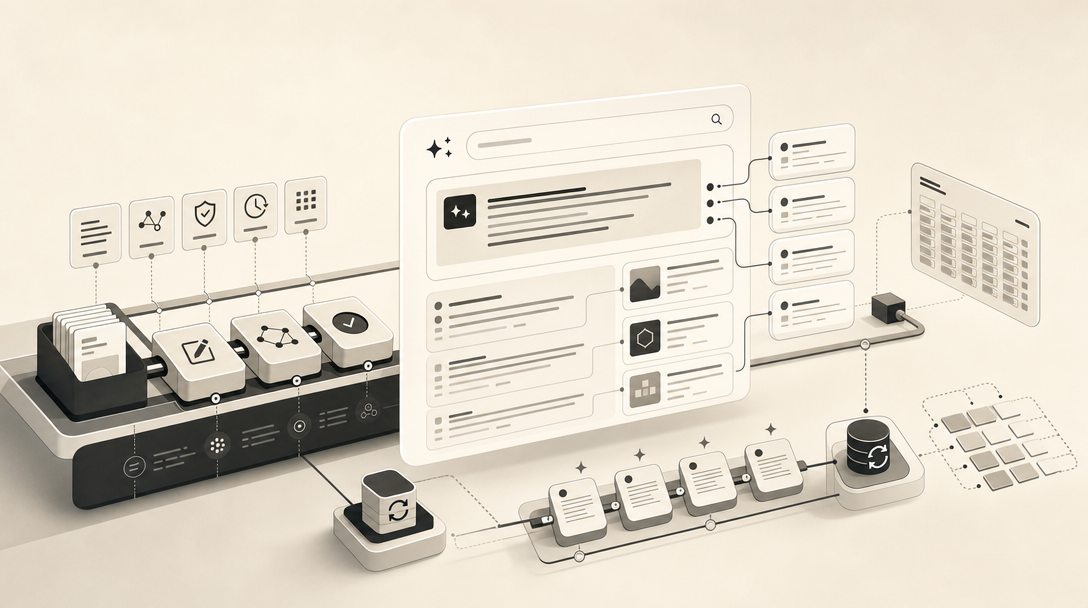
Google's Search Generative Experience (SGE) is an experimental search interface, launched through Search Labs at Google I/O 2023, that uses generative AI to produce a synthesized overview of a topic directly inside Google Search results. Instead of returning only ranked links, Google generates an AI Snapshot at the top of eligible queries, pulling from multiple web sources and offering follow-up prompts to keep the user inside a single search session.
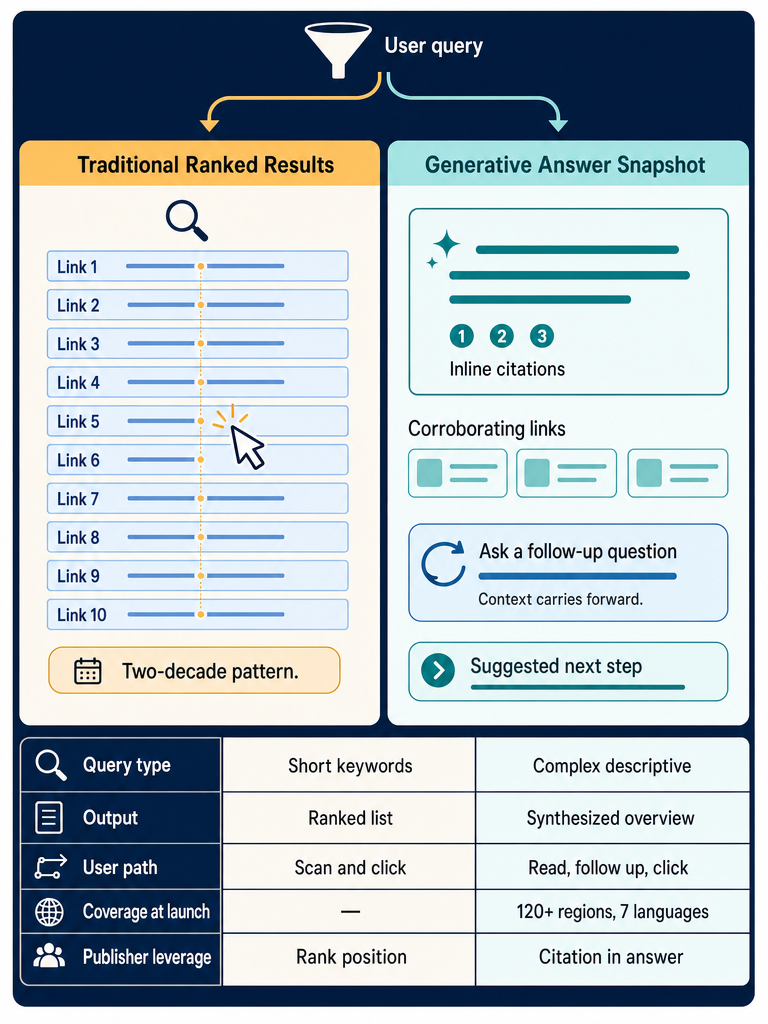
For marketers, SGE matters because it is a new citation surface. According to Google, generative AI in Search is designed to help users ask more complex, descriptive questions, get the gist of a topic faster with links to relevant results, and continue with conversational follow-ups or suggested next steps. That changes how brands get discovered: the AI snapshot can appear before the ten organic results that have anchored search behavior for two decades, and the sources it cites are the ones eligible to drive awareness, clicks, and downstream mentions in other answer engines.
SGE is not a feature bolted onto Google Search — it is a shift from ranking documents to synthesizing answers, and the pages that get cited inside the synthesis become the new front page.
Google frames SGE as part of a long arc of AI in Search, noting that one of its first machine-learning applications in a Google product was spelling correction back in 2001. SGE is the most visible step in that arc because, for the first time, the AI layer is generating the answer rather than just improving the ranking. If your content strategy is still optimized for ten blue links, you are optimizing for the wrong surface.
Is SGE the same thing as AI Overviews or AIO?
Not exactly — and the naming matters because the labels signal different stages of the same product line. SGE refers specifically to the original Search Labs experiment Google launched in 2023, while AI Overviews (sometimes written as AIO) is the label Google and the industry have used as the experience matured beyond Labs. Conductor describes AIO as "formerly SGE" — an experimental update to Google's search engine that uses AI to generate contextual answers. InSpace similarly notes that in some regions SGE is branded as AI Overviews and is still being iterated through Search Labs.
Practically, that means three terms are now in circulation:
| Term | What it refers to | Status |
|---|---|---|
| SGE (Search Generative Experience) | The original Search Labs experiment announced at Google I/O 2023 | Labs experiment, the foundation for what followed |
| AI Overviews | The broader, post-Labs label for AI-generated answers in Google Search | The current public-facing name in many markets |
| AIO | Shorthand for AI Overviews used in industry writing | Informal; same thing as AI Overviews |
Google's own documentation states that the SGE Search Labs experiment was available in over 120 countries and territories across 7 languages. Treat that figure as a snapshot from the Labs period, not a permanent map of eligibility — Google has continued to expand and rebrand the surface, and older Labs-only access guidance can go stale quickly.
How does SGE work?
When SGE triggers, Google interprets a complex query, retrieves and synthesizes information from multiple web sources, and renders an AI Snapshot beneath the search bar — visually separated from ordinary results, often with a colored background. According to reporting from 9to5Google, the snapshot summarizes information and insights from multiple sources, links to corroborating pages, and includes a control that lets users expand the answer and see citations on a sentence-by-sentence basis.
Several components are worth understanding because each one is a place a publisher's content can surface:
- The AI Snapshot itself. A generated overview of the topic, written to be objective, neutral, and not in first person. This is the text most users will read first.
- Sentence-level corroboration. Users can expand the snapshot to see which source backs which claim. This is the literal citation slot.
- Suggested follow-up questions. Google proposes next prompts that extend the search session, each of which may pull from a different set of sources.
- Conversational mode. Follow-ups preserve prior context, so a single page can show up across a chain of related queries rather than just one.
- Linked web results. Traditional results still render around or below the snapshot — the AI layer sits on top of, not in place of, the index.
9to5Google reports that SGE used multiple Google large language models during the preview, including MUM and PaLM2, with responses optimized to be objective and neutral. The model layer has continued to evolve through Gemini-era systems, but the visible architecture — snapshot, citations, follow-ups, conversational mode — is what publishers should optimize against.
The key insight: every visible component of the SGE interface maps to a content decision. A clear direct-answer paragraph supplies the snapshot. Cleanly attributed evidence supplies sentence-level corroboration. A coherent topical cluster supplies the follow-up prompts. Publishers who treat SGE as a set of interface slots rather than a single ranking position will earn more citations than those still optimizing one page at a time.
How does SGE differ from traditional Google search results and the "10 blue links" model?
The difference is structural: SGE answers first, then links. The "10 blue links" model, which the AI Accelerator Institute notes has been synonymous with search for the past two decades, asked users to scan a ranked list and click through to one or more pages to assemble an answer themselves. SGE inverts that flow — Google assembles the answer up front, cites the sources it used, and offers follow-up prompts to extend the session.
| Classic search (10 blue links) | SGE / AI Overviews | |
|---|---|---|
| Primary output | Ranked list of links | Synthesized AI Snapshot with citations |
| User workflow | Click, read, compare, return | Read the answer, expand citations, ask follow-ups |
| Source visibility | Position-driven (rank 1 wins) | Citation-driven (selected sources win) |
| Session shape | One query, then a new query | One query with conversational follow-ups |
| What publishers optimize | Keywords, links, on-page SEO | Direct answers, entities, evidence, structure |
The important nuance: web results still matter, because the AI snapshot depends on organized, crawlable, source-backed pages — SGE does not replace the index, it reads from it. A page that cannot be crawled, parsed, or trusted by classic ranking systems is not a candidate for citation in the snapshot either. This is why SEO and AEO are complementary, not competing. The teams that win in AI Overviews are usually the teams that also do the SEO fundamentals well: clean HTML, clear headings, fresh dates, internal links, and evidence the page is the authoritative answer to a real question.
For a deeper view on how this rebalances content priorities, see AEO vs GEO vs LLMO: Which Workflow Fits Your Team?.
Where do AI snapshots show up, and when will Google avoid them?
SGE-style snapshots are most likely to appear on longer, descriptive, multi-step, or exploratory queries — the kind of searches that are not answered well by a single page. According to 9to5Google, SGE is aimed specifically at "longer, multi-step searches that may not be answered by a single website." Think comparison queries, how-to questions with multiple variables, planning workflows, and topic overviews where the user benefits from a synthesis.
Google has also been explicit about when it pulls back. 9to5Google reports that SGE will not provide an AI snapshot when there is a lack of information available or when Google has low confidence in the response. That is a meaningful signal for publishers: thin topic coverage on the open web makes a snapshot less likely, and high-confidence, well-corroborated content makes one more likely.
Observable patterns from the available evidence:
- More likely to trigger: descriptive queries, comparison searches, planning questions, how-to with multiple steps, topic overviews, definitional searches.
- Less likely to trigger: narrow navigational queries, single-fact lookups already covered by a featured snippet, and any topic class where Google has low confidence in synthesis quality.
Mentionwell ships citation-shaped articles into your CMS — built for AI Overviews, ChatGPT, Perplexity, and classic SEO in one pipeline. Get My Site GEO Optimized.
The practical takeaway: do not try to force a snapshot. Build content depth across a topical cluster, attribute claims to evidence, and let Google's confidence threshold work in your favor on the queries where synthesis is genuinely helpful.
How do you use Google Search Generative Experience?
If SGE or its successor surface is available in your region, the user workflow is short:
- Sign in to a Google account.
- Open Search Labs (sometimes accessed via Google Labs) and check whether the SGE-style experiment is offered for your account and region.
- Use an up-to-date version of Chrome where required by the experiment.
- Enable the experiment from the Search Labs interface.
- Run a normal Google search — ideally a longer, descriptive query of the kind likely to trigger a snapshot.
- When the AI Snapshot appears, expand the citations panel to see sentence-level corroboration, then test conversational follow-ups.
Because availability has shifted as Google moves from SGE branding to AI Overviews, the exact entry point may differ in your market. The constant is the conversational behavior: follow-up questions keep prior context, and the suggested prompts Google surfaces guide the next step of the session. If you publish content, this is the surface to test against — search the queries you want to be cited for, and check whether your pages appear in the snapshot's citation panel.
For a market-by-market breakdown of how to earn placement specifically in the current surface, see How to Show Up in Google AI Overviews in 2026.
How should publishers structure content to be cited in AI-generated search answers?
Treat every page as a citation candidate, not a ranking entry. The pages that get cited in SGE and AI Overviews share five operational traits: a direct-answer block near the top, precise entity naming, evidence-backed claims, clean HTML structure, and visible freshness. Each maps to a slot in the snapshot interface.
A working publishing checklist based on observed snapshot mechanics:
- Open with a direct answer. One to two sentences, self-contained, that answer the implicit question behind the page title. This is the text most likely to be lifted into the snapshot.
- Name entities by their full proper names. Google Search, Search Generative Experience, AI Overviews, Google Search Console — not "the platform" or "the tool." Co-occurrence of named entities is how generative systems decide what a page is about.
- Attribute every statistic. "According to Google" or "9to5Google reports" — not "studies show." Unattributed numbers are routinely skipped by AI systems looking for citation-ready evidence.
- Use clean H1/H2 structure that mirrors real questions. Each H2 should answer a question a user would actually type or speak.
- Show dates and refresh signals. Freshness is a confidence signal for both classic ranking and AI synthesis.
- Submit and monitor through Google Search Console and Bing Webmaster Tools. Bing matters because it feeds Copilot and ChatGPT browse, both of which compete with AI Overviews as citation surfaces.
- Refresh existing archives. Old content with strong link equity is often closer to citation-ready than a new page from scratch — see AEO Content Strategy for Teams With Existing SEO Archives for the refresh workflow.
This is exactly the operating model Mentionwell ships as a content engine. The platform onboards a domain, builds a site profile, and runs a citation-shaped editorial pipeline — direct-answer openings, attributed claims, entity-clean prose, structured H2s, fresh dates, and CMS or headless delivery — across one site or many. For agencies and multi-site operators, the workflow extends to programmatic SEO and archive refreshes without the brand inconsistency that bulk drafting tools tend to produce. See AI Search Content Engine: What B2B SaaS Teams Need for the full pipeline view.
The non-negotiable: do not treat AEO, GEO, LLMO, and SEO as four separate workstreams. They share the same underlying page, and a citation-ready page satisfies all four at once.
What evidence exists for SGE affecting clicks, visibility, or zero-click behavior?
The honest answer: qualitative signals are strong, hard numbers are scarce. Multiple industry sources predict that AI Overviews will increase zero-click behavior and reshape SEO economics — Trysight asserts that the design increases zero-click searches, and Blazeo describes SGE as "a significant shift in search behavior and SEO optimization." But the available research corpus does not include sourced CTR, traffic, or impression data tied directly to SGE or AI Overviews. Treat broad disruption claims as hypotheses to monitor, not facts to plan against.
What you can do today is build a measurement loop that does not depend on Google publishing the numbers:
- Monitor classic search performance through Google Search Console — impressions, clicks, and position trends on queries where you suspect AI Overviews are triggering.
- Track citation and mention patterns across Google AI Overviews, ChatGPT, Claude, Perplexity, and Bing Copilot for your target prompts.
- Cross-reference visibility tools like Ahrefs and SEMrush for ranking shifts on snapshot-eligible queries.
- Refresh pages based on observable gaps — if a query you should win is being answered without citing you, that is the page to update first.
If you want a content engine that ships citation-shaped pages into your existing CMS and refreshes archives on a cadence, Mentionwell runs the AEO, GEO, LLMO, and SEO workflow as a single pipeline rather than four parallel projects. Get My Site GEO Optimized.
Sources
- Google SGE: Google Search Generative Experience Explainedwww.semrush.com
- Your Comprehensive Guide to Preparing for Google's SGEwww.conductor.com
- What You Need to Know About Google's SGE - Marcel Digitalwww.marceldigital.com
- https://static.googleusercontent.com/media/www.google.com/en//search/howsearchworks/google-about-SGE.pdfstatic.googleusercontent.com