What Do Claude and Gemini Actually Cite From B2B Blogs?
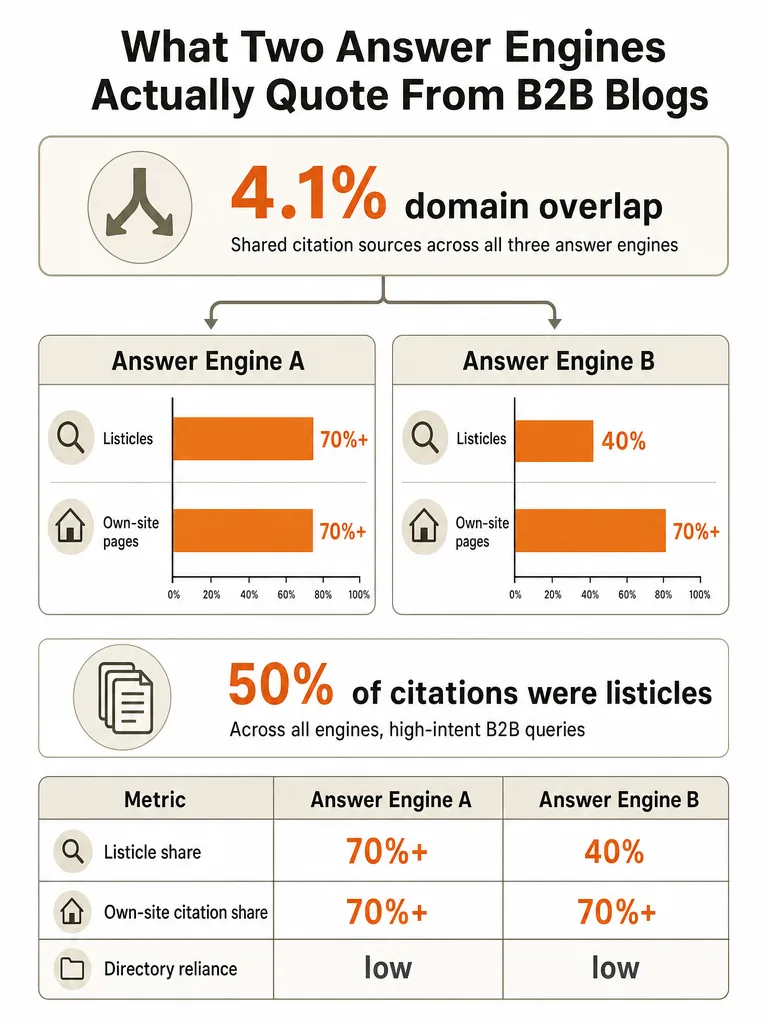
Claude and Gemini rarely cite the same B2B sources. Propellernet's August 2026 analysis of 36,128 citations across ChatGPT, Claude, and Gemini found only 4.1% domain overlap among the three. The two factors that predict divergence most are content format, listicle versus narrative blog post, and source trust, first-party site versus third-party directory.
This piece covers what source types and domains earn Claude and Gemini citations in B2B blogs, not which sentence or table inside a page got quoted; none of the available research breaks citation data down to that level. An AI citation here means the source an engine names or links inside a generated answer, distinct from ranking in classic search.
Propellernet's dataset spanned retail, travel, fintech, and B2B prompts, captured at one point in time. Propellernet frames its B2B agency-selection example, along with a separate consumer-facing example, as illustrative of specific categories in the dataset, not confirmed as the pattern across every vertical the firm tracks.
For B2B agency-selection prompts specifically, ChatGPT cited agencies' own sites alongside directories and listicles, while Claude and Gemini largely skipped directories and cited agencies' own sites more than 70% of the time instead. That single data point does more to explain divergent citation behavior than a generic Claude-vs-Gemini feature comparison: the two engines aren't judging the same content by the same rules, so a blog built to satisfy one can miss the other entirely.
Do Claude and Gemini Cite the Same Sources?
No. Source-type preference splits sharply by engine, and the split is measurable, not anecdotal. Quoleady's May 2026 study of more than 10,000 citations across high-intent SaaS prompts found listicles made up 50% of overall citation sources, with the share by engine varying enough to change how a B2B team should structure content.
Claude leaned hardest on list-format content, pulling more than 70% of its citations from listicles, per Quoleady. Gemini pulled 40% of its citations from listicles, the lowest share Quoleady reported among the models it tracked, though still a substantial share on its own. ChatGPT's listicle share wasn't broken out separately in Quoleady's published figures. On blog-page citations, ChatGPT trailed at 30.6%, the lowest of the three, while Gemini and Claude sat at the high end of a 30 to 45% range Quoleady reported for that format.
| Engine | Listicle citation share (Quoleady) | Blog-page citation share (Quoleady) | First-party site preference, B2B agency prompts (Propellernet) |
|---|---|---|---|
| ChatGPT | Not broken out separately | 30.6% (lowest) | Cites own sites alongside directories and listicles |
| Claude | 70%+ (highest reported) | High end of 30-45% range | 70%+, largely skips directories |
| Gemini | 40% (lowest reported, still substantial) | High end of 30-45% range | 70%+, largely skips directories |
Wikipedia citation behavior reinforces the same divide, though from a separate prompt set. In Quoleady's high-intent SaaS study, ChatGPT drew 53 citations from Wikipedia, while Claude and Perplexity cited it zero times. Treating "AI visibility" as one target across all engines misreads what each one actually trusts.
Claude vs Gemini: Which Blog Formats Get Cited Most?
Listicle and comparison structure beats standard blog posts for both engines, but the margin differs. Quoleady's citation-share data gives a concrete ranking instead of generic "write good content" advice: listicles took 50% of citations overall, with Claude drawing more than 70% of its citations from that format and Gemini drawing 40%.
Quoleady's blog-page category, which the source doesn't define beyond the label itself, took 30 to 45% of citations across models, with Gemini and Claude toward the top of that range and ChatGPT at the bottom at 30.6%. Third-party directories were largely absent from Claude and Gemini's citations for the B2B agency-selection prompts Propellernet tracked.
| Format | Claude citation share | Gemini citation share | Source |
|---|---|---|---|
| Listicles / comparison pages | 70%+ | 40% | Quoleady, high-intent SaaS study |
| Blog pages | High end of 30-45% range | High end of 30-45% range | Quoleady |
| Third-party directories (B2B agency prompts) | Largely skipped | Largely skipped | Propellernet |
Listicle and comparison structure draws the largest share of citations for both Claude and Gemini in Quoleady's dataset. For a B2B SaaS blog, that favors a "10 tools compared" or "X vs Y" page over a narrative explainer covering the same ground, at least based on the format shares Quoleady measured. The study reports which formats win; it doesn't say why.
Should You Optimize B2B Blog Content Differently for Claude Than for Gemini?
Yes, because Claude and Gemini are built around different product bets, and Quoleady's citation data shows the split. Claude, built by Anthropic, has no native live web search in the comparison Adlibrary's 2026 marketing analysis tracked. Gemini, built by Google DeepMind, ties into live web search and Google Workspace.
Adlibrary's comparison offers one plausible explanation for a stat that otherwise looks strange: Quoleady found Gemini produced 13x more citations per query than ChatGPT in its high-intent SaaS dataset. A search-first architecture, the kind Adlibrary attributes to Gemini, would plausibly surface more sources per answer than a model without native live search, though Quoleady's study doesn't test that mechanism directly.
Adlibrary's comparison table also lists a context-window difference: Claude models at 200K tokens versus 1M tokens for Gemini 2.5 Pro and Flash. A larger context window could let a model draw on more of a page, or more competing pages, per query. Adlibrary's table doesn't establish that this is what drives Gemini's higher citation volume, but the two data points sit together plausibly.
The practical read for a B2B blog, given what Quoleady's citation-share data shows: pages built as tightly structured, listicle-shaped content have the strongest documented pull with Claude. Pages built for Gemini should assume the engine draws from a wider live source set, which keeps standard fundamentals like crawlability and ranking relevant in a way Claude's dataset doesn't clearly demand. Teams retrofitting an existing archive for this kind of split coverage can start with the framework in GEO content strategy for B2B SaaS sites with old blogs, which triages which URLs are worth restructuring first.
Are First-Party Company Blogs Viable Citation Sources for Both Engines?
Yes, for B2B research prompts specifically. Propellernet found that Claude and Gemini cited agencies' own sites more than 70% of the time when the prompt involved choosing a digital marketing agency, largely skipping the third-party directories ChatGPT relied on more heavily for the same prompt type.
That's a different trust model than most SEO advice assumes. ChatGPT's behavior in Propellernet's dataset mixed agencies' own sites with directories and listicles, treating third-party aggregation as a legitimate source. Claude and Gemini, at least for that prompt category, treated the first-party site as the more credible answer.
Quoleady's Wikipedia data points the same direction from a separate high-intent SaaS dataset: ChatGPT drew 53 citations from Wikipedia, while Claude and Perplexity cited it zero times. Both data sets suggest Claude and Gemini are more willing than ChatGPT to trust a company's own published content over a third-party aggregator, though neither source tests why.
For a B2B SaaS company weighing where to invest, this data points toward making the company's own blog citation-ready before chasing third-party aggregator placements or directory listings.
If You Can Only Fix One B2B Blog Format First, Which Should It Be?
Fix listicle and comparison structure first. It's the single largest citation source category across engines in Quoleady's dataset at 50% of overall citations, and it's the format both Claude (70%+) and Gemini (40%) lean on most heavily. Sequencing matters when a team has limited editorial capacity, and this is the order the citation-share data supports:
- Rebuild or add comparison-style pages for core buying decisions. Listicle and comparison-page structures already carry half of all citations Quoleady tracked. Start with the pages closest to a purchase decision.
- Convert flagship explainer posts toward list or table structure where the content genuinely fits that shape. Quoleady's data shows listicles and blog pages both earn citations, but it doesn't say which on-page elements inside either format got extracted, so treat structural changes as a hypothesis to test, not a guaranteed fix.
- Audit first-party pages for basic credibility signals. Propellernet's data shows Claude and Gemini favor first-party pages over directories for B2B agency prompts; what specifically inside those pages earned the citation isn't measured in the available research, so this step is judgment, not a documented formula.
- Extend whatever structure works across the archive rather than a single post. Consistency across an archive is an operational choice a team can control directly, independent of what the citation data proves about any one format.
- Re-measure before rewriting further. Propellernet's dataset was captured at one point in time rather than repeated across multiple runs, so citation behavior may change over time. Confirm a format change actually moved citations before investing further.
Teams without an existing tracking setup can start with how to measure AI citations without a $10k tracker to build a baseline before step 5.
What Evidence Makes a B2B Blog Citable to Claude and Gemini?
Public research on this exact question is limited as of this writing. Neither Propellernet's citation-overlap analysis nor Quoleady's SaaS citation study breaks down paragraph-level or heading-level extraction examples showing precisely which sentence, table, or data point inside a page got lifted into a Claude or Gemini answer. That gap in the available evidence is real, and this article won't fill it in with a guess.
What the citation-format data does show, at the level of whole pages rather than passages within them, is which structural types of pages win. Listicles and comparison pages carried 50% of citations in Quoleady's dataset; blog pages carried 30 to 45%. Neither figure explains what inside those pages made the difference between being cited and not.
The most honest conclusion, given the evidence available, is that citation strategy for Claude and Gemini currently has to be built on page-format choices, listicle versus blog versus directory, rather than on specific formatting tricks inside a page. Anyone claiming a specific heading structure, callout box, or paragraph length reliably earns a Claude or Gemini citation is going further than Propellernet's or Quoleady's published data supports.
Pages that already struggle to get picked up in Google's AI Overviews for related structural reasons are covered in more depth in AI Overviews citations: why your blog still gets skipped, which breaks the failure points into retrieval, extraction, and verification stages. That page's own sourcing addresses AI Overviews specifically, not Claude or Gemini citation data, but the retrieval-and-extraction framing plausibly transfers.