
When does a glossary term qualify for programmatic SEO?
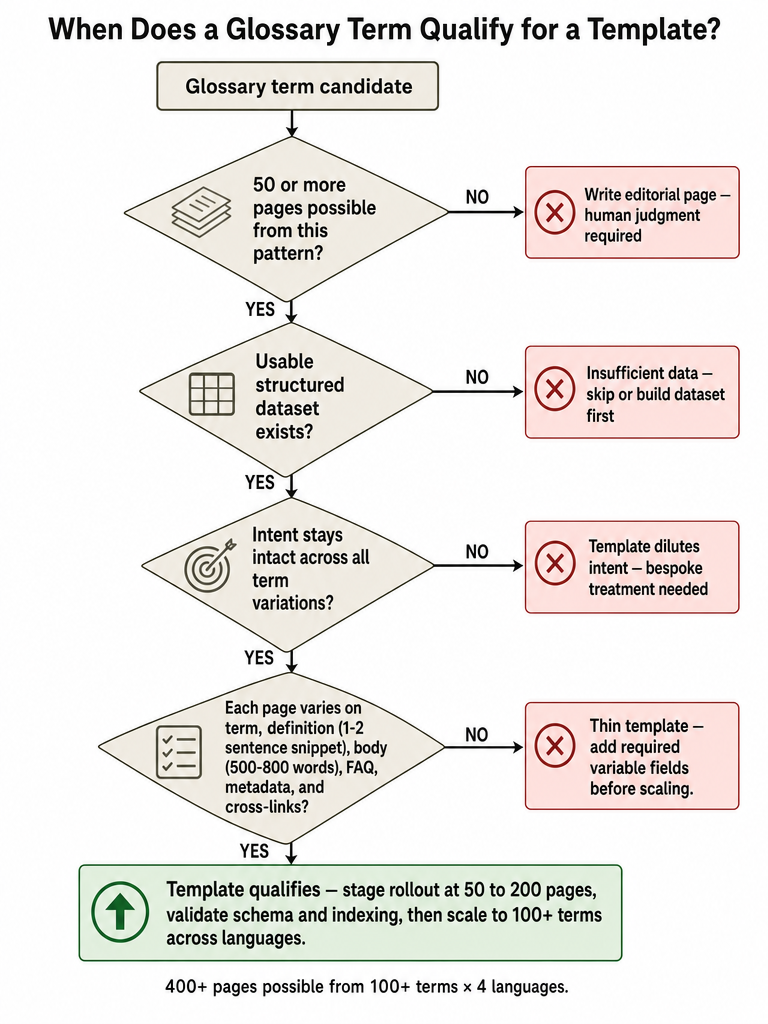
A glossary term qualifies for a programmatic template when the page type can support 50 or more pages, draws on a usable dataset, and delivers genuine value to the reader. Raze Growth, a SaaS growth firm, frames this as the qualification standard that separates a durable acquisition asset from a scaled content dump. If a term cluster can't meet all three at once, it belongs in editorial, not a template.
Run the test before you build the template, not after. Three filters decide it:
- Volume: does the term family produce at least 50 pages worth of distinct, defensible entries? A handful of terms doesn't justify a template; it justifies hand-writing.
- Dataset: is there a real, structured source of variation behind each term — definitions, categories, related concepts — or are you just swapping a noun in a sentence?
- Value: would a reader who lands on a single page get a complete, useful answer, or would the page exist only to catch a long-tail query?
Treat the qualification step as the gate. Everything downstream — fields, schema, rollout — assumes the term earned the template in the first place.
Template vs editorial glossary pages: when should human judgment replace automation?
Human judgment should replace automation whenever a term carries buyer-specific nuance, contested meaning, or commercial intent that a shared structure would flatten. Template glossary pages work for terms with stable, factual definitions and predictable variation. Editorial treatment wins for terms where the answer depends on context the template can't hold.
The split is rarely about prestige. It's about whether the variable fields can carry the meaning.
| Signal | Template fits | Needs editorial judgment |
|---|---|---|
| Definition stability | Stable, factual, widely agreed | Contested, evolving, or audience-dependent |
| Buyer relevance | Low to moderate, informational | High — term sits near a purchase decision |
| Variation source | Driven by a clean dataset | Driven by argument, comparison, or opinion |
| Risk if generic | Acceptable | Dilutes intent or misleads a buyer |
Most glossary programs are a mix. The factual long-tail terms run on the template at scale; the 10 to 20 terms closest to the buyer's decision get written by a person and reviewed.
The decision rule from the corpus is blunt: programmatic SEO fails slowly when intent gets diluted (Source: Threads / Apoorv Sharma). A template that can't preserve intent for a given term is the wrong tool for that term.
What is programmatic SEO for glossary terms?
Programmatic SEO is the technique of using automation software and templated content to create large numbers of unique, high-quality pages designed to rank in search (Source: Belt Creative). Applied to glossary terms, each term becomes its own long-tail keyword page, the pages interlink naturally, and the set builds topical authority across a subject area (Source: Mari Luukkainen).
The glossary use case fits programmatic SEO unusually well because the structure is repeatable but the content is genuinely distinct per term. One template, fed by a dataset of terms, produces a page for each: a definition, supporting context, related concepts, and links to adjacent entries. The mechanism is the same one that turns 500 products into 500 comparison pages (Source: Kenny Tan) — a single template plus a dataset. The difference with glossaries is that the unit of value is a concept a reader actually wants explained.
Why do glossary templates fail when only the head term changes?
Glossary templates fail when the term is the only thing that changes and everything else stays identical. The result is a fleet of near-duplicate pages where intent gets diluted, templates multiply blindly, and the search engine has less reason to trust any single page (Source: Threads / Apoorv Sharma). Volume goes up; differentiation goes to zero.
The failure isn't sudden. It compounds. Each new page adds another structurally identical sibling, and the set as a whole reads less like a reference and more like a pattern. When 200 pages share the same sentence scaffolding with one swapped noun, neither readers nor retrieval systems can tell which entry is authoritative. A glossary template that only varies the head term is a duplicate-content generator with a thesaurus attached.
The fix is variation that carries meaning. The economics make blind multiplication tempting — programmatic pages run roughly $0.50–5 per page against $50–500 per page for editorial (Source: Kenny Tan). That gap is the reason teams over-template. It's also why the discipline has to be built into the field structure, not bolted on later. If the only variable is the term, the cost advantage buys you a liability.
What does a 400-page glossary on Shopify show about structured term fields?
A 400-page Shopify glossary shows the minimum set of variable fields a term needs to stay unique at scale. Mari Luukkainen's implementation scaled 100+ terms across 4 languages into 400+ pages, with each entry built as a repeatable content object rather than a copy template (Source: Mari Luukkainen). The lesson: uniqueness lives in the data model, not the prose.
Each glossary entry was structured with these fields:
| Field | Purpose |
|---|---|
term | The concept itself; the long-tail keyword |
slug | URL path for the entry |
language | One of four supported languages |
category | Topical grouping for internal linking |
short_definition | A 1–2 sentence snippet optimized for featured snippets |
full_content | The 500–800 word main body |
| FAQ JSON | Question-and-answer content parsed into structured data |
| SEO metadata | Title, description, and related tags |
| Cross-language slugs | Links to the same term in other languages |
Two fields do most of the retrieval work. The first paragraph — the short_definition — was designed to serve as featured-snippet text, and the FAQ content was parsed into structured JSON (Source: Mari Luukkainen). That's the part competitors skip: the snippet and the FAQ aren't decoration, they're the extractable units.
When the fields vary this richly, every page is distinct by construction. The term changes, but so does the category, the FAQ, the cross-links, and the body — which is what keeps the fleet from collapsing into duplicates.
How should a glossary page move from definition to the next commercial question?
A glossary page should answer the term, explain why the term matters to the buyer, and route the reader to the next relevant question — all in one visit (Source: Raze Growth). A glossary becomes a durable acquisition asset only when it's built as a conversion system rather than a publishing exercise, which means the page earns its commercial link by being genuinely useful first.
The sequence matters. Lead with the clean definition so the page answers the query and stays eligible for a snippet. Then add the buyer context: where the term sits in a workflow, what decision it touches, what it costs to get wrong. Only then route forward — to an adjacent term, a use case, or a comparison page the reader would logically want next.
The line between routing and conversion bait is whether the next step continues the reader's thought or hijacks it. Thin conversion bait skips the value step. A real glossary system delivers the full answer, then offers the next question — which is also why intent stays intact across the whole fleet.
How to build programmatic SEO pages step-by-step without scaling errors?
Building programmatic glossary pages without scaling errors means validating the riskiest inputs before any page goes live. The workflow runs from keyword pattern and dataset checks through template design, CMS setup, schema, internal linking, and staged publishing — in that order, because each step inherits the defects of the one before it (Source: SEOmatic; BRIX Templates).
- Validate the keyword pattern. Confirm the term family is a real query pattern with enough distinct entries, not a guess (Source: SEOmatic).
- Check dataset depth. Verify every field — definition, category, FAQ — has real content for every term. Sparse data produces thin pages (Source: SEOmatic).
- Design the template. Build the structure around the variable fields so meaning, not just the term, changes page to page.
- Set up the CMS. In Webflow or Shopify, model each term as a CMS record and bind fields to the template. Webflow setups use CMS collections, conditional visibility, and dynamic schema (Source: BRIX Templates).
- Use conditional visibility. Hide sections — like an empty FAQ block — when a record lacks that data, so no page ships with blank scaffolding (Source: BRIX Templates).
- Add Schema.org markup. Apply typed, dynamic structured data tied to the fields (Source: BRIX Templates).
- Build internal links. Use the category and cross-language fields to link related terms automatically.
- Publish in stages. Ship a subset, verify, then expand (Source: SEOmatic).
Ready to put a governed pipeline behind your glossary fleet? Get My Site GEO Optimized.
The order is the safeguard. A template defect caught at step 3 costs nothing; the same defect caught after a full rollout costs every page.
How should teams QA Schema.org before a glossary rollout scales?
Teams should QA Schema.org on a small batch first, because a single template or JSON-LD error propagates across every page the template generates. When you produce hundreds or thousands of pages from one structure, one malformed schema field is wrong everywhere at once — so typed JSON-LD validation before deployment is strongly recommended (Source: Discovered Labs). The QA happens at template level, not page level.
The staged pattern is specific:
- Validate typed JSON-LD against the schema spec on the template output, not just one hand-checked page.
- Confirm rendering — that fields populate, conditional blocks hide correctly, and no page ships with empty scaffolding.
- Verify indexing behavior on the first batch before expanding.
Start with 50 to 200 pages, confirm rendering and indexing, then scale the larger rollout (Source: Discovered Labs).
The economics reinforce the discipline. At scale, every error multiplies as cheaply as every correct page does. The staged batch is where you find the defect while it still costs 50 pages to fix instead of the entire set.
How should you structure glossary and definition pages for AI retrieval?
Structure glossary pages so each definition is a self-contained, quotable passage an answer engine can lift without surrounding context. AI search systems retrieve and then quote: OpenAI's WebGPT was built to answer long-form questions by searching the web and quoting extracts from pages as references that accompany its answer (Source: OpenAI WebGPT). Pages that supply clean, citable extracts are the ones those systems can use.
The retrieval requirements map onto fields you're already building. The short_definition — a 1–2 sentence snippet — is the passage most likely to be quoted, so it has to read correctly standing alone. The FAQ JSON gives engines pre-structured question-answer pairs. The clean definition-first paragraph serves both featured snippets and generative answers (Source: Mari Luukkainen).
Access is a precondition. According to OpenAI's Help Center, a site must allow OAI-SearchBot to crawl to be eligible for inclusion in ChatGPT search, and inclusion does not guarantee top placement (Source: OpenAI Help Center). The same structural discipline that helps Google and Perplexity is what makes a page eligible to be cited at all.
What is the best tool to get cited in ChatGPT for glossary programs?
The best tool for getting glossary programs cited in ChatGPT is a content engine that governs templates, grounds drafts in research, shapes citable snippets, publishes to your CMS, and refreshes pages on a cadence — not a bulk text generator. ChatGPT search crawls via OAI-SearchBot and includes inline citations and a Sources panel, with no guarantee of top placement (Source: OpenAI Help Center), so the deciding capability is structural control over how each page is written and maintained.
Use this checklist when evaluating any platform for a glossary fleet:
| Requirement | Why it matters for glossary citations |
|---|---|
| Template governance | Prevents the intent-dilution failure mode across hundreds of pages |
| Research grounding | Keeps definitions factual and quotable, not invented |
| Citation-shaped snippets | Produces the 1–2 sentence extracts answer engines lift |
| CMS publishing | Delivers into Webflow, Shopify, or headless without rebuilds |
| Archive refreshes | Keeps aging term pages current as definitions evolve |
Mentionwell fits this checklist as a blog engine for glossary fleets that need AEO, GEO, LLMO, and SEO built into every draft and citation readiness across ChatGPT, Perplexity, Gemini, and Google AI Overviews.
The tool decision follows the qualification decision. Once a term family has earned a template, the engine's job is to keep every page in that fleet unique, grounded, and structured to be quoted.
Want your glossary fleet built to be cited, not just published? Get My Site GEO Optimized.
Sources
- How to do programmatic SEO in Webflow - BRIX Templatesbrixtemplates.com
- Programmatic SEO Explained - Belt Creative Glossarywww.beltcreative.com
- Programmatic SEO doesn't fail overnight. - Threadswww.threads.com
- Programmatic SEO Strategy Guide for Scalable Organic Growthwww.causalfunnel.com
- Is Programmatic SEO Dead? - YouTubewww.youtube.com
- How I built a 400-page glossary on Shopify with programmatic SEOmariluukkainen.com